

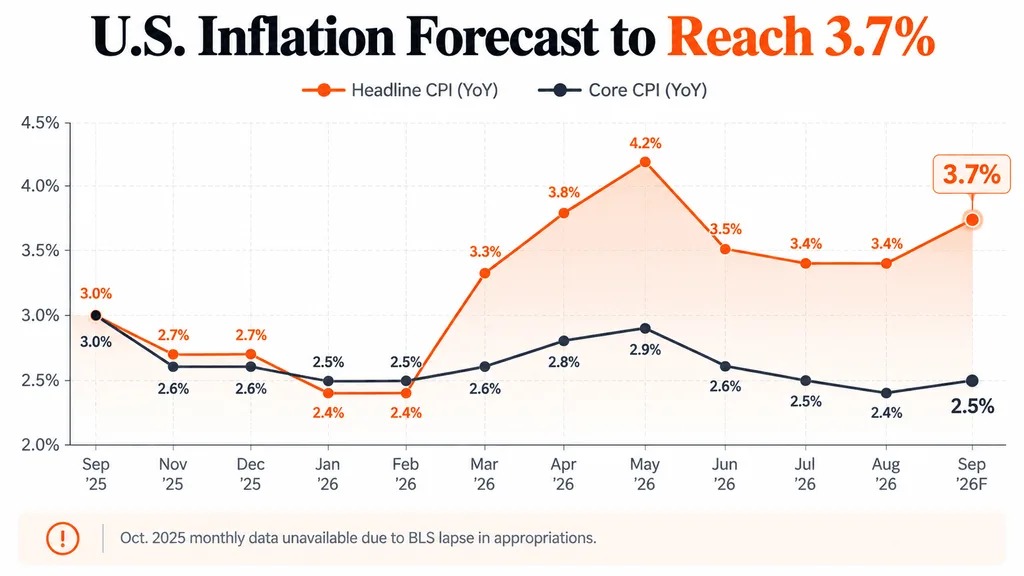
Economists expect that overall consumer prices will rise from the year-on-year increase of 3.4% in August, mainly due to higher energy costs. Core inflation, excluding food and energy, is expected to be 2.5%, which highlights the widening gap between price pressures driven by oil prices and potential inflation.
The Consumer Price Index ( CPI ) report will be released on Wednesday, October 14th, with only two weeks left before Federal Reserve officials decide whether to keep interest rates unchanged or to tighten monetary policy again.
After the rise in oil prices, the US CPI may rise to 3.7%
As conflicts in the Middle East disrupt global fuel supplies, energy has become a major source of rising inflationary pressures. The price of Brent crude oil has remained above $100 per barrel, increasing costs for transportation, manufacturing, and households.
The August inflation report already showed this impact, with gasoline prices rising by 3.9% that month. Overall, CPI rose by 0.4% on a month-on-month basis, while annual core inflation fell to 2.4%.
If the reading in September reaches 3.7%, it will mean that overall consumer prices will rise again at an accelerated pace, complicating the Federal Reserve's efforts to control inflation.
However, an expected core inflation rate of 2.5% indicates that broader price pressures may still be significantly lower than energy-driven inflation.
After the interest rate hike in September, the Federal Reserve faces a decision on October 28th.
The Federal Reserve raised its benchmark interest rate by 25 basis points in September, bringing the target range to 3.75% to 4.00%. Minutes of the meeting released on October 7th showed that policymakers are still concerned about persistent inflation, but are reluctant to commit to multiple consecutive interest rate hikes.
The market currently expects that the Federal Reserve will keep interest rates unchanged in October, although there is still a possibility of another rate hike later this year.
The difference between CPI and PCE is also important. CPI provides earlier signals of inflation, whereas the Federal Reserve's official inflation target of 2% is based on the Personal Consumption Expenditures Price Index ( PCE ).
However, the CPI report, which is stronger than expected, may still change the market's expectations for future interest rates.
What does 3.7% inflation mean for the stock market?
Before the release of this inflation report, Wall Street was facing U.S. Treasury yields that were near their highest levels in decades. The benchmark 10-year U.S. Treasury yield recently rose to around 5.36%, putting additional pressure on technology stock valuations and borrowing costs.
The recent selling of U.S. Treasuries indicates how quickly concerns about inflation can spread to the stock market and other financial markets.
Higher-than-expected inflation could push bond yields higher again, while more modest readings might reduce the market's expectations for further policy tightening.
Maya Bennett
Maya Bennett is a financial journalist with experience covering cryptocurrencies, stocks, and broader market trends. Her reporting focuses on Bitcoin, major digital assets, the stock market, monetary policy, and economic developments that influence investor sentiment. She is adept at transforming rapidly changing market news into clear and concise reports.