Bitcoin, Ethereum, and Solana ETF all turned negative in October
Decrypt
1h ago
Ai Focus
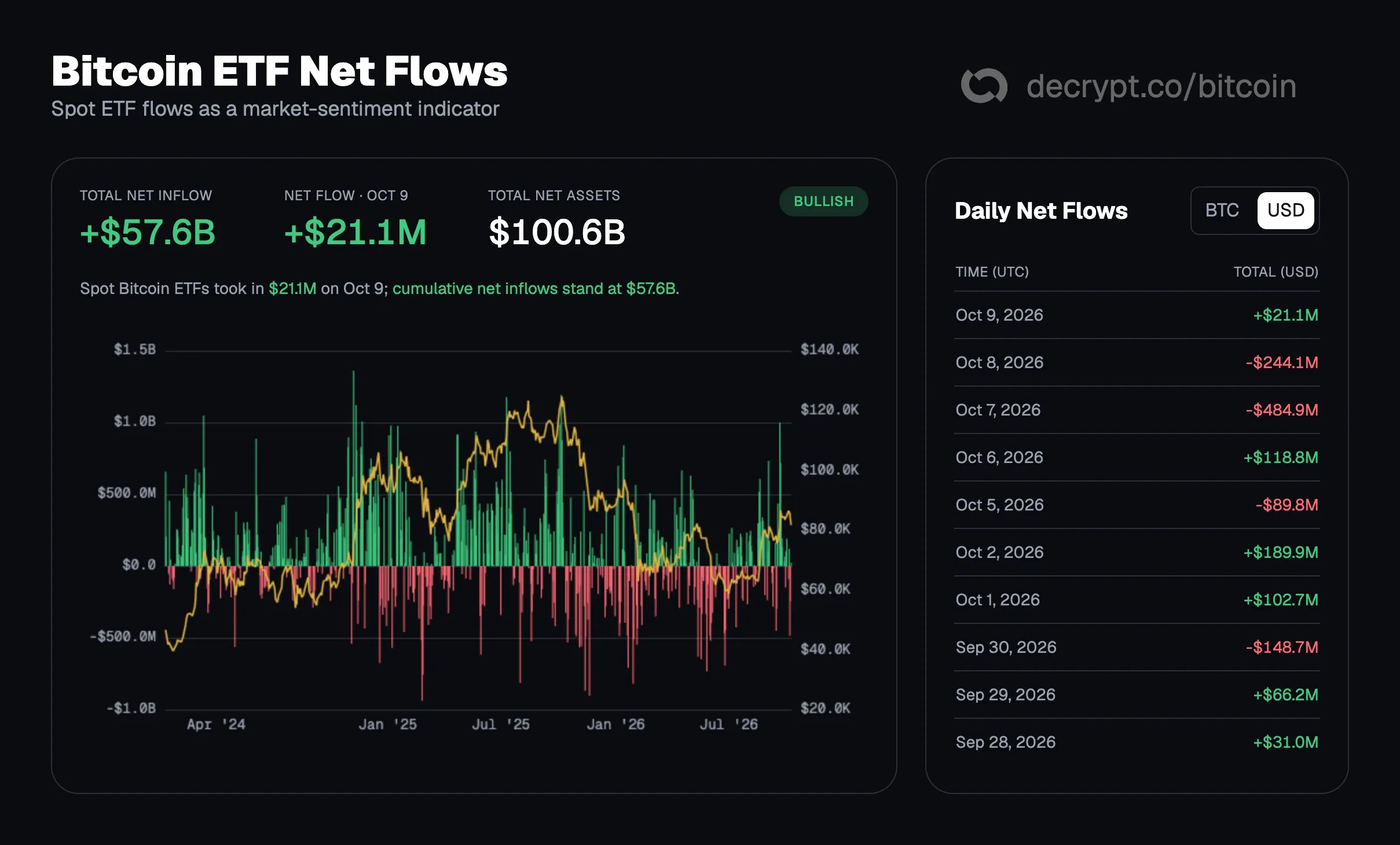
According to the tracking data from ETF of Decrypt, US spot Bitcoin ETF recorded $21.1 million in inflows on Friday, but still had a net outflow of $386.3 million over the first seven trading days of October; Ethereum ETF experienced a net outflow for nine consecutive trading days, with a total outflow of $635 million in October; Solana ETF also turned to net outflow in October, with a cumulative loss of $24.8 million.
Helpful
No.Help

In short

  • US spot Bitcoin ETF saw a net outflow of $386.3 million in October, due to a single-day outflow of $484.9 million on Wednesday, which was the worst performance since June, although there was an inflow of $21.1 million on Friday.
  • The outflow trend of Ethereum ETF continued for nine consecutive trading days, with a total outflow of $635 million in October, and the entire consecutive outflow period approached $700 million.
  • In October, it also remained in the negative range. After five consecutive trading days of outflows, the cumulative loss amounted to 24.8 million US dollars.

The claim of “Uptober” has not been fulfilled in the case of encryption ETF.

According to the tracking data from ETF of Decrypt, US spot Bitcoin ETF recorded an inflow of 21.1 million US dollars on Friday. This represents a mild rebound following outflows of 484.9 million US dollars on Wednesday and 244.1 million US dollars on Thursday. Nevertheless, these funds still experienced a net outflow of 386.3 million US dollars over the first seven trading days of October.

Bitcoin and other crypto assets ETF allow investors to gain exposure to digital currencies without using crypto exchanges or wallets. These funds track the prices of the underlying assets and are traded in brokerage applications just like stocks. Since their introduction, such products have been very successful, and the inflow and outflow of fund capital have become reliable indicators of current market sentiment.
A strong start to this month was recorded, with a total inflow of $292.6 million on October 1st and 2nd. However, the inflow of $118.8 million on October 6th was not enough to offset the subsequent selling pressure, and Wednesday's outflow marked the worst day for these funds since June.

This represents a sharp reversal from September. In mid-September, a vote on a motion to terminate the debate regarding Clarity Act in the Senate failed, leading to a large-scale outflow of funds; subsequently, Bitcoin ETF recorded inflows for nine consecutive trading days, amounting to approximately $3 billion. This round of inflows has pushed the capital flow for 2026 back into a positive range so far.
Ethereum’s performance under ETF is even worse. On Friday, these funds saw a net outflow of 56.1 million US dollars, extending the consecutive days of outflows to nine trading days.

As of now, they have seen outflows of $635 million in October, with the total continuous outflow period approaching $700 million. The largest single-day outflow occurred on October 6th, amounting to $201.9 million. Since its launch, the cumulative net inflow has been $13.2 billion, and the total net assets are $14.5 billion.

Solana ETF also experienced net outflows in October, although on a much smaller scale. On Friday, these funds saw outflows of $3.8 million, marking the fifth consecutive trading day of outflows, which brought the cumulative net outflow for October to $24.8 million. The only inflow of the month occurred on October 2nd, amounting to $1.3 million. Since its launch, the cumulative net inflow has amounted to $137.9 million.

According to the tracking data of Decrypt, since the launch of Bitcoin ETF, the cumulative net inflow has totaled 57.6 billion US dollars, and the total net assets held by the fund are 100.6 billion US dollars.

Tip
$0
Like
0
Save
0
Views 29
CoinMeta reminds readers to view blockchain rationally, stay aware of risks, and beware of virtual token issuance and speculation. All content on this site represents market information or related viewpoints only and does not constitute any form of investment advice. If you find sensitive content, please click“Report”,and we will handle it promptly。
Submit
Comment 0
Hot
Latest
No comments yet. Be the first!
Related
AI Why Can a Company Sign a Trillion-Dollar Contract Without Having to Pay the Full Amount in Advance?
OpenAI and Anthropic are signing artificial intelligence infrastructure agreements worth tens of billions of dollars, but there is no need to pay the full amount in one lump sum when the contracts are announced. The article explains that such long-term cloud computing contracts typically spread out expenses, capacity reservations, and payment obligations over multiple years. The real risk lies in whether the future AI revenue will be able to cover these commitments.
Coinpaper
·2026-10-12 02:01:55
10
U.S. inflation expected to rise to 3.7% on the eve of the Federal Reserve's decision on October 28
Economists expect that the U.S. CPI in September will rise to 3.7% year-on-year, with core inflation expected to be at 2.5%. Rising energy prices are seen as the main driving factor, and these data will provide an important reference for the Federal Reserve's interest rate decision on October 28th.
Coinpaper
·2026-10-12 02:01:54
10
Revolut CEO Aims at American Tech Giants, Plans to Develop AI Based on 40 Million Transactions per Day
Revolut CEO Nik Storonsky stated that the company is utilizing daily transaction data of 30 to 40 million records to develop its own AI model, with the aim of building a global technology enterprise that can compete on par with large American tech companies. He also mentioned that if the company goes public in the future, Revolut would prefer to list its shares mainly in the United States; however, the company indicated that IPO might not happen until after 2028 at the earliest.
Coinpaper
·2026-10-12 02:01:52
13
What happens when Bitcoin mining becomes unprofitable?
Bitcoin mining requires a large amount of computing power and electricity. However, when the production cost exceeds the miners' income, some operators will shut down their machines, sell their bitcoins or equipment, and companies with weaker finances may even go bankrupt. Bitcoin's built-in difficulty adjustment mechanism helps the remaining miners increase their chances of profitability after some miners withdraw.
Coinpaper
·2026-10-12 01:01:41
20
Bitcoin life insurance company Meanwhile supported by Sam奥特曼 secures additional funding
Bitcoin-only life insurance company Meanwhile announces $37.5 million in new funding from existing investors. The company stated that, amid broader macroeconomic instability, there has been an increase in international demand for its Bitcoin life insurance policies, particularly from Asia, Europe, and the Middle East.
Cointelegraph
·2026-10-12 00:50:22
20
View More