Xiaomi Pegasus OS Beta Recruitment closes on October 14; official version will be rolled out in batches starting from October 15
The Block
1h ago
Ai Focus
Xiaomi Pegasus OS 4 Beta version will end its beta recruitment at 12:00 noon on October 14th. The official version will be rolled out in batches starting from October 15th, with the first batch covering models such as the Xiaomi 17 series and the REDMI K100 Pro series.
Helpful
No.Help

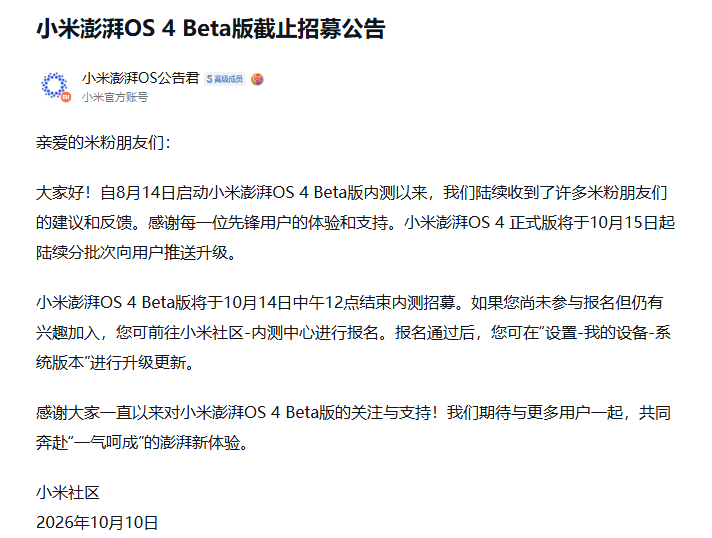
News from the IT Home on October 10th: Xiaomi Paddle announced today that the recruitment period for the internal testing of version Beta of Xiaomi Paddle has come to an end, and also confirmed the schedule for the release of the official version OS.

On August 14th of this year, the Xiaomi Pegasus OS 4 Beta version launched its internal testing phase. According to the announcement, the official version of Xiaomi Pegasus OS 4 will be rolled out to users in batches starting from October 15th. The first batch will cover models such as the Xiaomi 17 series and the REDMI K100 Pro series, with subsequent expansions to more existing models to follow.

Xiaomi Pegasus OS 4 Beta version will end its beta test recruitment at 12:00 noon on October 14th. Users who have not yet registered but are still interested in experiencing it can go to the Xiaomi Community - Beta Test Center to complete the registration. After successful registration, they can upgrade and update their device by going to "Settings - My Devices - System Version".
Xiaomi Pegasus OS 4 is Xiaomi's new generation operating system, which has achieved a comprehensive upgrade in AI capabilities, cross-device collaboration, and overall smoothness. It integrates Super Xiaoai 2.0 and self-developed MiMo large models, bringing new features such as Expert Mode and Inspiration Ball interaction. At the same time, it optimizes the overall smoothness of the system. Officials claim that it will provide users with a "seamless" new Pegasus experience.

Tip
$0
Like
0
Save
0
Views 31
CoinMeta reminds readers to view blockchain rationally, stay aware of risks, and beware of virtual token issuance and speculation. All content on this site represents market information or related viewpoints only and does not constitute any form of investment advice. If you find sensitive content, please click“Report”,and we will handle it promptly。
Submit
Comment 0
Hot
Latest
No comments yet. Be the first!
Related
Robinhood Chain Transaction Slows Down: Fees Spread to Trading Volume, with the Number of Transactions Dropping by Over 40%
Since mid-September, the average daily trading volume of Robinhood Chain has dropped from 10.8 million to 6.2 million transactions. Robinhood is still processing some token exchanges and paying network fees for users through its wallet. While the spot trading volume, active addresses, and network fees have declined, deposits remain above $1 billion, and the trading volume of perpetual contracts has increased.
CoinDesk
·2026-10-10 12:47:09
1
Ethereum Discusses "Transaction Assertions": Signature is Correct, So Why Could the Result Still Be Wrong?
When the wallet pops up a signing window, users usually confirm what action they want to perform, but it is difficult to guarantee what the final result of the transaction will be. A research article by the Ethereum Foundation on October 5th referred to this discrepancy as the uncertainty of transaction outcomes and discussed a native transaction assertion: after the transaction is executed and the state is truly established, the results are checked by the read-only rules on the blockchain; if the result violates pre-set constraints, the transaction is rolled back. This solution is still in the design and discussion phase. EIP-7906 is just one of the possible approaches, and it has not been determined whether it will be implemented in the upgrade, let alone considered a new security feature already available on the main Ethereum network.
币界网
·2026-10-10 12:37:43
11
Solana Launches DvP Open-source Settlement Program: JPMorgan Chase Has Given Its Opinions, But That Does Not Mean Banks Have Already Launched It
The easiest story to tell about tokenized assets is that “transfers are very fast,” but the most difficult part is whether securities and funds can be delivered simultaneously in the same transaction. On October 6th, the Solana Foundation announced Solana DvP, an open-source custody program and interface for financial institutions, aiming to make the delivery of securities and funds into a reusable on-chain standard. The logic behind DvP is simple: funds are credited immediately when assets are handed over; otherwise, neither party's transaction is completed, avoiding the risk of one party having paid while the other has not yet delivered the securities. Its goal is not to have all securities markets migrate to Solana immediately, but rather to reduce the workload for institutions to rewrite custom contracts and coordinate delivery processes for each individual project.
币界网
·2026-10-10 12:37:41
13
Canada lost 68,000 jobs in September: Unemployment rate rises to 6.5%, but we can't just look at one number
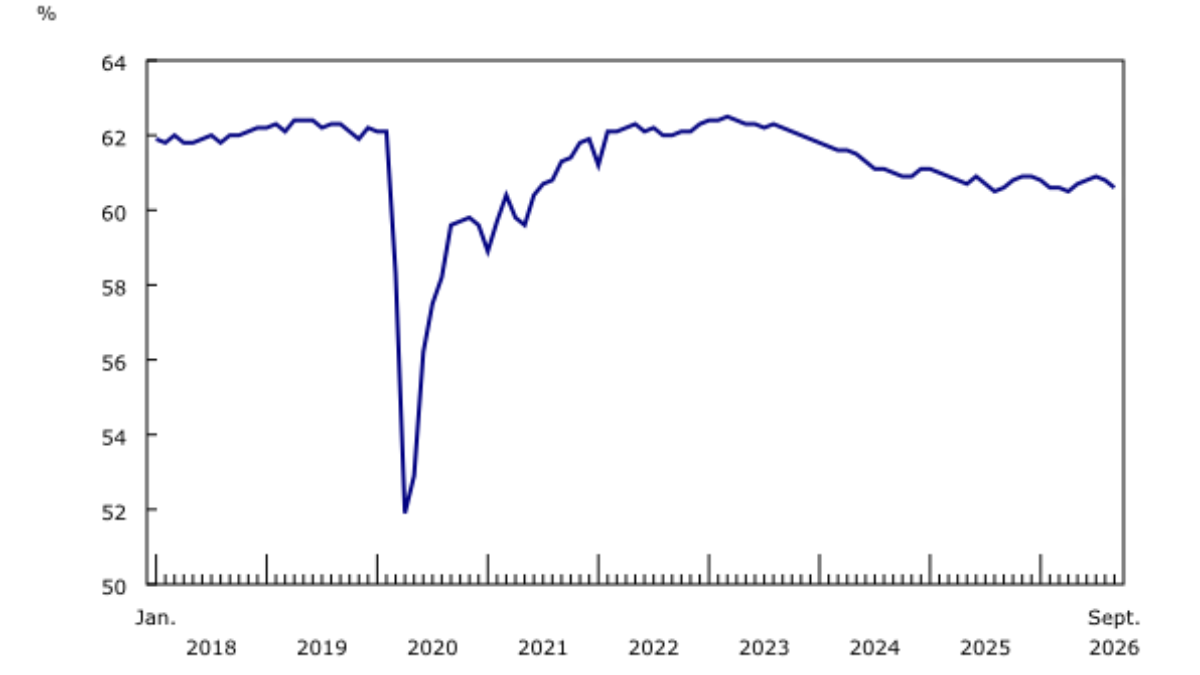
The Canadian Statistics Agency released its September labour force survey on October 9th, presenting a less-than-encouraging set of figures to the market: the number of employed persons decreased by 68,000 compared to the previous month, representing a month-on-month decline of 0.3%; the employment rate fell to 60.6%, while the unemployment rate rose by 0.1 percentage points to 6.5%. This is the second consecutive month of declining employment, following a decrease of 42,000 in August. If one looks solely at the unemployment rate, the change may seem modest; however, when considering job vacancies and labour participation rates, the cooling of the labour market is more evident. Macroeconomic analysis cannot simply pick one of these three indicators as the most favorable.
币百科
·2026-10-10 12:37:36
10
Asana Reduces browser proxy costs by 76 times; what really makes a difference is changing the history records less frequently
Every step a browser proxy takes may result in the re-sending of page text, screenshots, tool definitions, and previous operations to the model. Intuitively, one might think that saving money would mean switching to a cheaper model or deleting old screenshots as soon as possible. However, the cases published on October 8th and 9th by Asana and OpenAI demonstrate that this intuition is not always correct. After the team under Asana, namely StackAI, made changes to the way proxy history was cached, the rhythm of screenshot cropping, and the context budget, the optimized GPT-6.1 Sol process had an average cost of about $0.47 per model run and took approximately 4 minutes; this is compared to the production configuration that previously used another model at the same price range.
CoinMeta
·2026-10-10 12:37:34
9
View More