

The listing plans of Australian data center company Firmus Grid have suddenly faced a cooling in demand, sounding the alarm for the booming AI infrastructure financing market.
On October 8th, according to Bloomberg, Firmus failed to secure sufficient subscriptions at the target price of 11 Australian dollars per share. Just a few days prior, the company had indicated that interest in subscriptions far exceeded the issuance volume, with its valuation once reaching as high as $30 billion. This sharp turnaround highlights that investors have begun to re-evaluate the high valuations and capital-intensive models of AI infrastructure companies.
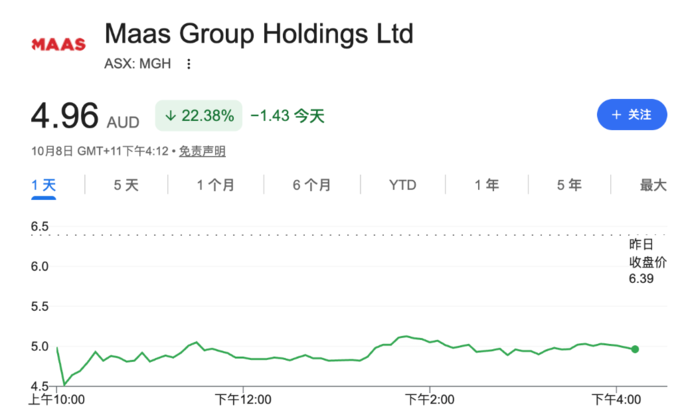
Firmus Stock price volatility also quickly affected related parties. Maas Group, which holds shares in Firmus, saw a sharp 30% drop during trading in Sydney on Thursday, setting a record for the largest single-day decline, and ultimately closed down 22%. Maas Group admitted that there are currently "a large number of speculations and comments regarding whether IPO can move forward."
The company originally planned to raise approximately $5.5 billion through IPO and list with a valuation of nearly $30 billion, but the final pricing and transaction structure were not announced for a long time after the subscription book was closed. Market participants expect that the issue price may be forced to be lowered, and there is even a possibility that the transaction could be postponed.
Valuation soars far beyond business expansion, investors begin to question growth potential
The core issue faced by Firmus is that the rate of valuation increase far exceeds the pace of business expansion.
It is reported that at the end of August, when the company completed its first round of financing, its valuation was approximately $10.5 billion, with investors including Jane Street and Blackstone. Just two months later, IPO's target valuation has approached $30 billion.
However, the actual operational scale of Firmus is still limited at present. The company's revenue for the fiscal year 2026 was only 51 million US dollars, and it currently operates two data centers with a built capacity of 46 megawatts; although the planned data center capacity reaches 912 megawatts, most of these projects are still yet to be constructed.
Firmus plans to use funds from IPO to expand its AI data centers in Asia, with customers including Meta and OpenAI. The hardware is provided by shareholder NVIDIA. This means that the company's current valuation relies heavily on the success of future projects and ongoing financing.
It is reported that investors are mainly concerned about the company's lack of large-scale operational experience, an overly high valuation, and the potential selling pressure that may arise from approximately 58% of the shares being freely tradable after listing. In addition, the regulatory and financing environment in the data center industry is also tightening.
Institutional investors: The story behind AI holds water, but this price is unacceptable.
Institutional investors have begun to express their doubts about valuations quite clearly.
A large Australian pension fund, UniSuper, has decided not to participate in this IPO. Its chief investment officer, John Pearce, stated that although there "is indeed an intriguing story" behind it, the "valuation is not particularly appealing." He believes that for the company to justify such a valuation, too many conditions need to be met simultaneously, and that expansion will still rely on continued debt and equity financing.
Co-founder Jun Bei Liu stated that this time, IPO is facing "doubts from a large number of investors," with the core issue being that Firmus "has not yet built a large number of data centers." Rayliant Global Advisors, the head of investment portfolio management, Phil Wool, said that Firmus was originally expected to become one of the largest IPO in Australia, and this setback thus constitutes a "historic failure."
AI The financing boom is starting to face higher barriers
The predicament of Firmus is not an isolated case. Bloomberg previously reported that when the data center company Accelevation Holdings went public in the United States last month, its pricing was lower than the range suggested earlier, indicating that investors' valuation expectations for AI's infrastructure assets are on the rise.
At the same time, some of the hot transactions in the AI industry chain have also begun to cool down. The South Korean Composite Stock Price Index has fallen by 27% since its peak in June, and the storage chip market, which was previously led by Samsung Electronics and SK Hynix, is clearly under pressure.
The warnings about valuation bubbles are also intensifying. This week, it was stated that AI is a “classic bubble,” with massive debt financing and high interest rates increasing the risk of a bubble burst. The “great bearish” Michael Burry compares the current stock market environment to that of 2000 and 2008.
The bigger question is, how much future revenue does the AI industry need to have in order to justify the current investments? Bain estimates that by 2031, the AI industry will need to achieve annual revenues of $6 trillion in order to justify the capital invested in data center construction at present.
At the same time, some AI cloud computing companies are turning to high-cost debt financing. While serving as the co-lead underwriter for Firmus IPO, JPMorgan Chase is also promoting a $5 billion leveraged loan with an interest rate of about 11% for Volta Infrastructure Holdings for its Norwegian data center project.
Capital requirements remain substantial, yet the risks associated with IPO are on the rise.
The capital requirements for infrastructure, denoted by AI, have not disappeared despite the downturn in IPO.
KKR It is estimated that completing the construction of global AI infrastructure may require approximately 8 trillion US dollars; Anthropic It is reported that large-scale IPO could begin as early as next month. However, the attitude of the capital market is changing: investors no longer grant high valuations based solely on AI growth stories, but are beginning to require companies to prove that their revenue growth, project implementation, and financing capabilities match the capital invested.
Wool warns that as the popularity of the AI topic peaks, investors are beginning to recalculate how much future growth is required for the large-scale financings of the past few years to be financially viable. "This will not be the last disappointing AI related IPO."
Firmus was founded in 2019 by Oliver Curtis, Tim Rosenfield, and Jonathan Levee. It initially started its business with Bitcoin mining machines. For this issuance, the co-lead underwriters of IPO include JPMorgan Chase, Bank of America, Morgan Stanley, and Morgans Financial.