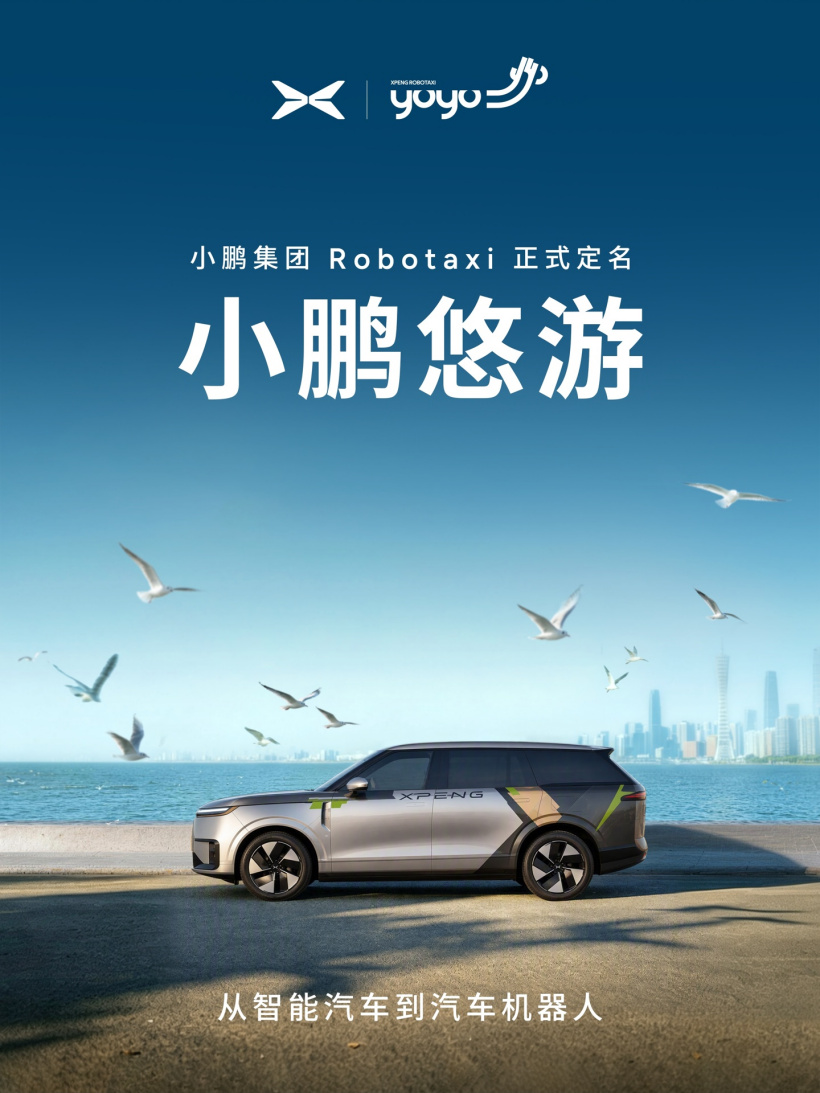
News from the IT Home on October 8th: This morning (the 8th), Xpeng Motors' official Weibo account announced that Xpeng Group's Robotaxi has been officially named "Xpeng Youyou XPENG YOYO".
According to the introduction, the Chinese name “Xiaopeng Youyou” represents a travel experience of “being at ease in one’s heart and roaming freely on the journey”; the English name “XPENG YOYO” is described as being “easily readable throughout the world”, marking its first step towards the international market.
The "Xpeng YOYO Autonomous Driving" mini-program has also been launched, with user beta test spots becoming available gradually. It is reported that users can remotely adjust the temperature and fragrance inside the car, as well as pre-select music styles through the mini-program in advance.
In January this year, Xpeng Group obtained permission for road testing of intelligent connected vehicles in Guangzhou, officially entering the stage of regular public road testing. In March, Xpeng Group established a dedicated business department to coordinate all aspects of product definition, research and development, testing, and operations, accelerating the process of commercial implementation.
As previously reported by IT, in May of this year, Xpeng's first mass-produced Robotaxi vehicle rolled off the production line. In July, Xpeng Motors began internal testing, with He Xiaopeng becoming the first user of this model.
In August this year, He Xiaopeng, the chairman of Xpeng Motors and CEO, revealed that the pre-installed mass-produced Robotaxi equipped with the second-generation VLA has completed over 2,000 internal testing orders in Guangzhou, and has run through the entire process of manned demonstration operations. The company has completed the development of the platform for cloud management, with the goal of achieving passenger transportation operations without safety officers next year.
According to He Xiaopeng's estimates, the Robotaxi business in Guangzhou could achieve break-even for each vehicle as early as the second half of 2027. The main factor determining break-even is not the total scale of the fleet, but whether a high enough vehicle density can be achieved within a specific operational area. In smaller cities with fewer inhabitants, several hundred Robotaxi vehicles are expected to be sufficient to cross the break-even threshold.
Xiaopeng plans to launch a new model next year that is more suitable for the business of Robotaxi, and gradually expand its services to overseas markets.