

Just how clean is the air in an office? This is precisely the question that Tanvi Thombre and Lakshya Saraf began to study when they were engineering students in a university maker space.
Thombre stated via email that during their use of the space, they were 'exposed to toxic fumes generated by laser cutters, 3D printers, and soldering irons without their knowledge', but it was not until her best friend fainted and was taken to the hospital that they realized this.
Thereafter, Thombre said, "We began to study indoor air pollution and realized that it is a invisible but dangerous health risk—especially in schools, offices, hotels, beauty salons, and any commercial buildings where windows cannot be opened due to air conditioning."
Even though the buildings are equipped with air purifiers, these problems still exist, and that's exactly the case with their maker spaces. Saraf states that the issue is that while purifiers are good at removing particles such as dust and pollen, they are less effective at eliminating toxic gases like carbon dioxide, formaldehyde, and benzene. Many of these gases are classified as volatile organic compounds, abbreviated as VOCs, which are chemicals that easily evaporate into the air.
Thombre says that VOCs is related to chronic diseases and "sick building syndrome." Sick building syndrome refers to health issues and discomfort that people experience after staying in a building for an extended period, without any clear cause or identified disease being found. She also cited research from Harvard University, which states that improving indoor air quality can enhance cognitive function and productivity.
This is also the reason why this duo founded Greenairy. The company targets toxic gases in workplaces and will participate in this year's TechCrunch Disrupt as part of Startup Battlefield 200.
The core method of Greenairy is to create a plant tower, which claims to be able to absorb air, decompose toxic gases, and then release purified air. Saraf says: "Plants in potted gardens purify the air very slowly. But when we change the conditions around the plants, their speed of purifying air is much faster than these traditional methods, and the effect is also better."
Saraf also indicates that although some air purifier filters can remove a "narrow range of VOCs", these filters need to be replaced frequently to maintain their effectiveness. In contrast, plants are a "natural solution that do not produce harmful by-products and do not require filter replacement."
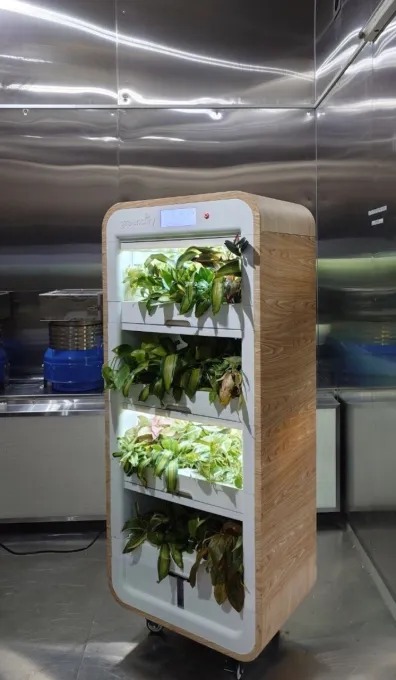
Greenairy has already conducted short-term pilots in locations around Singapore. Saraf stated that in tests using air monitoring equipment certified through RESET, they compared three offices: one equipped with a Greenairy plant tower, another with a medical-grade ionizer – a device that uses electricity to make dust and other particles aggregate and settle from the air – and a third office that used a HEPA air purifier designed to capture extremely fine particles.
"Our tower has the lowest level at VOC, and it also removes VOC the fastest," she said, "The office staff also really enjoy the natural 'fresh' scent and atmosphere that this tower brings."
Thombre added that they saw 'immediate' improvements during normal working hours, with both the average daily VOC and peak levels decreasing by 50%. She stated that as 'the plants and microorganisms mature, and gas accumulation is prevented', the results will further improve.
Greenairy also indicates that the results have been verified by the German testing and certification institution TÜ V S ÜD, and will be announced shortly thereafter. (In the meantime, the results can be provided upon request.) This is in line with the founders' plan to start mass production after the results are certified.
Currently, the two founders of this startup are located on opposite sides of the globe: Saraf is in Berkeley, California, while Thombre is in Singapore. Saraf says that this arrangement "is working well at this stage," allowing one founder to focus on testing in Singapore, while the other can raise funds in the Bay Area.
"If everything goes according to plan, by the first half of 2027, both of us will be in Singapore," she added, "by then we expect to launch the first batch of mass-produced towers and install them for our first customers in Singapore."
Welcome next week to San Francisco to learn more about this company and dozens of other teams that will present to venture capitalists on Disrupt.