RoboParty releases high-performance full-stack open-source humanoid robot RP1 at IROS
PR Newswire
1h ago
Ai Focus
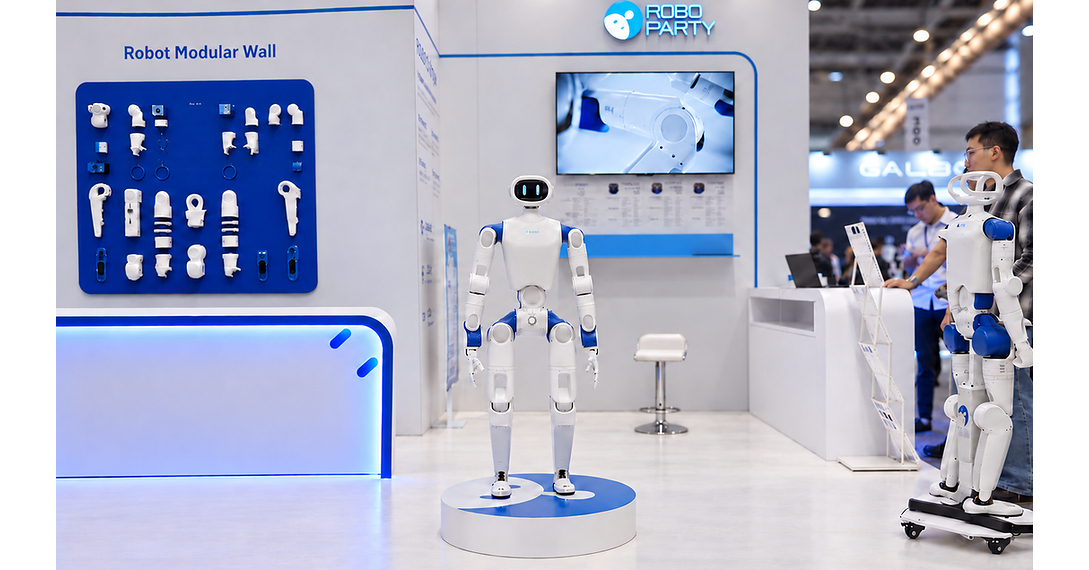
RoboParty publicly released RP1 (ROBOTO 01) on IROS 2026, calling it the world's first high-performance full-stack open-source bipedal humanoid robot. The company stated that RP1 is based on their open-source project RPO, and will gradually make available motion control, simulation environment, SDK, training tools, and the foundation for PartyOS development.
Helpful
No.Help

Pittsburgh, October 3, 2026 / PRNewswire / -- RoboParty was publicly released on IROS on September 28, 2026, marking the global debut of this robot. RP1 is built upon the foundation of RPO ( ROBOTO ORIGIN ). RPO is a fully open-source humanoid robot project launched by RoboParty in January 2026, with over 2,500 stars (likes). RoboParty positions RP1 as the world's first high-performance, full-stack open-source bipedal humanoid robot, aimed at researchers, educators, robot developers, and AI teams.

At the company's IROS booth, an interactive demonstration named “Kick Me” allowed visitors to directly push and kick the robot. RP1 quickly adjusted its posture and regained balance under these external disturbances, which was used to test its dynamic stability, physical performance, and system-level robustness. The aforementioned capabilities are supported by PartyOS. PartyOS is an open research and development foundation developed by RoboParty for humanoid robots, integrating UFO – a training framework that discovers humanoid motion skills through unsupervised reinforcement learning, covering skill switching, disturbance recovery, and fall recovery, without the need to rely on predefined action trajectories.

RoboParty is integrating the robot body, actuator modules, underlying control systems, and the AI algorithm into a single system for continuous joint verification. The peak joint torque of RP1 can reach up to 160 N•m, and it utilizes the company's self-developed Romomo actuator modules along with a real-time motion control system.

RoboParty indicates that "full-stack open-source" is not just about making mechanical files available. The company plans to gradually make its motion control systems, simulation environments, SDK, training tools, and the PartyOS development foundation available as well, allowing developers to be involved from hardware and low-level control all the way to model training and deployment.

RoboParty founder Huang Yi stated: "Humanoid robots should not be closed systems, accessible only to a few teams while others can only watch from the sidelines. We hope that RP1 will become an open platform where developers can access, modify, train, and continuously improve them."

RP1 is built upon the verified open-source robot ontology and workflow of RPO, the Romomo executor modules, as well as the agile RP Hand. PartyOS continues to evolve in areas such as bipedal walking, perceptual interaction, full-body manipulation, and autonomous intelligent humanoid robots.

Core team members have studied at prestigious institutions such as Tsinghua University's Yao Class, Peking University's Zhi Class, Harbin Institute of Technology, Stanford University, Carnegie Mellon University, and Zhejiang University. RoboParty stated that the company has established a global community of over 5,000 developers and will announce more details of its open-source roadmap in October 2026. By then, additional software and hardware will be released, and mass production plans will be advanced later in the fourth quarter of this year.

Media contact: [ email protected ]

GitHub : https :// github.com / Roboparty /roboto_origin

Website: https :// roboparty.com /

Tip
$0
Like
0
Save
0
Views 19
CoinMeta reminds readers to view blockchain rationally, stay aware of risks, and beware of virtual token issuance and speculation. All content on this site represents market information or related viewpoints only and does not constitute any form of investment advice. If you find sensitive content, please click“Report”,and we will handle it promptly。
Submit
Comment 0
Hot
Latest
No comments yet. Be the first!
Related
Trump claims that if Republicans control Congress after the midterms, adults from both parties could receive $5,000
Trump once again promised that if the Republicans win both chambers of Congress in November, he will distribute a $5,000 "Trump dividend" to every adult American citizen. The White House previously described this plan as a cash distribution linked to the performance of the U.S. economy, but the source of funding has yet to be resolved; based on an estimated 240 million adult citizens, the total cost would be about $1.2 trillion.
Coinpaper
·2026-10-04 01:22:44
11
Why is NASDAQ still rising while the U.S. stock market is generally declining?
A review of September on NASDAQ shows that despite the weakness in most sectors of the U.S. stock market, the NASDAQ 100 index still rose by 3.3% in September. The strong performance of large technology stocks and communication service stocks, especially the leading companies related to AI, offset the weakness in the broader market; at the same time, the yield on 10-year U.S. Treasury bonds soared to 5.29%, putting greater pressure on smaller stocks that rely more on external financing.
Coinpaper
·2026-10-04 01:22:41
12
OpenAI has banned PewDiePie twice; they are actively developing a censorship-free AI Ajax that can run on personal computers.
PewDiePie stated in a new video that OpenAI banned his account twice during the period when he was building Ajax. Ajax is a small AI model designed to run on local computers, based on Alibaba's Qwen 3.5. PewDiePie claimed that he used GPT-5.6 and Sol to generate training data, and with the help of open-source tool Heretic, he removed the model's ability to refuse responses.
Decrypt
·2026-10-04 01:12:11
11
OpenAI Security Employee Resigns, Claiming the Company's "Culture Has Failed"
David Robinson published an article in The Atlantic Monthly stating that he was responsible for writing the security reports accompanying the major product releases of OpenAI. He has now resigned because he believes that the company's "culture has failed." A spokesperson for OpenAI stated that the company is continuously improving its security measures.
TechCrunch
·2026-10-04 00:41:38
14
Polygon claims that 55% of its historical stablecoin trading volume was completed in the past 21 months
Polygon indicates that since January 2025, $1.67 trillion has been circulating on the blockchain, accounting for approximately 55% of its historical stablecoin transaction volume. The network processed $933 billion in 2025, $276 billion in 2024, and another $741 billion since 2026 to date. Polygon states that the increasing use by payment companies, along with upgrades to network capacity, are driving its transformation towards a stablecoin payment infrastructure.
Coinpaper
·2026-10-04 00:22:26
17
View More