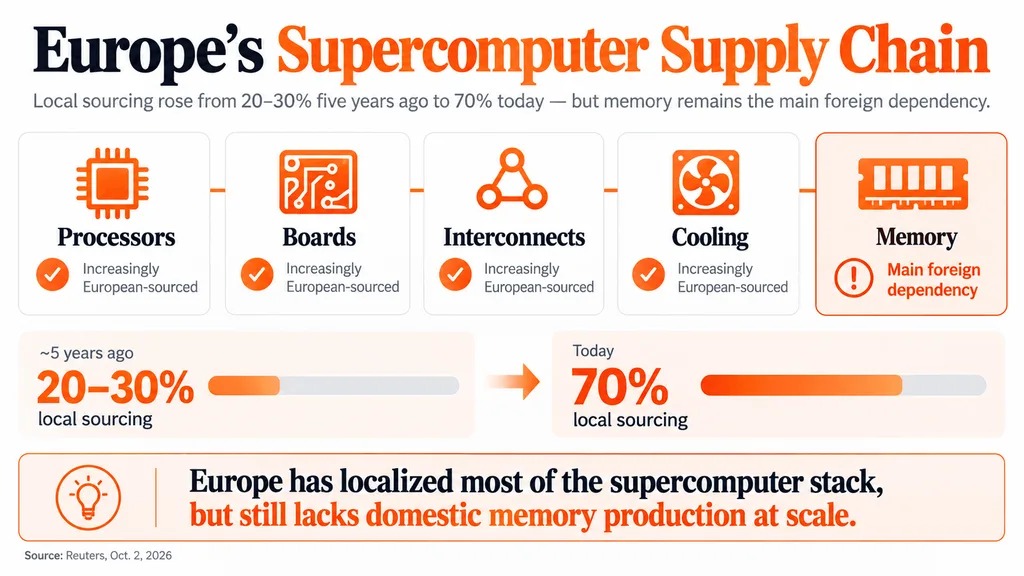
Europe has achieved 70% localization of supercomputing components, but still cannot manufacture its own memory
Coinpaper
1h ago
Ai Focus
The CEO of French supercomputer manufacturer Bull, Emmanuel Le Roux, stated that approximately 70% of the components used in the company's systems can now be sourced from Europe, up from 20% to 30% five years ago. However, memory remains a major exception; Europe lacks large-scale suppliers that can compete with Samsung, SK Hynix, and Micron. As a result, a key component in AI's computing stack still relies on overseas production.
Helpful
No.Help

The CEO of French supercomputer manufacturer Bull, Emmanuel Le Roux, stated that approximately 70% of the components used in the company's systems are now sourced from Europe, compared to only 20% to 30% five years ago. Currently, circuit boards, interconnection devices, cooling equipment, and an increasing number of processors can all be purchased directly within Europe.

But memory remains a major exception.

Currently, there is no large-scale supplier in Europe that can compete with Samsung, SK Hynix, or Micron. This means that a key component of the AI computing stack still relies on overseas production.

Most of Europe's supply chains have been re-established.

This transformation comes at a time when Europe is pushing to build more autonomous and controllable computing infrastructure.

The Bull currently held by the French government has recently increased the monthly production capacity of its Angers factory from 6 racks to 12 racks, and is expected to raise it to 24 racks by 2027. The company has built Europe's first exascale supercomputer, JUPITER, and the EU plans to invest about 7 billion euros by 2027 to enhance local AI computing power.
The processor's dependence on overseas suppliers is also declining. European developers are beginning to produce their own chips, thereby addressing another long-standing weakness in the region's computing stack.

However, the importance of the processor itself may have been overestimated. Le Roux indicates that processors account for about 10% to 20% of the value of a supercomputer, while memory has become one of the biggest cost pressures in the industry.

Memory is becoming a bottleneck for AI.

The reason this is important is that modern AI systems require an increasingly large amount of DRAM and high-bandwidth memory.

The continuously rising cost of memory has driven up the prices of some NVIDIA servers by more than 15%. Nowadays, the broader AI infrastructure construction relies not only on GPU, but also on memory, networking, cooling, and power supply.

As the expenditure associated with AI accelerates, the importance of this shortcoming may further increase. Global construction already requires trillions of dollars in AI financing, and a shortage of any single component could drive up the cost of the entire system.

Ethan Mercer

Ethan Mercer is a financial journalist who covers cryptocurrency, stocks, and the global economy. He studied economics and finance before turning to market reporting, with a particular focus on Bitcoin, stocks, monetary policy, and investor sentiment. His reporting focuses on explaining daily market fluctuations and the broader trends behind them.

Tip
$0
Like
0
Save
0
Views 22
CoinMeta reminds readers to view blockchain rationally, stay aware of risks, and beware of virtual token issuance and speculation. All content on this site represents market information or related viewpoints only and does not constitute any form of investment advice. If you find sensitive content, please click“Report”,and we will handle it promptly。
Submit
Comment 0
Hot
Latest
No comments yet. Be the first!
Related
Sean Parker is rebuilding around music Stability AI
Co-founder Sean Parker stated that his return to the music industry this time will be "played by the rules." Two years ago, he participated in a $80 million bailout for Stability AI; now, together with his long-term partner and current CEO Prem Akkaraju, they are working to transform this company into a AI tool provider for music professionals. At the end of August, Stability AI announced that it had received $76 million in financing from institutions such as Sony, Warner, and Universal. These companies also authorized their respective music libraries for training purposes during the transaction. Since then, the company has launched three new audio models and the AI music editing software.
TechCrunch
·2026-10-03 05:23:35
11
72% of enterprises in the eurozone planning to invest in AI intend to finance with their own funds
A survey by the European Central Bank of 5,087 enterprises in the eurozone shows that among those planning to invest in AI, 72% expect to use internal funds, including cash flow and retained earnings; bank loans and subsidies each account for 16%, leasing for 15%, private equity or venture capital for 6%, and debt securities for only 1%.
Coinpaper
·2026-10-03 05:14:48
13
S&P 500 Enters Fourth Quarter: Earnings Growth of 30%, U.S. Treasury Yields Rise to 5%
FactSet Currently, it is expected that the earnings of S&P 500 constituents will grow by 30% in calendar year 2026, with analysts also forecasting growth of 27.4% and 25.2% for the third and fourth quarters, respectively. However, the yield on 10-year U.S. Treasury bonds has risen above 5%, which is changing the valuation logic.
Coinpaper
·2026-10-03 05:14:46
14
Anthropic to invest $100 million in training AI engineering talents
Anthropic will invest $100 million to establish a AI Talent Training Institute. By the end of 2027, it plans to train 10,000 "Frontier Deployment Engineers" from Claude Partner Network partner companies. The first batch of trainees includes engineers from Accenture, Morgan Stanley, Novo Nordisk, and several top consulting firms.
CNBC
·2026-10-03 05:14:45
13
Novogratz claims Bitcoin could approach $100,000 by the end of 2026
Galaxy Digital CEO Mike Novogratz indicates that the worst phase of Bitcoin's latest round of decline may have passed. He believes that around $60,000 could be the low point of this cycle, and it is important for the weekly closes to stay above $80,000. He does not rule out the possibility of Bitcoin falling back to around $78,000 before rising again, with a close to $100,000 by the end of the year.
U.Today
·2026-10-03 05:04:52
14
View More