

Leading indicators show that in the past month, the expansion of manufacturing in the United States has continued, but the costs and supply chain pressures faced by businesses have clearly increased.
On Thursday, October 1st, Eastern Time, the Institute for Supply Management (ISM) of the United States announced that the U.S. manufacturing index for September fell slightly to 54.5 from 54.6 in August, below the market expectation of 55.0. This marks two consecutive months of decline after the index reached a four-year high in July. Earlier on the same day, the final reading of the S&P Global Manufacturing PMI for September was released at 54.8, which is the highest level since May 2022 and higher than the August final reading of 53.9, but lower than the initial value of 57.0 at the beginning of September.
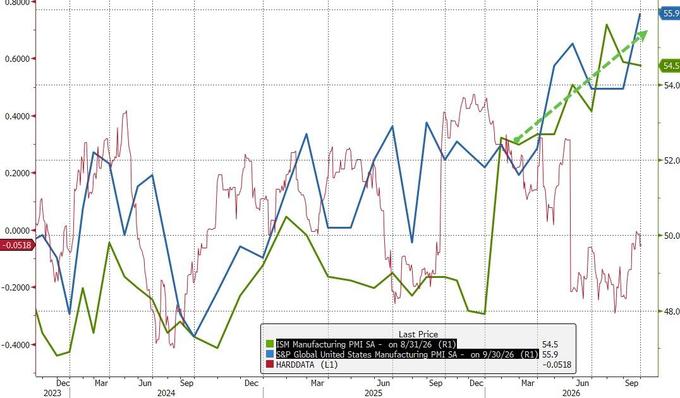
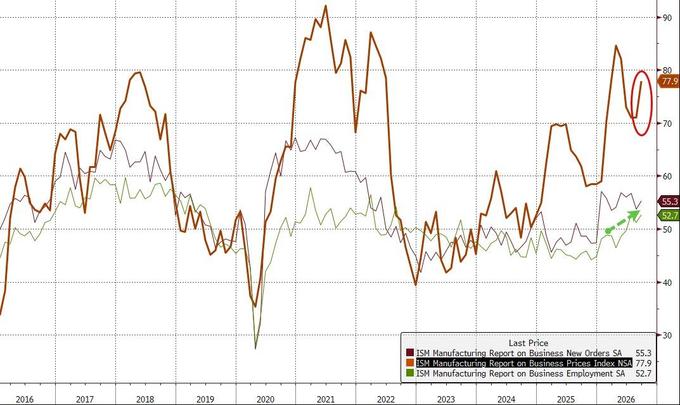
Although it continued to decline, the ISM manufacturing index has remained above the 50 threshold for nine consecutive months, indicating that manufacturing activities have been in an expansionary phase since 2026. Sub-indicators highlight the pressure of rising inflation: the price index measuring corporate raw material costs soared from 71.1 in August to 77.9, reaching the highest level in four months since May.
After the data was released, concerns about the economy's resilience and the resurgence of inflationary pressures grew. The U.S. stock market declined, with the Dow Jones Index, which started the session in decline, seeing an expanded loss. The S&P 500 Index, which opened slightly higher on Thursday, and the Nasdaq also turned lower. The U.S. Treasury market weakened as well, with the price of 30-year Treasuries falling significantly, and their yields rising first.
The manufacturing index has been expanding for nine consecutive months, with orders showing a clear recovery.
ISM data shows that in September, the PMI of manufacturing was 54.5, a decrease of only 0.1 percentage points from August. Although it did not rebound to 55.0 as expected by the market, this marks the ninth consecutive month of expansion for the U.S. manufacturing sector and is also the longest period of continuous expansion since 2022.
ISM indicates that in September, the manufacturing PMI corresponded to the U.S. economy maintaining growth for the 23rd consecutive month. Based on historical relationships, a manufacturing PMI of 54.5 in September roughly corresponds to an actual annualized growth of 2.4% GDP.
Looking at the sub-items, demand in the manufacturing sector has actually increased.
The new orders index rose from 53.7 to 55.3, marking a relatively fast expansion rate recently, with expansion remaining within the positive range for nine consecutive months; the backlog of orders index also increased significantly from 51.8 to 56.4, reaching its highest level since February this year. Although the production index fell from 58.3 to 56.7, it still maintained a relatively fast growth rate.
Employment has also shown improvement. The manufacturing employment index rose from 51.2 in August to 52.7, remaining in the expansionary range for the third consecutive month, marking the longest consecutive period of employment growth since 2022.
This means that the slight decline in manufacturing PMI in September is not due to a sudden weakening of demand, but rather reflects a slowdown in production growth. The rebound in orders and backlogs indicates that factories still have an adequate workload.
Similar to the US S&P Global Manufacturing PMI index for September, which was announced earlier on Thursday, the ISM index also reflects a trend of rising price indices, as well as a recovery in new orders and employment.
Chris Williamson, the chief business economist at S&P Global Market Intelligence, summarized that these data signal a positive trend of further growth in manufacturing capacity in the coming months. However, the situation of supply falling short of demand also means that inflationary pressures remain a focal point of concern for all parties, especially against the backdrop of high oil prices.
Cost pressures suddenly increase; raw material price index rises to a four-month high
What truly alerts the market are price indicators.
In September, the ISM Manufacturing Price Index rose significantly by 6.8 percentage points from August to 77.9, approaching the level of 78.3 at the beginning of the Iranian conflict in March this year. This is also the 24th consecutive month of rising raw material prices.
According to ISM, 58.6% of the surveyed enterprises reported an increase in raw material prices in September, compared to 46.2% in August; 16 manufacturing industries reported rising raw material prices, with no industry reporting a decrease.
The increase in prices covers a wide range of commodities, including aluminum, copper, steel, fuel, freight, electronic components, semiconductors, memory components, etc. Among these, the rise in prices of steel and aluminum is affecting the entire manufacturing value chain, while tariffs and the increase in oil product prices due to conflicts in the Middle East are further driving up corporate costs.
At the same time, supply chain pressures still exist.
The supplier delivery index in September was 59.0, which represents a slight improvement from August's 59.3, but it still indicates a slow delivery speed. This marks the 10th consecutive month that supplier deliveries have been slowing down. ISM In the survey, major industries such as computers and electronics, machinery, food, transportation equipment, and chemicals all reported a slowdown in supplier delivery speeds.
The media points out that strong domestic demand, especially the expansion of AI infrastructure and companies' restocking efforts, has helped maintain momentum for the U.S. manufacturing sector. However, rising energy costs and disruptions to the supply chain are increasing inflationary pressures.
Economist Williamson from Standard & Poor's Global commented, "In September, the growth pace of U.S. manufacturing accelerated once again." He noted that with a surge in new orders, factories significantly increased production and hired more workers, driving PMI to a four-year high, and stated:
The number of unfinished orders continues to increase, and suppliers are becoming increasingly busy. This indicates that as companies strive to meet the demands of both consumer and corporate markets, production capacity is starting to become strained. This phenomenon is particularly evident in the fields of machinery investment and production, and is often associated with the growth in expenditures related to artificial intelligence ( AI ). Preventive stockpiling due to concerns about prices and supply chains also continues to support demand, although the ongoing loss of export orders remains disappointing.
The combination of "strong demand + high costs" is putting pressure on the market.
From a market perspective, the ISM report released in September sends a rather complex signal.
On one hand, there have been improvements in new orders, backlogs of orders, and employment, indicating that there are no obvious signs of cooling down in the US manufacturing sector; on the other hand, the rapid rise in price indices and the continued slow delivery by suppliers mean that the cost pressures faced by businesses are accumulating again.
This is also why a PMI figure that is only 0.1 percentage points lower than the previous value, but clearly below expectations, has not turned out to be a simple “positive for economic cooling.” What the market is more concerned about are the price components: manufacturing demand remains resilient, while input costs have significantly increased. This combination may make it more difficult for inflationary pressures to subside quickly.
After the data was released, U.S. stocks, which had opened slightly higher, turned lower, while U.S. Treasury bonds continued to face pressure, with the price of 30-year Treasuries falling the most. Against the backdrop of already high yields on longer-term U.S. Treasuries recently, the rise in the manufacturing price index has undoubtedly further intensified market concerns about inflation and interest rates remaining high.
Reuters also pointed out that in September, the performance of the U.S. manufacturing sector showed that, supported by factors such as AI infrastructure investment and corporate inventory replenishment, manufacturing demand remained resilient. However, energy prices and supply chain pressures are creating new inflation challenges.
From the perspective of industry performance, data from ISM shows that among the 18 manufacturing industries, 12 experienced growth in September, including electrical equipment, primary metals, and machinery; only two industries, printing and related support activities, and textiles, showed contraction. Five out of the six major industries—computers and electronic products, food and beverages, transportation equipment, machinery, and chemicals—exhibited expansion.
Therefore, the manufacturing data for September ISM does not simply indicate a "cooling down" in the manufacturing sector: there is still support on the demand side, but the pressure on the cost side is clearly increasing. For markets that are already highly concerned about inflation, energy prices, and long-term U.S. Treasury yields, the latter may be the more significant signal worth trading on after the release of these data.