

Nike's road to recovery has been longer than anyone expected. Quarterly reports fell short of expectations, annual revenue forecasts were significantly lower than market projections, and a new round of layoffs followed. The world's largest sports brand is facing multiple pressures simultaneously, and Wall Street's patience is beginning to wear thin.
On Thursday (October 1st) local time, Nike announced its financial results for the first quarter of fiscal year 2027. Revenue for that quarter decreased by 4% to $11.2 billion, falling short of market expectations; net profit also declined by 2% to $712 million.
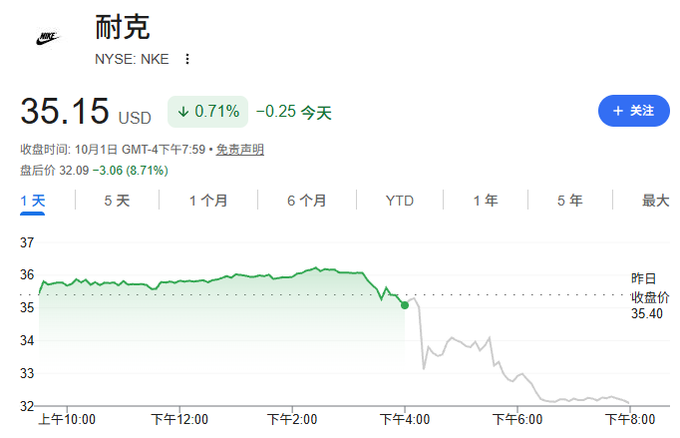
What worries investors even more is the outlook: Nike expects its annual revenue for the fiscal year 2027 to decline by "a high single-digit percentage" year-on-year, far worse than the previous market expectation of a decrease of about 2%. The company's adjusted annual earnings per share guidance is $1.15 to $1.35, which is also significantly lower than analysts' forecast of $1.68. After the financial report was released, Nike's stock price fell by more than 8% after the market closed.
At the same time, Nike announced the launch of a new cost-cutting initiative named “Pace”, with the goal of saving $2.5 billion by the fiscal year 2031. The company will also further reduce jobs among its approximately 73,000 employees and reorganize its global regional structure from four to three regions.
According to Bloomberg data, Wall Street analysts' overall rating of Nike has dropped to its lowest level in at least 25 years. Bank of America downgraded its rating to "underperform the market" this week and set a target price of $30. Based on after-hours prices, Nike's stock price has fallen by nearly 50% this year. If it fails to recover by the end of the year, it will record its worst annual performance since 1993.
Quarterly reports under comprehensive pressure
Nike's first-quarter performance fell short of expectations across the board.
Financial reports show that for the first fiscal quarter ending August 31, Nike's revenue was $11.21 billion, a year-on-year decrease of 4%, which fell short of the $11.32 billion expected by analysts from FactSet. Adjusted earnings per share were $0.48, slightly higher than the analysts' forecast of $0.44, but net profit still decreased by 2% to $712 million year-on-year.
Sales in the Greater China region decreased by 26% year-on-year when calculated using a fixed exchange rate, marking the ninth consecutive quarter of decline. CEO Elliott Hill stated during the financial report conference call that Nike needs to enhance its local relevance in China and reduce discount promotions. He pointed out that most of the local physical stores have not been renovated for over seven years. Increased competition from local brands and changing consumer demands are eroding Nike's market share.
Sports apparel ($Sportswear) also performed weakly, with revenue declining by double-digit percentages year-over-year, accounting for less than half of Nike's total revenue in its first fiscal quarter. Hill admitted, "There is currently a general lack of vitality in the lifestyle sector, which is affecting foot traffic. Consumers are indeed cautious, but as industry leaders, it is our responsibility to bring more creativity to sports apparel."
Sub-brand Converse (Converse) also dragged down overall performance, with revenue of $263 million in the first fiscal quarter, a year-on-year decrease of about 28%.
Annual guidance significantly lower than expected, recovery timeline postponed again
Nike's outlook for the fiscal year 2027 disappointed the market, and analysts generally lowered their profit forecasts.
Nike expects its annual revenue for the fiscal year 2027 (ending in May 2027) to decline by "high single-digit percentage" year-over-year. The adjusted annual earnings per share guidance range is $1.15 to $1.35, compared to analysts' previous expectation of $1.68. This means that Nike's revenue will miss out on billions of dollars less than previously anticipated by the market.
According to Bloomberg, Bank of America analyst Lorraine Hutchinson downgraded Nike's rating from "neutral" to "underperforming the market" in his latest research report, and postponed the expectation for sales recovery to 2028, while also significantly reducing profit forecasts for 2027 and 2028. Hutchinson set a target price of $30, which represents a potential downside of about 16% compared to the Friday closing price of $35.75.
"We believe that there are downside risks to both earnings per share expectations and valuations, as Nike's innovation continues to be overshadowed by its classic product line, which is under pressure, while category and macroeconomic pressures continue to accumulate," Hutchinson wrote in the research report.
A new round of layoffs and reorganizations: The “Pace” plan aims to save $2.5 billion
Nike announces the launch of a new round of cost-cutting measures, which will include further layoffs and the integration of its global regional structure.
Nike stated that the new cost-cutting plan “Pace” is expected to save approximately $2.5 billion by the end of the 2031 fiscal year, while also incurring about $1 billion in pre-tax restructuring costs, mainly related to employee-related expenses. Of this, about $300 million in severance costs were recognized in the previous fiscal year.
The company plans to cut some positions from its approximately 73,000 employees, but the exact number of layoffs and the locations have not yet been disclosed. The notification of these job adjustments is expected to begin in 2027. At the same time, Nike will consolidate its global regional structure from four to three to improve operational efficiency.
In addition, Nike also plans to build a new campus in Bangalore, India. Hill described India in an internal letter to employees as "an important growth market and manufacturing center for Nike, with strong capabilities and talent resources."
Hill stated in an internal letter, "The future belongs to those companies that can act faster, be closer to local athletes and consumers, and be more proactive in innovation. For this reason, Nike must make changes to become a more agile, more efficient, and more athlete-centric company."
Jordan Excess brand supply, strategy for retro shoe models urgently needs to be reshaped
Nike acknowledges its over-reliance on classic retro products and plans to proactively reduce the release scale of the Jordan brand.
Hill stated during the financial report conference call that Nike is facing an oversupply issue with its Jordan brand of basketball shoes. 'We will return to the scarcity model we created. In short, we have supplied too many of our iconic retro products, and they are being asked to bear too much.'
He stated that Nike plans to "deliberately reduce the quantity and frequency of releases for certain Jordan retro models" in order to rebuild consumer anticipation. "When consumers see the Jumpman logo, it should feel special, it should make them feel that it's worth having," said Hill.
At the same time, Nike is also trying to launch new products to attract consumers who value cost-effectiveness. Some of these new products, such as the Vomero running shoes and the Caitlin Clark signature shoes that were quickly sold out after their release on Thursday, have gained market recognition. However, analysts generally believe that Nike's overall new product line has not yet developed sufficient market appeal, while competing brands such as On Running and Hoka are continuing to capture consumer attention.
Wall Street confidence drops to a 25-year low, with multiple damages to brand image
Analysts' ratings have dropped to historic lows, and Nike is facing multiple challenges to its brand image at the same time.
According to Bloomberg, Nike's Wall Street composite rating has dropped to its lowest level in at least 25 years. Nike's stock price has fallen by nearly 50% this year, and if it cannot rebound before the end of the year, it will record its worst annual performance since 1993, which was also the year that Michael Jordan retired from professional basketball for the first time. More than two years have passed since the announcement of Hill's return, and Nike's market value has evaporated by nearly $77 billion.
At the brand level, Nike has also recently faced multiple setbacks. According to Bloomberg, both teams in the FIFA World Cup final wore equipment from their competitor, Adidas; French football superstar Kylian Mbapp transferred to On Holding; and its Converse brand has become embroiled in a public opinion controversy due to its advertisements being criticized for associating with a history of racial violence.
At the management level, the new Chief Financial Officer, David Denton, joined Nike in August of this year from Pfizer (Pfizer). Bank of America analyst Hutchinson pointed out that Denton is taking over a situation where there is "almost no room for operational mistakes."
"With the new CFO taking office, cost reduction will become a core topic," writes Hutchinson. "We believe there is no room for cuts in demand creation, but we expect operating management expenses to decrease this year, and the cost structure will be examined from a completely new perspective."