On September 30th, at last week's 2026 World New Energy Vehicle Conference, during the special forum on "AI Driving the Technological Transition of Intelligent Vehicles and Their Full-Scenario Implementation," Xie Tian, Vice President of Baidu and General Manager of Baidu Maps, officially launched Baidu Maps V22.

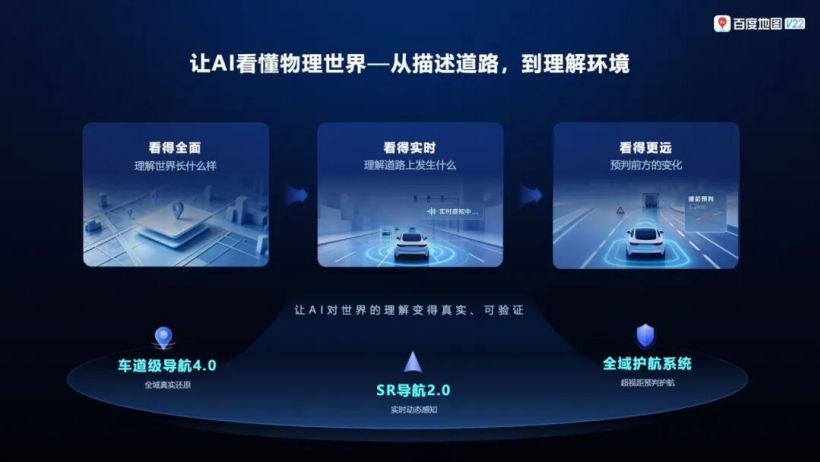
Baidu Maps V22 brings three major navigation capability upgrades: Lane-Level Navigation 4.0, Navigation 2.0, and the Global Escort System. It also further builds a spatio-temporal intelligence foundation to connect real-world data, real-time changes with user needs. IT summarizes the main updates as follows:
Lane-Level Navigation 4.0
Lane-level navigation 4.0 has been upgraded to achieve 'full network coverage, full terrain depiction, and full intersection restoration'.
This time, lane-level navigation has been further extended to internal roads in residential areas and industrial parks, overcoming the “last mile” challenge of parking in over a million parking lots. From entering the destination to finding a parking spot, the navigation service can now be more seamless, pushing the navigation experience towards a “spot-to-spot” approach.
The new version also upgrades the representation of seven different landforms and two seasons, more accurately restoring the surrounding environment such as mountains, grasslands, and rivers along the roads.
Combining the capabilities of large-scale model image recognition, the lanes and turning positions at complex intersections can also be presented more clearly.
SR Navigation 2.0
SR Navigation 2.0 further integrates road information with real-time vehicle perception, extending road guidance and environmental presentation from public roads to parking lots, thus connecting the driving and parking experiences.
In manual and assisted driving scenarios, users can more intuitively understand traffic congestion and potential risks ahead through maps. The new version also introduces AI generative rendering, which provides different visual styles on top of presenting real road information.
Global Escort System
The Global Escort System promptly communicates any abnormalities on the road ahead to drivers behind. Currently, the system supports over 30 types of safety alerts, capable of detecting major road anomalies in seconds and issuing real-time warnings to vehicles following. It also helps mobile and in-vehicle users understand the situation ahead in advance through reconstructions of congested traffic scenarios.
Upgrade AI service
Baidu Maps V22 upgrades its services centered around "good answers and accurate recommendations" AI:
AI Searching can understand colloquial requests that include multiple locations and various conditions. Even if users do not mention the exact place names, the map can find the locations based on the descriptions, arrange routes, and add temporarily added items to the itinerary.
AI When planning a trip, one can take into account factors such as the number of days for travel, regional arrangements, and making use of the route for convenience. It is also possible to answer specific questions regarding the opening hours of scenic spots and the crowd situation on that day. Moreover, "map verification" provides verifiable information.
AI The route can take into account travel memories, understanding expressions such as "Let's go to the restaurant I visited last week" or "Take the road I'm familiar with." When new needs arise during the journey, it can also provide adjustment options for users to choose from.
Before departure, AI will take into account the user's intended destination, real-time traffic conditions, and weather to display the estimated travel time as well as traffic conditions for departing at different times, helping users decide the best moment to set off.
During the journey, AI provides conversations and companionship in specific scenarios from the passenger seat, while AI connects the environmental descriptions with interactive elements along the way, allowing users to learn about the attractions they pass by and their history without having to search actively.