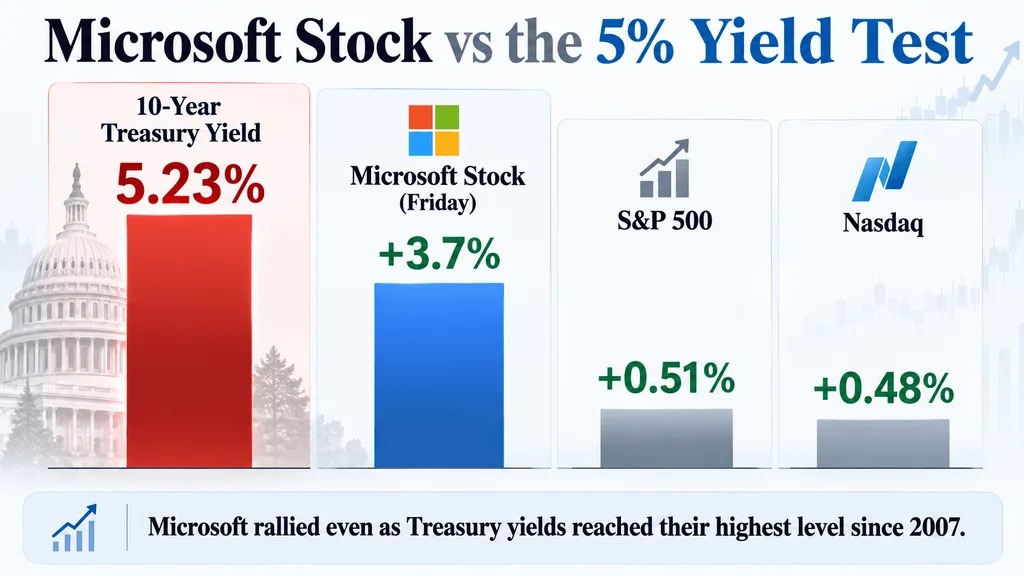
Microsoft's stock price rose 3.7% on Friday, following the company's announcement of a major Copilot upgrade; at the same time, the yield on 10-year U.S. Treasury bonds briefly reached 5.23%, the highest level since 2007.
The reason this combination is important is that high yields on government bonds typically put direct pressure on technology stocks with higher valuations. Higher risk-free interest rates reduce the present value of future earnings and also provide investors with more attractive alternatives to stocks.
Microsoft's rebound indicates that, at least for now, investors are still willing to ignore such pressures when the growth story around AI is strong enough.
Microsoft's official Copilot announcement introduced three main capabilities: Home, Code, and Autopilot. Code allows users to build applications and workflows using the same underlying technology as GitHub Copilot; Autopilot is designed as a continuously running AI proxy that can continue to work without the need for repeated prompts.
Microsoft continued to rise despite a warning from the bond market
This round of increase occurred against an exceptionally difficult interest rate backdrop.
During trading on Friday, the yield on the benchmark 10-year Treasury note briefly reached 5.2297%, while long-term borrowing costs remained near their highest levels in decades. Despite this, Microsoft still rose by 3.7%, Qualcomm rose by about 4%, Dell rose by about 5%, and the broader S&P 500 index closed up 0.5%.
This is contrary to what investors usually expect.
As we have explained before, higher Treasury bond yields tend to suppress AI and tech stocks: companies whose valuations are based on profits expected in several years ahead are particularly sensitive to changes in the discount rate.
This impact has become apparent this month. The S&P 500 index fell when its 10-year yield once again rose above 5%, and investors are increasingly viewing the bond market as one of the biggest risks facing stocks.
AI Profit expectations are now outweighing the issue of discount rates
The simplest explanation is that investors currently believe that AI is a strong enough profit story to offset some of the valuation pressures coming from the bond market.
Microsoft no longer just sells a chatbot. The new Copilot strategy integrates AI more deeply into Word, Excel, PowerPoint, Teams, coding, and continuously running enterprise agents, while also adding a pay-per-use model for more advanced workloads.
This may allow Microsoft to generate revenue from AI in various ways without relying on a single product.
Ethan Mercer
Ethan Mercer is a financial journalist who covers cryptocurrency, stocks, and the global economy. He studied economics and finance before turning to market reporting, with a particular focus on Bitcoin, stocks, monetary policy, and investor sentiment. His work focuses on explaining daily market fluctuations as well as the broader trends behind them.