





AI Expansion is pushing the construction of data centers in the United States to new power consumption thresholds. Multiple institutions predict that by 2030, data centers could account for about 10% of the total electricity consumption in the US. As demand for computing power and cloud computing continues to grow, power supply is becoming a new bottleneck following GPU and servers.
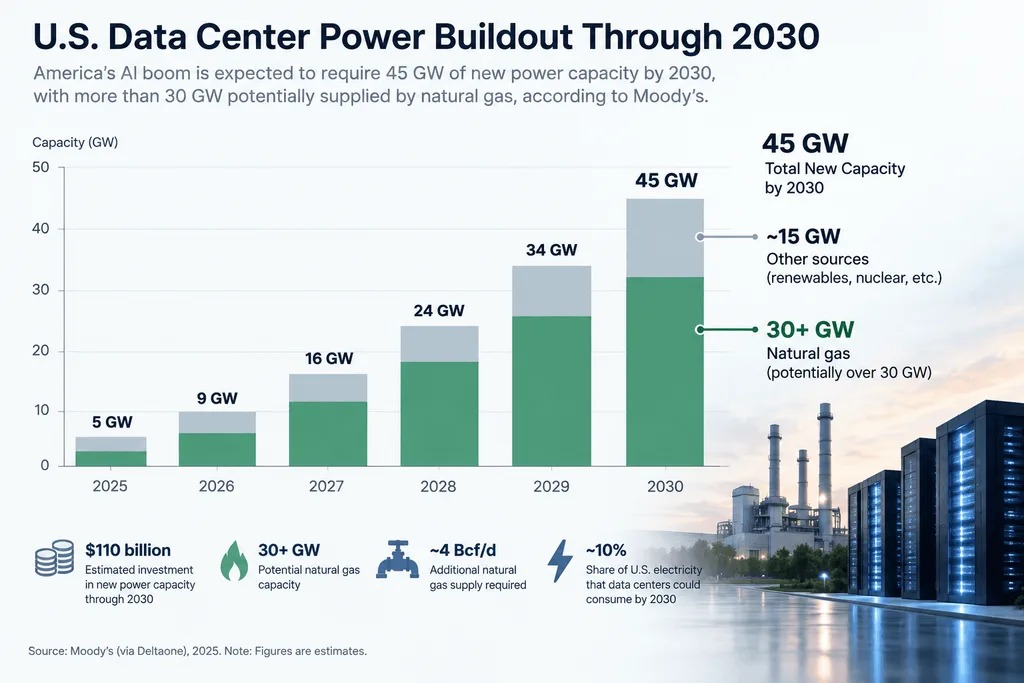
By 2030, an additional 45 gigawatts of electricity may be required.
According to Moody's estimates cited in the text, U.S. data centers may require approximately $110 billion in investment by 2030 to add 45 gigawatts of power generation capacity. Of this, more than 30 gigawatts of the additional capacity could come from natural gas.
This means that the infrastructure competition, AI, is shifting further from chips and servers to grid access, power generation capacity, and long-term power supply assurance. For large data center projects, the ability to obtain stable electricity has become as important as hardware procurement.
Global data center power consumption continues to rise
The International Energy Agency predicts that by 2030, global data center electricity consumption will approach 950 terawatt-hours, almost doubling from the level in 2025. The main factors driving this growth are AI training, inference tasks, and the continuous expansion of cloud service loads.
The article argues that this change indicates that the investment focus of AI is shifting from semiconductor companies to a broader range of infrastructure sectors, including utilities, power equipment, refrigeration systems, and energy supply chains.
Natural gas may become a direct beneficiary.
Since the AI data center requires stable power supply around the clock, a power source that can be scheduled and operate continuously is of even greater importance. The article cites S&P Global Data, which states that among the power projects announced in the United States for serving data centers, over 80% rely on natural gas.
McKinsey estimates that by 2030, the power generation systems in the United States and Canada may need to additional about 4.1 billion cubic feet of natural gas per day, with more than half of this increased demand related to data centers.
Citi further predicts that by 2030, data center electricity consumption could account for about 10.9% of the total electricity consumption in the United States, significantly higher than the approximately 4.5% in 2023. If this trend continues, AI infrastructure will become one of the most important sources of new electricity demand in the United States.
From a market perspective, the focus of the AI industry chain is changing. In addition to chip performance and server shipments, who can obtain power more quickly, connect to the grid, and secure stable energy sources is becoming the key to competition in the next phase.