

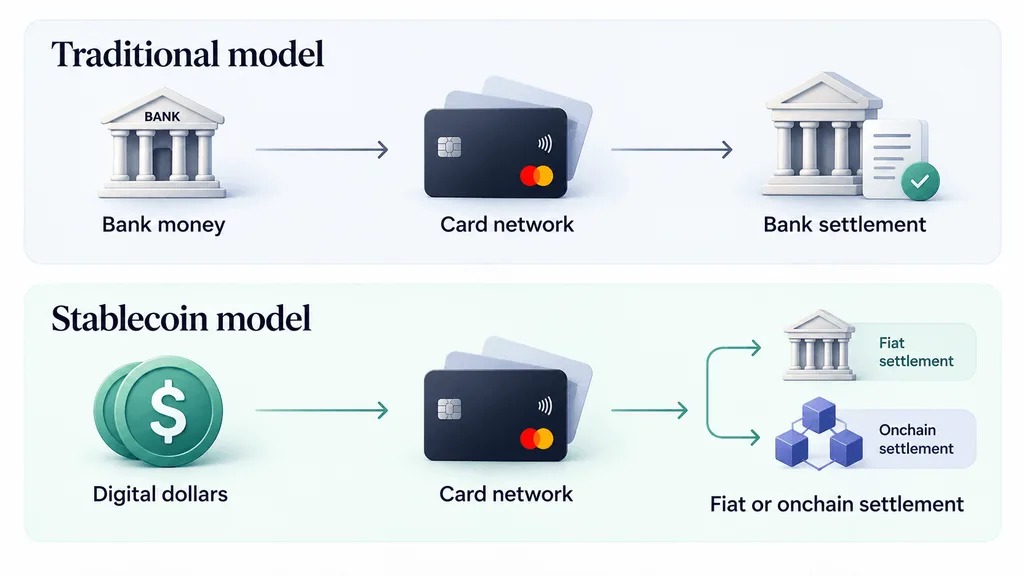
Foreign media believes that stablecoin payment cards are not currently replacing traditional card organizations, but rather adding a new layer of capital and settlement capabilities to the existing bank card system. On-chain assets are responsible for transferring value, while Visa and Mastercard are still responsible for connecting this money to the global merchant network.
Merchants still use the original channels.
When users use stablecoins cards for transactions, the process seen by merchants is similar to that of regular bank card transactions. The issuing institution first verifies the wallet balance, then reserves or exchanges the corresponding stablecoins, and subsequently sends the transaction to the acquiring bank and merchant through the networks Visa or Mastercard.
This means that most merchants do not need to configure encrypted wallets, nor do they need to directly connect to the blockchain. Restaurants, retailers, and online platforms can still use their existing payment systems, with stablecoins being used merely as a source of funds or a settlement tool in the backend.
Stablecoins address the issue of settlement efficiency.
The article points out that stablecoins such as USDC can enable 24/7 transfers and are also more suitable for cross-border transactions. However, retail payments are not just about moving money from one place to another; they also involve transaction routing, merchant identification, exchange rate conversion, refunds, fraud monitoring, and chargeback processing.
These capabilities have long been undertaken by the card network. To completely bypass Visa and Mastercard, global merchants would need to replace their entire payment infrastructure, which is highly difficult in the short term. Therefore, a more realistic approach for stablecoin cards is to reform the back-end settlement without changing the way merchants accept payments.
Two major card organizations are also integrating on-chain settlement.
Visa indicates that in 2025, the transaction volume of cards linked to stablecoins was approximately 5.2 billion US dollars, representing a year-on-year increase of 319%; the monthly consumption scale of crypto cards was about 600 million US dollars. The article also mentions that Rain has used USDC to support the 7-day settlement for Visa card projects.
In terms of Mastercard, the scope of stablecoin settlement has been expanded to cover USDC, PYUSD, and RLUSD, and weekend settlements as well as intraday settlements have been promoted. Visa is also providing USDC settlement capabilities for financial institutions, which includes relevant arrangements made through Solana.
The focus of competition has shifted to payment revenues.
The article argues that subsequent competition is not just about who will handle payments, but also about who will obtain the main profits in the payment chain. Stablecoin issuers can generate revenue from their reserve assets, while banks may face the pressure of having their deposits and some payment revenues diverted.
In contrast, the advantage of Visa and Mastercard is that they do not rely on consumers having bank deposits. As long as transactions continue to pass through their networks, both companies can still maintain a central position in merchant acceptance and payment orchestration.