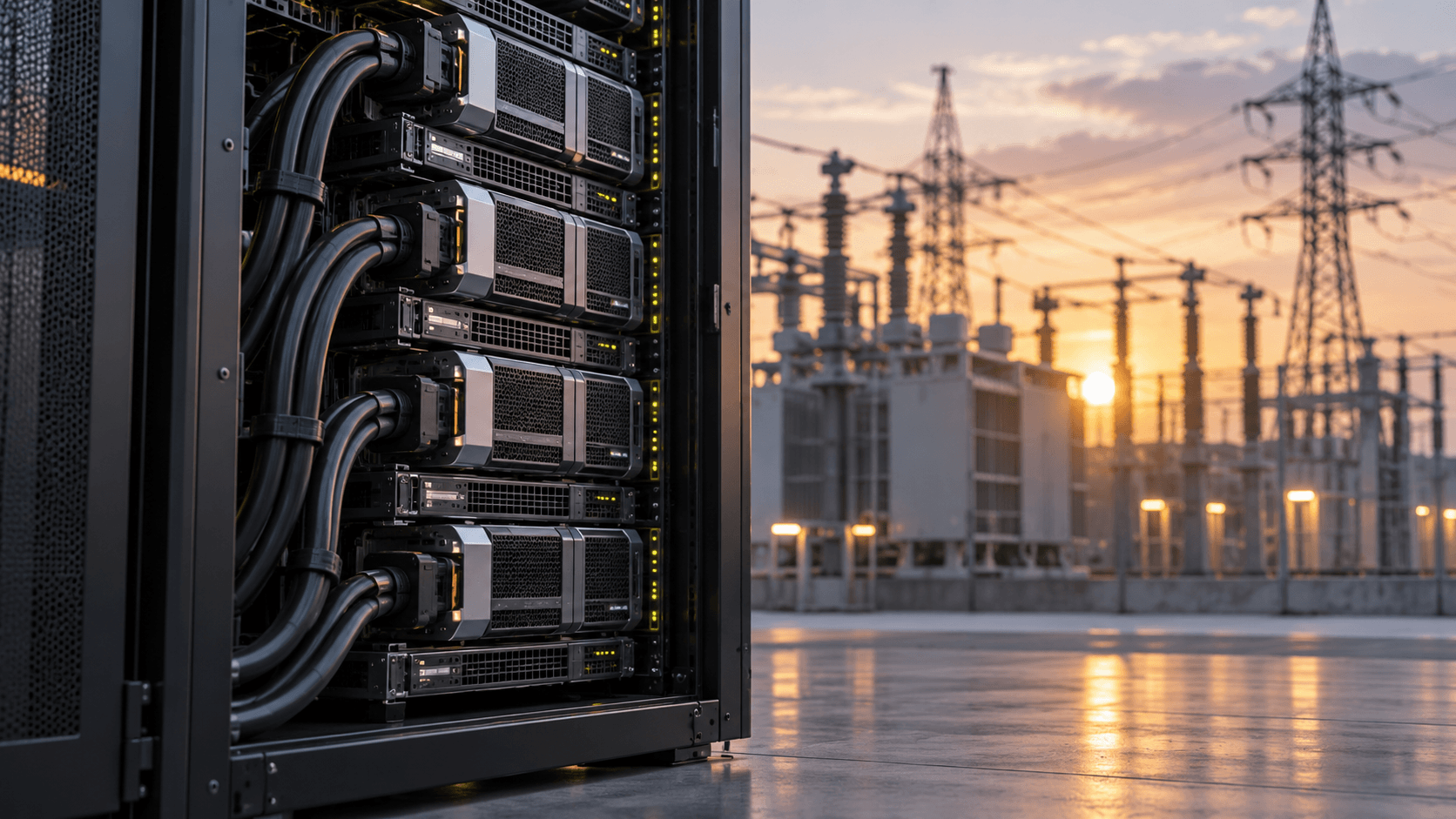


Foreign media believes that the AI craze is usually interpreted as a competition in procurement and capital expenditure among cloud vendors, but the more challenging aspect is shifting towards electricity supply. While the construction cycle for data centers is relatively short, the advancement of power transmission lines, substations, and new power generation capacity is often slower, which makes power supply capacity a real constraint in the expansion of AI.
Data center electricity consumption continues to rise
The International Energy Agency predicts that global data center electricity consumption will increase from approximately 485 TWh in 2025 to about 950 TWh by 2030, with the growth rate for facilities serving AI being even faster. The article points out that the issue is not just how much electricity AI consumes, but rather that the demand is increasing too rapidly, making it difficult for power grids and supporting infrastructure to expand in tandem.
In addition to GPU, there are also supporting systems.
The article states that the AI cluster does not only require processors. The deployment of large-scale accelerators also depends on network equipment, power conversion, cooling systems, grid connectivity, and stable power supply. As the density of servers continues to increase, the infrastructure requirements to support the operation of these devices are also rising in tandem.
- GPU Interconnection with the Internet
- Power Conversion and Thermal Management
- Power grid access and generation capacity
The article argues that some of the bottlenecks in these processes cannot be quickly resolved by placing additional orders, as is the case with chip procurement. Large cloud service providers can continue to purchase more GPU, but they cannot immediately obtain new high-pressure access capabilities.
More than 700 applications for access to Texas have been received GW
Texas is considered a relatively typical case. The article cites data stating that the number of power connection applications submitted for proposed data centers in the area has exceeded 700 GW, which is far higher than the actual power consumption of current data centers in the United States. Since some projects may not ultimately be implemented, regulatory authorities have begun to tighten connection rules to prevent grid resources from being occupied by "phantom demand."
This also brings direct financial issues. Utility companies may invest in infrastructure for projects that have not yet been implemented, while the AI parks that are actually in progress may face years of waiting and difficulty in obtaining power access in a timely manner.
Mining companies and power companies benefit
The article suggests that this bottleneck is changing the range of beneficiaries within the AI industry chain. Vertiv, a supplier of power management and cooling equipment for data centers, has recently agreed to acquire Utility Innovation Group, a microgrid company, with the total transaction amount potentially reaching up to $2.6 billion. This indicates that the value of on-site power generation and infrastructure that is independent of the main power grid is on the rise.
The importance of microgrids lies in their ability to combine grid power supply, on-site power generation, and energy storage, thereby reducing a project's dependence on the progress of public utility connections. At the same time, power suppliers such as NextEra Energy and Dominion Energy are also benefiting from the long-term demand brought about by cloud service providers and data center developers.
The article also mentions that the expansion of AI is changing the economic logic of the Bitcoin mining industry. Mining companies typically control access to electricity in areas with low electricity prices, and these connections are already scarce in themselves. If AI companies are willing to pay a higher price for the same electricity, some mining companies may shift part of their production capacity to high-performance computing services.