

After new changes in the regulatory framework of the Federal Reserve Banks in the United States, the progress of Ripple in obtaining a nationwide trust bank license has once again come under attention. The Federal Reserve Board (FRB) stated that it will provide a clearer path for new entrants, including digital asset companies, to apply for federal licenses, in an attempt to reverse the long-term scarcity of new banks being established.
OCC Emphasizes the new application channel
The person in charge, OCC, recently stated that regulatory authorities hope to allow more eligible enterprises to enter the national banking system. According to disclosures by OCC, 40 applications for new banks have been received over the past 18 months, including applications for national trust banks.
The institution stated that, with complete documentation, many applications can be decided upon within 120 days. OCC also mentioned that recently, a fully functional national bank has received final approval and commenced operations, which is the first such case in nearly five years.
Gould also clearly states that as long as the business itself is legal, companies involved in digital assets should also have a feasible path to enter the national banking system.
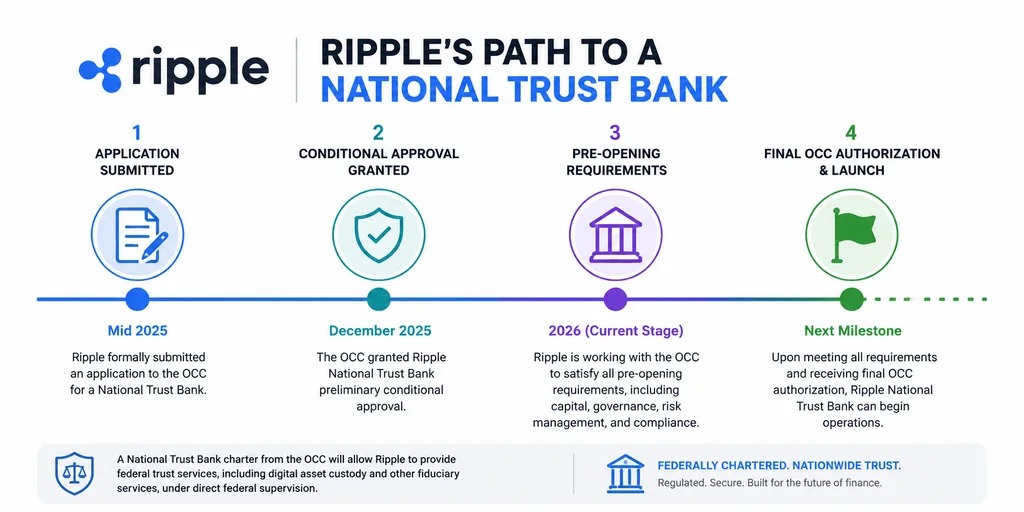
Ripple is still in the conditional approval phase.
Ripple has once again become the focus because its application was submitted earlier than that of most of its peers, entering the approval process sooner. In December 2025, OCC issued a conditional preliminary approval to Ripple National Trust Bank; other applications in the same batch included those from Circle, BitGo, Fidelity Digital Assets, and Paxos.
However, this does not mean that Ripple is ready for official operation yet. It still needs to meet the pre-opening requirements stipulated by OCC before it may be granted final authorization.
Unlike traditional retail banks, the national trust bank proposed to be established by Ripple is expected to focus on institutional custody, settlement, and trust services, rather than deposit accounts for individual customers or traditional lending business.
Stablecoin business enhances the value of licenses
As of March this year, Ripple is still in the final stages of fulfilling these requirements. The market continues to monitor this progress because this license may become an important compliance entry point for its institutional custody and settlement services.
This is not an isolated case of Ripple. In December last year, OCC covered 5 digital asset companies at once, indicating that federal banking regulatory authorities are more willing to evaluate crypto business models in accordance with existing banking laws.
This trend continues in 2026. World Liberty Financial has also recently received conditional approval from World Liberty Trust Company. If the remaining requirements are met, the relevant entity will be able to support its USD1 stablecoin business.
For Ripple, timing is particularly crucial. The market value of RLUSD has recently exceeded $2 billion, further highlighting the importance of regulated custody, reserve management, and institutional settlement infrastructure.
If the path for federal licensing continues to be open, encryption companies' reliance on state-level licensing systems may decrease, and more digital asset businesses could be directly brought under the federal regulatory framework. However, the current status of Ripple is still conditional approval; capital, governance, compliance, risk control, and operational requirements still need to be met one by one.