
















The rebound in U.S. tech stocks that began on July 29th has outperformed the broader market by 18.1 percentage points over 52 trading days. However, according to Deutsche Bank, this round of market gains has reached its peak.
According to Zuifeng Trading Desk, on October 9th, analysts from the bank's multi-asset strategy team, including Parag Thatte, issued a report in which they downgraded their rating of U.S. tech stocks and large-cap growth stocks (MCG & Tech) from "overweight" to "neutral." The analysts stated:
The rotation of tech stocks has gone far, and the recent risk-return ratio is no longer attractive.
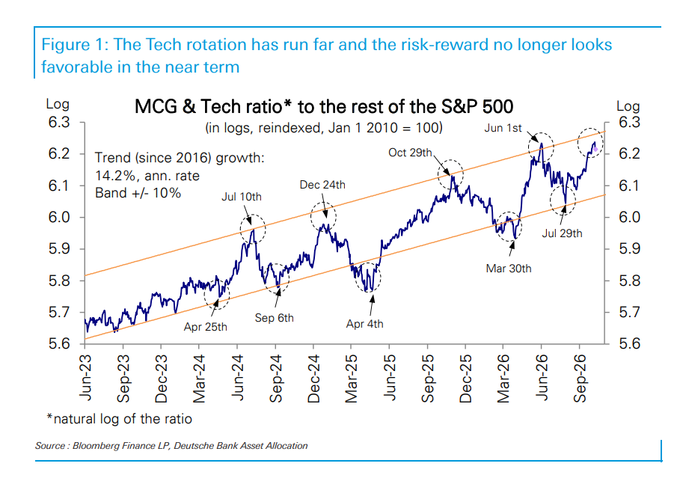
An inverted V-shaped reversal is approaching?
Deutsche Bank tracked the five cycles of rotation in U.S. tech stocks over the past two years.
Data shows that the median increase in the previous four rounds of recovery was about 29.5 percentage points (relative to the broader market), while in this round, as of October 8th, it has already outperformed by a cumulative 18.1 percentage points.
Analysts point out that the current relative performance of tech stocks has approached the upper track of the long-term trend channel – which is precisely the starting point for several previous reversals.
Specifically, current tech stocks still have about 4 percentage points of upside potential relative to the broader market before they can reach the top of the channel. However, once they hit that peak and start to fall, historical trends indicate that the potential downside could be as much as 16 percentage points. The report states:
Past rotations all exhibited an inverted V-shaped reversal.
Position asymmetry: Over-allocation in technology, generally under-allocation in other sectors
Position data also supports this judgment.
As of October 8th, the position in technology and large-cap growth stocks was at the 58th percentile. Although it has fallen from recent highs, it is still significantly overweighted.
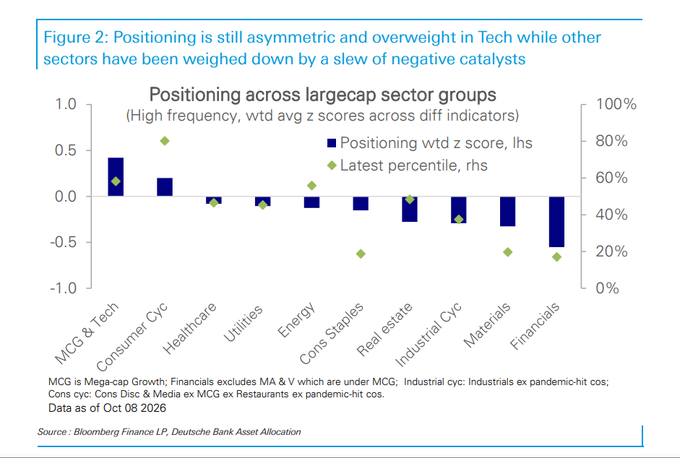
Meanwhile, the situation in other sectors is quite different:
- Financial stock positions have dropped to the 17th percentile, indicating a significantly underweight allocation.
- Industrial cycle stocks are at the 38th percentile.
- Material stocks are at the 20th percentile.
- Consumption of necessities is at the 19th percentile.
Analysts pointed out that the overall position of active investors is at the 32nd percentile, which is considered a moderately low allocation; although the position of systematic strategies is at the 85th percentile, it has also declined recently.
Strong performance may not be enough to boost stock prices; market focus has shifted.
Analysts expect that the earnings growth rate of U.S. tech stocks in the third quarter will be around 55%, continuing the previous strong momentum.
But this may not be sufficient to drive the stock price up further.
Market concerns are now focused on future profitability, a issue that is difficult to resolve in the short term.
In contrast, the expected threshold for non-technology sectors is extremely low – the market generally believes that these sectors have little to no growth. However, Deutsche Bank predicts that the profit growth rate for non-technology sectors in the third quarter will be around 21% (year-on-year), which is not much different from the 23% in the second quarter. The profit growth rate for companies in the S&P 500 is expected to remain at a relatively high level of over ten percentage points.
"The entry barriers for other sectors are very low, and the market generally believes that there is almost no growth there – but in fact, the growth is still quite strong." Analysts believe that this discrepancy in expectations constitutes the basis for rotation.
Rotation direction: Funds are flowing to other sectors, and the breadth of the market is expected to improve.
Analysts believe that the high concentration of technology stocks has always raised concerns about a lack of diversification in the market, and the past two months have been no exception.
Once funds shift from technology stocks to other sectors and small-cap stocks, this concern is expected to ease.
Looking at historical data, during the rotation phase of tech stocks, the median increase in non-tech sectors was about 3 percentage points, while tech stocks on average fell by about 14.8 percentage points.
Across regions, the report indicates that the exposure to tech stocks is a key variable determining the market performance of each region. The European market, which accounts for only 9% of tech stocks, has an advantage in terms of rotation compared to the US market, where tech stocks make up 40%.
Risk of sharp decline: Historical experience suggests the need to be wary of external shocks
Whether the rotation of tech stocks will be accompanied by a broader market decline is a key question. Analysts write:
Recent history indicates that the answer is yes – but it's important to note that these rotations often coincide with major external shocks, such as the tariff impacts on "Liberation Day" and the outbreak of the Iran war, which have dragged down all stocks together.
In other words, in the absence of major external shocks, this rotation is more likely to be a structural rebalancing of sectors rather than a systemic market downturn.
Long-term trend remains unchanged: The logic that tech stocks outperform in the long run still holds true.
It is worth noting that Deutsche Bank's downgrade this time is only aimed at the short-term tactical level.
Analysts say that the trend of tech stocks outperforming the broader market in the long term remains intact. Over the past decade, tech stocks have outperformed the remaining components of the S&P 500 by about 14 percentage points annually, driven by sustained and stronger earnings growth.
We believe that this dynamic will not change.