This week, the international market has seen significant fluctuations, with the situation in the Middle East remaining tense. The AI sector has experienced increased volatility. U.S. stocks rose across the board, with the Dow Jones Index up 0.93%, the Nasdaq Index up 0.64%, and the S&P 500 Index up 1.15%. In Europe, the three major stock indices showed mixed performances: the UK's FTSE 100 Index rose 0.86%, while Germany's DAX 30 Index fell 0.57%, and France's CAC 40 Index fell 1.19%.
There are quite a few highlights next week, with the biggest focus being on U.S. inflation data. Investors generally expect the Federal Reserve to raise interest rates again by the end of this year. In Europe, the final inflation figures for September in the eurozone and the economic growth data for August in the UK will be released. Investors will also pay attention to speeches by officials from the Bank of Japan as well as the latest minutes from the Reserve Bank of Australia's meetings. Recently, the yields on government bonds in several major developed economies have risen to multi-year highs, and the trend in the bond market continues to keep investors on edge. France is receiving extra attention due to budget issues. The World Bank and the IMF Annual Meeting will be held in Thailand, so keep an eye on the latest economic forecasts. The U.S. corporate earnings season has begun, and whether it can boost the U.S. stock market remains to be seen.
Major inflation indicators released
The U.S. Consumer Price Index ( CPI ) for September will be released next Wednesday (the 14th), and investors will use this to determine the timing of the Federal Reserve's next interest rate hike.
Refinitiv ( LSEG ) data shows that due to the recent weak employment data in the United States, coupled with statements from several Federal Reserve officials indicating there is time to wait and see before raising interest rates again, the current market pricing for a rate hike on October 28 is only 19%, whereas previously the market's highest estimate for this probability was 70%. However, the market has already fully priced in a 25-basis-point rate hike by the Federal Reserve in December.
James Nettley, an economist at ING Group ( ING ), stated in a research report: "Only one CPI report that significantly exceeds expectations would change the market's expectation of no interest rate changes in October. A substantial increase in gasoline and airfare prices is not entirely impossible. Even so, we still believe that the Federal Reserve will wait until December to raise interest rates."
In addition, the producer price index for September, which will be released later, will be able to reflect the extent of rising inflationary pressures from upstream against the backdrop of recent sharp increases in energy prices. Other indicators worth watching include retail sales for September and industrial output data for September.
The third-quarter financial reports will officially kick off next week, with major banks such as Wells Fargo, Goldman Sachs, Citibank, JPMorgan Chase, Bank of America, and Morgan Stanley releasing their results one after another. According to data from Reuters, analysts expect the overall earnings of S&P 500 components to increase by 30.6% year-on-year from July to September; the energy sector is expected to see the highest year-on-year growth, at 123%, followed closely by the technology sector with a year-on-year increase of 66.5%.
Crude Oil and Gold
International oil prices rose slightly as the market continued to assess the prospects of the Middle East situation. WTI The near-month contract for crude oil rose by 0.81% week-on-week, reaching $91.85 per barrel, while the near-month contract for Brent crude oil rose by 2.42% week-on-week, reaching $104.72 per barrel. Several analysts expect that the disruption in crude oil supply will continue until the beginning of 2027.
Data from Kepler ( Kpler ) shows that recent attacks have led to a significant decline in crude oil transportation volumes this week: the total crude oil flow through the Strait of Hormuz has plummeted from 12.26 million barrels per day on October 4th to 2.72 million barrels per day on October 7th. In the United States, a hurricane has forced several major oil and gas producers to shut down their facilities along the Gulf of Mexico coast, putting regional key refineries at risk, and the already tight supply of refined oil markets may face further pressure.
The precious metals market has rebounded, with the COMEX gold futures for October delivery on the New York Mercantile Exchange rising 1.39% week-on-week to close at $4,191.00 per ounce, and the COMEX silver futures rising 1.16% week-on-week to close at $60.67 per ounce.
StoneX Market Analysis Director Ron O'Connor stated: "The rise in gold prices is due to buying at lower levels, and a support bottom is forming around $4,000. It can be said that the market has already priced in the possibility of the Federal Reserve raising interest rates again, as well as the expectation of continued net gold purchases by official departments. In the absence of any black swan events, I think it will be difficult for gold prices to achieve a convincing breakout upward."
The yield on 10-year U.S. Treasury bonds has moved away from the over two-decade high reached on Wednesday. In an environment of high interest rates, the attractiveness of interest-free assets such as gold typically declines compared to assets that pay interest. Han Tan, Chief Market Analyst at Bybit, pointed out: "The CPI data to be released next week could become a catalyst for the next major move in gold prices... If inflation remains stubborn and forces the Federal Reserve to embark on a more aggressive interest rate hike cycle, spot gold may once again test the $4,000 psychological barrier."
Can the French government bond market stabilize?
Eurozone retail sales grew by only 0.1% in August, showing a slight recovery but with very weak momentum. Actual household consumption is under pressure due to high energy bills, and real household incomes are recovering slowly. There is no significant improvement in domestic demand, and the recovery of consumption is highly sluggish.
Next week, the final figures for September CPI in the eurozone and various economies will be released one after another, and these data may have a significant impact on the future policy path of the European Central Bank.
Meanwhile, French government bonds continue to come under market scrutiny. There are concerns that France may struggle to pass its latest budget proposal in parliament, driving the yield on French 10-year sovereign debt to its highest level since 2002. Analysts at the Bank of Baden-Württemberg in Germany wrote in a report: "Investors will continue to closely monitor any news related to France's 2027 budget plan."
UK manufacturing PMI saw a slight rebound in September but remained in a contractionary range, while the service sector PMI continued to expand albeit at a slower pace. The service sector remains a pillar of economic growth, but businesses are once again facing increased costs due to rising fuel and energy prices. Manufacturing orders are weak, and overseas demand is average. In business surveys, there is an expectation of rising prices in the future, reflecting that energy costs are beginning to be passed on to downstream consumers.
The UK's Gross Domestic Product (GDP) for August ( GDP ) will be announced next week, which will be used to determine whether the UK's strong economic performance recently can continue, especially as high energy costs may soon have an impact on the economy. Philip Shaw, an economist at TD Bank ( Investec ), said: "The UK's economic performance this summer has been fairly good, and the hot and sunny weather has likely played a boosting role. Considering that the conflicts around Iran have now entered their eighth month, the UK economy has shown remarkable resilience."
Next Week's Highlights
Looking ahead to next week, the situation in the Middle East, global bond market yields, and economic data are expected to become the key catalysts driving the U.S. stock market.
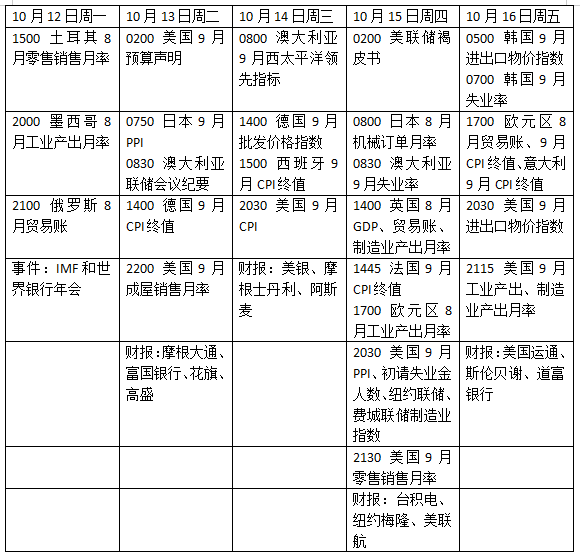
As the earnings season approaches, geopolitical factors and expectations regarding the Federal Reserve's monetary policy may once again dominate the U.S. stock market.