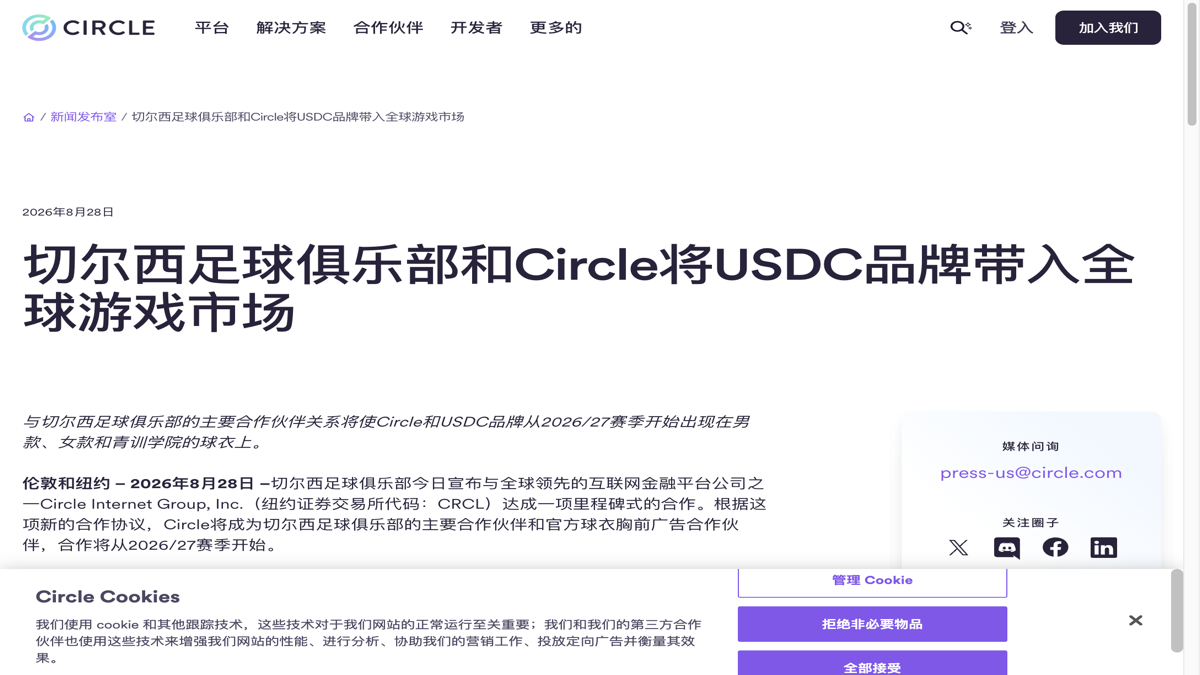


Circle announced a main partnership with Chelsea Football Club on August 28th. The Circle and USDC brands will appear on the front of Chelsea's men's, women's, and youth training kits starting from the 2026/27 season. The announcement stated that this logo will make its debut during the men's team's first Premier League home match against Brighton. This is a sports sponsorship and brand collaboration, rather than the launch of tokens, trading products, or investment plans aimed at fans; Circle specifically noted in the announcement that this news does not constitute an invitation or inducement to purchase, hold, or trade any crypto assets.
Placing stablecoin brands in the core spotlight of global sports IP indicates that industry competition is shifting from reaching crypto-native users to gaining recognition among the general public. For Circle, USDC serves as its central product for digital dollar infrastructure; for clubs, main sponsors provide long-term business partnerships and global dissemination resources. The combination of both can increase brand visibility, but visibility does not equate to financial usage rates, nor does it prove that a certain stablecoin has been more widely accepted in a particular market.
Sponsorship can increase awareness, but it cannot replace compliance and product responsibility.
In the press release, Circle positions this collaboration within the brand narrative of “open and globalized currency flows,” and states that USDC is issued by regulated affiliates. Regardless of how strong the brand communication is, the use of stablecoins still involves issues such as the issuing entity, channels for holding and redeeming, service provider qualifications, regional regulations, wallet security, and market risks. Just because football fans see the logo does not mean they automatically have access to applicable fiat currency deposit and withdrawal services, nor does it imply that these services are available in all jurisdictions.
Therefore, any communication surrounding this collaboration should avoid two types of exaggeration: first, describing the jersey sponsorship as Chelsea's integration with some payment or settlement system; the announcement does not make such a claim. Second, interpreting the exposure of the USDC brand as an investment advice. Sponsorship can change brand associations, but it cannot alter the real risks associated with crypto assets, such as price fluctuations, market structure, network operations, and regulatory differences. The more widespread the brand exposure, the clearer the risk warnings and boundary statements should be.
To observe commercial value, three different links should be distinguished.
The first point is media value: the reach brought by team uniforms, event broadcasts, and social media dissemination; the second point is brand value: whether the audience associates Circle and USDC with reliability, convenience, or globalization; the third point is product value: whether there are compliant channels, cooperative applications, and user experiences that can transform awareness into actual use. These three aspects are related, but they do not synchronize automatically. Sports sponsorship may rapidly enhance the first point, but the latter two need to be gradually verified through products and compliance capabilities.
The announcement also indicates that the cooperation covers men's football, women's football, and youth training programs, which expands the scenarios in which the brand appears. This also means that evaluations should not be based solely on a single match or an occasional exposure. What is more noteworthy is whether both parties will disclose specific projects aimed at communities, payments, education, or fan services in the future, as well as information regarding the regions these projects will be applied to, the methods of participation, and the associated risks. In the absence of further details, it is most appropriate to refer to this as "primary sponsorship and brand collaboration." For the Web3 industry, this is not only a major brand event but also a lesson about boundaries: moving towards the mainstream does not mean that product information and financial risk disclosures can be omitted.
The value of sponsorship ultimately depends on whether a sustainable customer relationship can be established in a compliant market, and not just on the number of exposures. Sports audiences span different countries, and the rules for stablecoin services, advertising, and consumer protection vary from one place to another; subsequent activities need to clearly explain the applicable regions and associated risks. Chelsea's global influence provides a platform for Circle to spread its message, but it does not make complex financial infrastructure any simpler automatically. Consumers should separate their judgment of business partnerships from their understanding of the assets, service terms, and associated risks.
For both parties, if there are any specific fan rights and interests, payment methods, or digital services involved in the next step, their technical implementations, funding flows, costs, revocability, and customer service mechanisms should be disclosed separately. Without these elements, the outside world should not infer the presence of financial product integrations from the design of the team uniforms. For other companies in the industry, this cooperation demonstrates that high-profile sponsorship can become part of a brand strategy, but it is not a shortcut to bypassing product competition and compliance requirements. Only service quality that can be verified by the public, transparent risk communication, and clear responsible parties determine whether a major sponsorship will leave behind long-term trust after the initial excitement fades.
Measuring cooperation by whether it provides clear, compliant services that users truly need is more in line with the standards that financial infrastructure should meet when it is accessible to the public, than measuring it by short-term social media discussion.
For consumers, seeing a brand name does not constitute financial advice; before any actual use, it is still necessary to verify for oneself whether the service provider, the region in which it is available, the fees, the redemption conditions, and potential loss risks are all supported.
When cooperation extends to specific services, users need to see independent, clear, and verifiable rules, rather than making financial arrangements based solely on the promotion of events. This is also a necessary reason for treating sports brand cooperation and financial decisions as separate entities.
This is also a necessary reason for treating sports brand collaboration and financial decision-making as separate entities.
Therefore, until new specific services are disclosed in the future, the most accurate judgment remains that this is a global brand sponsorship covering multiple team systems, and not an encrypted financial product that has already been launched for fans.