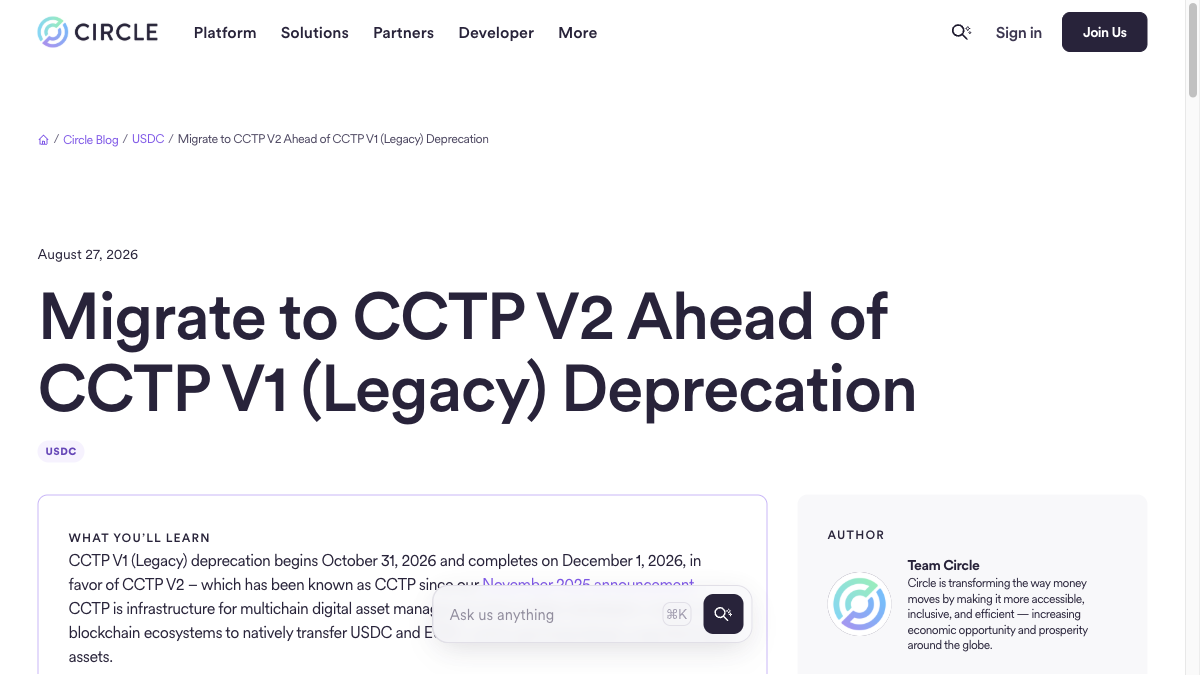


Circle reminds developers once again on August 27th to migrate to the cross-chain transfer protocol CCTP V1. According to the official schedule, starting from October 31, 2026, the destruction quota for the old version will be reduced, and its performance will gradually decline. By December 1st, the old contract will be retired and suspended. At that time, integrations that still point to the V1 contract will no longer be able to perform cross-chain transfers of USDC. Migrating to V2 is not a performance optimization suggestion, but a necessary change to maintain service continuity.
CCTP achieves cross-chain functionality through destruction on the source chain and native minting on the target chain, without relying on the traditional bridge model that involves locking assets before minting. V2 is now commonly referred to as CCTP and offers both standard and fast transfer modes, as well as programmable hooks for the target chain, supporting 27 different blockchains. The old version and the new version use different contracts and API; therefore, they are not backward compatible. Applications cannot assume that migration is complete simply by changing the version number.
As early as November 14, 2025, Circle announced the conversion arrangements, giving the ecosystem nearly a year to prepare. Now, by making public the specific reductions in quotas and the suspension of nodes, we have entered the countdown to implementation. For wallets, exchanges, bridge aggregators, payment applications, and the DeFi protocol, the risks are not limited to December 1st alone; starting from October 31st, the gradual decrease in quotas and performance may lead to delays, routing failures, or a deterioration in user experience.
Migration requires the simultaneous replacement of the contract, API, and the entire business process.
The development team must first conduct an inventory of all direct and indirect dependencies. An application may not directly call CCTP, but it might be using an older version through SDK, bridge aggregators, hosting providers, or backend services. It is not sufficient to only check the front-end repositories; contract addresses, environment variables, API endpoints, indexers, alarm systems, transaction simulation scripts, and disaster recovery scripts also need to be examined. The configurations for the test network and the main network should also be verified separately.
V2 Not being backward compatible means that migrations must undergo comprehensive regression testing. The destruction of the source chain, message retrieval, proofing, target chain minting, failure retries, and refund procedures all need to be verified. Quick transfer modes may involve different fees and risk parameters, while programmable hooks allow for automatic execution of target chain operations upon asset arrival, but they also increase the risks of combined calls and permissions. Teams should not add unnecessary complex logic during a single migration for the sake of new features.
The safest approach is to first support both V1 and V2 in parallel, verify the success rate and settlement time under low traffic conditions, then gradually switch the default route to V2, and finally stop creating new V1 transfers. For V1 messages that have been initiated but not yet completed, it is necessary to retain the ability to query and process them, and ensure they are completed before the official suspension. The front-end should clearly display the version being used, the estimated time, and a prompt indicating that the process is irreversible.
Monitoring indicators should include, at a minimum, the success rate of source chain destruction, proof-of-work waiting time, target chain铸造 failures, duplicate submissions, insufficient quotas, and changes in balances across various chains. If an aggregator automatically selects a path, it is also necessary to ensure that when the performance of V1 declines, users are not repeatedly rerouted back to the old version. The operations team needs to prepare status pages and customer service explanations in advance to avoid mistaking the retirement of the protocol for a loss of assets.
Unmanaged does not mean that Circle can recover erroneous transactions; user prompts need to be more explicit.
Circle emphasizes that CCTP is a non-hosted cross-chain messaging infrastructure; Circle Technology Services does not hold, control, or transfer user assets. Transactions are irreversible, and funds sent to the wrong address cannot be recovered by Circle. Non-hosted solutions reduce the risk of intermediate hosting accounts, but they leave the responsibility for selecting addresses, chains, and ensuring the correctness of call parameters to the applications and users.
V2 supports unlicensed packaging of third-party assets, but Circle does not review, endorse, or guarantee these assets. Developers must clearly distinguish between USDC native cross-chain assets and third-party packaged assets to prevent users from mistakenly assuming that all tokens that go through the CCTP interface possess Circle credit. There may still be vulnerabilities in combinations of smart contracts, message relays, and bridges.
The official page also mentions some nodes that support the modification of coin recipients or target callers in the old version, but there are obvious historical time issues with the dates stated. The development team should not rely on single textual descriptions in blogs to handle key deadlines; instead, they should refer to the latest migration guidelines, contract status, and developer documentation. They should also confirm any ambiguous entries with the Circle support channels.
The asset and interface teams should also notify users in advance. For advanced users who still save old transaction bookmarks, API examples, or manual contract addresses, version switching may lead to misoperations; documentation, the help center, SDK code snippets, and the block browser tabs must be updated synchronously. Institutional clients will need to change their approval processes, audit evidence, and rollback plans. Even if the core contract migration is successful, expired documentation and cached configurations may still cause issues months later.
The migration completion standard cannot be merely that "new transactions can succeed." The team should also confirm that the pending messages from the old version are cleared, that there are no longer any V1 calls in monitoring, that all third-party dependencies have been upgraded, and that user asset balances are consistent. Additionally, a read-only verification should be conducted after the old contract is suspended. By preserving these evidences, it will be possible to prove that there were no omissions in the funding path due to the version switch during subsequent disputes or audits.
CCTP V1 Retirement is a planned infrastructure migration, not an accident that has occurred to the protocol. Starting from October 31st, there was a reduction in quotas, and on December 1st, the old contracts were suspended; these represent two different risk points. Now that we have completed dependency inventory, dual-version verification, and low-traffic switching, the cost is far lower than making concentrated modifications in the last week. For users, a truly reliable cross-chain experience is not just about faster speeds, but also about ensuring that applications can maintain continuity in their fund paths, status notifications, and fault handling even when the underlying versions are changed.