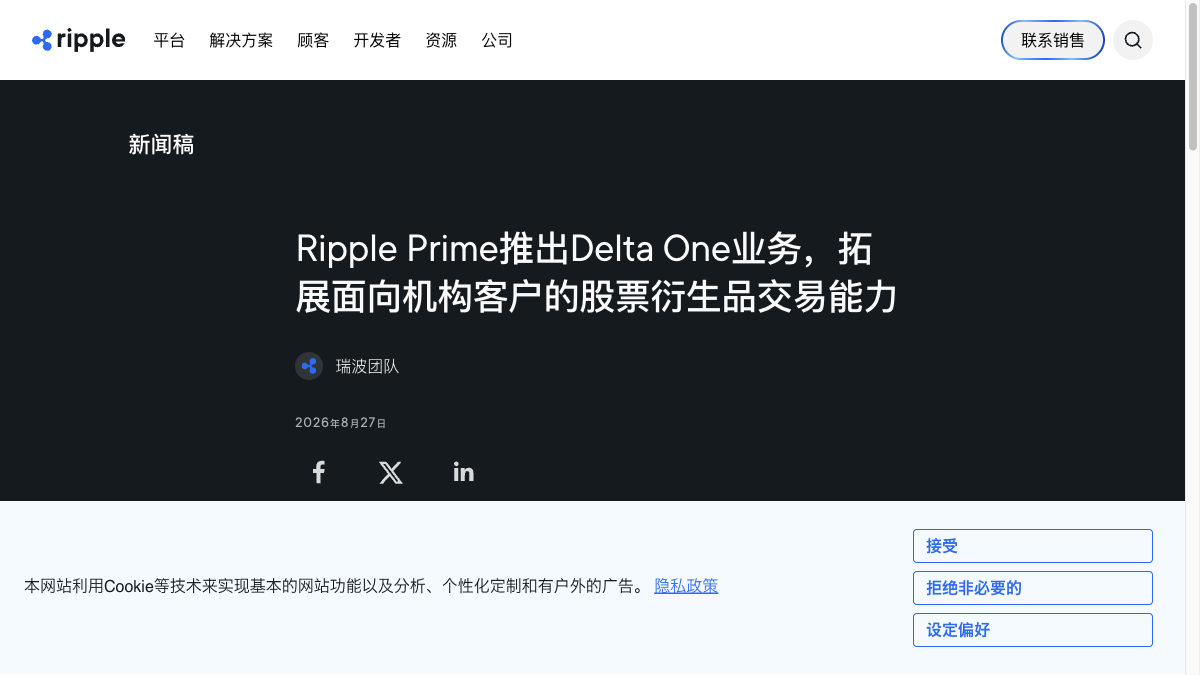


On August 27th, Ripple announced that its multi-asset principal brokerage platform, Ripple Prime, has officially launched the Delta One service. Qualified institutional clients can now obtain exposure to prices and yields of U.S.-listed stocks, indices, and digital assets through total return swaps, and manage cross-asset margins for positions in foreign exchange, derivatives, fixed income, and digital assets under the same counterparty relationship. The company stated that the service is now live, rather than still in the application or planning phase.
Delta One typically refers to products and strategies where price changes are approximately one-to-one with the underlying asset. In total return swaps, one party pays for the price fluctuations and income of the underlying asset, while the other party pays a financing rate or agreed-upon return. Customers obtain a contractual exposure and do not necessarily hold the stocks, index constituents, or digital assets themselves. Therefore, this announcement cannot be interpreted as meaning that U.S. stocks have been tokenized on XRP Ledger, nor does it imply that retail investors can directly purchase U.S. stocks on the blockchain using wallets.
Ripple Prime targets professional clients such as hedge funds and asset management institutions, providing clearing, financing, and principal brokerage services. The company emphasizes the efficiency of cross-asset margin management with a single counterparty and around-the-clock coverage. It states that its Delta One execution model is not aligned with proprietary trading or market-making activities, and is solely involved in clearing and financing processes. Although the conflict of interest structure may be simpler, clients still need to assess the source of quotes, counterparty risk, collateral discounts, and default handling procedures.
Total return swaps enhance capital efficiency, but they also concentrate counterparty and leverage risks.
The main reason institutions use interbank clearing is that they can obtain exposure without the need to hold and settle the underlying assets for each individual transaction. By placing positions in multiple markets with the same prime broker, margin requirements can be calculated based on the combined net risk, reducing the need to repeatedly use cash across different platforms. Managing digital assets and traditional assets 24 hours a day also helps to address the discrepancy between the continuous trading in the crypto market and the fixed trading hours of the stock market.
However, cross-margin requirements do not eliminate risk; they only change where the risk is concentrated. A decline in stock prices, sharp fluctuations in digital assets, and changes in foreign exchange can all impact the same margin pool at the same time; positions that seem diversified may be highly correlated during periods of stress. If a client's leverage is too high, the principal broker may require additional collateral or force a liquidation. Investors need to be aware of the frequency of valuation, the source of prices during non-trading hours, the maximum concentration limits, and the deduction ratios between assets.
Total return swaps also bring about legal and accounting complexities. Customers are faced with the contractual performance capability of Ripple Prime, rather than the direct obligations of the underlying securities issuers. Corporate actions, dividends, index adjustments, taxes, and regulatory restrictions must all be clearly defined in the contract. Digital asset forks, airdrops, or exchange halts add to the provisions for special events. The product's "tracking of Delta One" does not mean zero error at any given time.
Ripple reveals that Ripple Prime has over $1 billion in regulatory net capital and completed a $275 million issuance of senior unsecured notes this month. Previously, it also received a $200 million debt line provided by funds managed by Neuberger Specialty Finance. These capital figures indicate that the company has prepared a buffer for expansion, but they cannot replace ongoing scrutiny of its balance sheet, liquidity, and concentrated exposures.
Related to blockchain business, but the core of this product remains the infrastructure for institutional derivatives.
Ripple has long been known for XRP, RLUSD, payment, and custody, and its official introduction also lists these assets as part of its traditional and digital financial solutions. However, this announcement does not indicate that every stock or index swap is settled on the public chain, nor does it disclose that XRP or RLUSD is a mandatory collateral for all transactions. When reporting, it is important to distinguish between the company's overall blockchain strategy and the specific implementation mechanisms of Delta One products.
The real strategic significance lies in the fact that companies with a background in encryption or blockchain continue to enter the traditional principal brokerage business. Institutional clients wish to manage stocks, interest rates, foreign exchange, and digital assets within a single account. Supplier competition has expanded from merely providing trading platforms to also including financing, clearing, margin requirements, and reporting services. Those who can handle cross-market collateral and regulatory reporting stably are likely to become the infrastructure for institutions, rather than relying solely on token traffic.
Subsequently, three types of evidence need to be observed: the relationship between customers and transaction volumes, the performance of margin during periods of pressure, and the actual proportion of blockchain settlements. The announcement did not disclose the number of first batch customers, transaction volumes, fees, or a list of specific underlying assets supported. The launch of the service only proves that the product is available; it does not prove that it has already gained a significant market share.
Regulatory boundaries also determine the speed of expansion. Stock and index total return swaps are typically aimed at professional institutions and involve derivative reporting, capital requirements, margin requirements, and customer suitability checks; the digital asset portion may also face additional restrictions due to differences in underlying assets and jurisdiction. The so-called 24/7 service does not mean that reliable prices can be formed on every market throughout the day, nor does it mean that customers can use the same products in all regions. Formal contracts and local permits are more binding than global promotional statements.
Delta One's integration of total returns from US stocks, indices, and digital assets into the same principal brokerage platform represents a genuine product expansion. It enhances the efficiency with which institutions can obtain cross-asset exposures, and it also centralizes leverage, valuation, and counterparty risks within a more unified framework. The key to understanding this is not so much 'US stocks going onto the blockchain,' but rather that traditional derivatives and digital asset principal brokerage are now managed by the same set of capital, clearing, and risk systems.