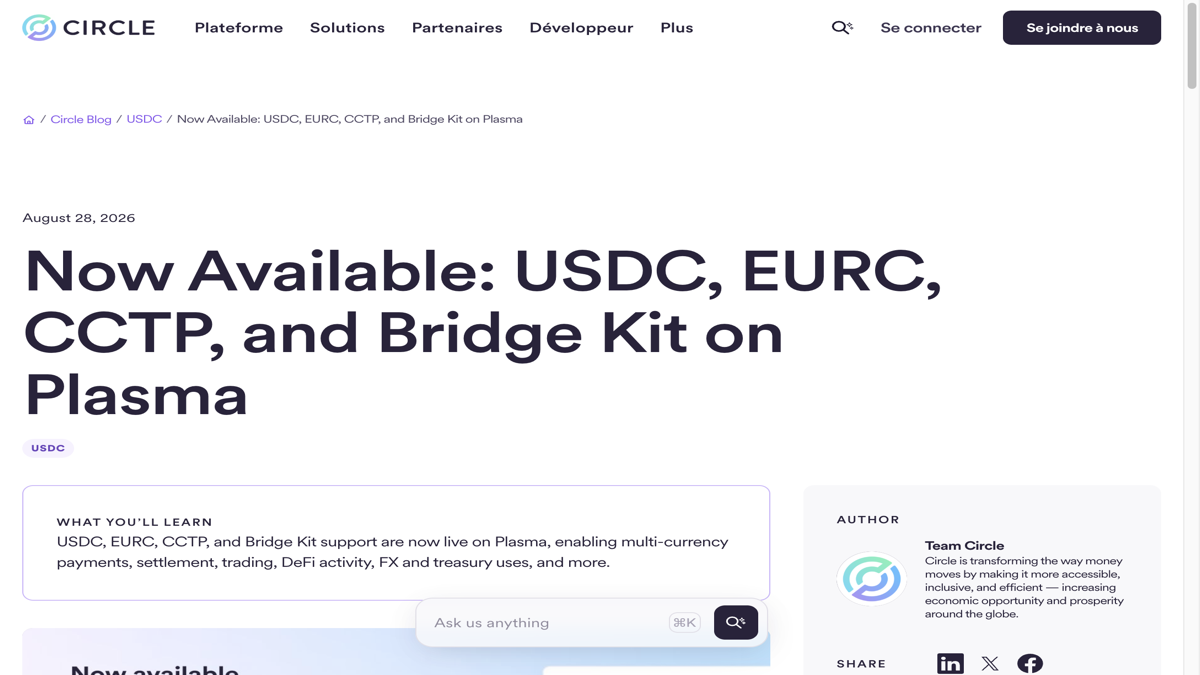


On August 28th, Circle announced that USDC, EURC, the cross-chain transfer protocol CCTP, and Bridge Kit have been launched on Plasma. Plasma is described as a EVM-compatible layer 1 network for high-throughput stablecoin applications; this launch enables developers and users to use the US dollar and euro stablecoins issued by Circle on this network, and allows USDC to interoperate with other supported networks through CCTP. The phrase "now available" in the announcement refers to the corresponding assets and infrastructure being launched, which does not mean that every exchange, wallet, payment institution, or institutional client has completed integration.
The Circle announced mainnet contract addresses for Plasma are USDC and EURC respectively, with the addresses being 0x2d661C89D812261039AF9764eceaAee884f5F67F and 0x3ee196e78d4d4248b849b8e1c7f44c5457fafd2c. For developers, these addresses are important landmarks for identifying official assets; however, ordinary users should not mistake any token with the same name for a native asset. Since assets with the same name on the chain, packaged assets, and phishing contracts have long existed, it is necessary to cross-check addresses, wallet displays, and the official supported network lists.
CCTP addresses interoperability issues, not all cross-chain risks.
Circle claims that CCTP allows USDC to move between networks and simplifies integration through Bridge Kit; the announcement mentions that institutional trading teams can use fiat currency for deposits and withdrawals, access to API capabilities, and developers can integrate cross-chain transfers in about ten lines of code. The focus here is on the protocol and tool capabilities, rather than any specific applications that already have a deep market. Whether cross-chain assets can be used smoothly is also affected by wallet support, front-end routing, exchange recharge rules, liquidity, compliance audits, and user experience.
It is also worth explaining the difference between native issued assets and packaged assets. One of the design goals of CCTP is to support cross-network transfers of USDC coordinated by the issuer's infrastructure, thereby reducing the need to rely on third-party packaged tokens; however, this does not automatically eliminate the risks that users face when bridging, signing, selecting networks, and identifying contracts. Developers still need to verify the chain ID, contract addresses, message status, and failure rollback; institutions also need to confirm account qualifications, regional availability, and the specific rules for fiat channels.
After it goes live, there are really four indicators that need to be closely monitored.
First is the actual distribution of native assets and the structure of their holders, second is whether trading and payment applications have achieved credible integration, third is the success rate, latency, and exception handling of the CCTP path, and fourth is the liquidity and price stability of the EURC and USDC trading pairs. The announcement mentions potential uses such as payment, settlement, remittance, trading, foreign exchange, and fund management; these represent the boundaries of capability rather than promised trading volumes. Any report that directly interprets "supportable" as "large-scale adoption" overlooks the critical verification process from deployment to actual use.
Circle also states that Circle Mint is aimed at institutions, while individuals and smaller organizations rely on exchanges, wallets, and service providers to access it; the services available to different users do not have to be the same. For the market, this launch indeed expands the native stablecoin infrastructure previously available on Plasma; however, whether a financial network on a single chain is truly established will depend on observing liquidity, user retention, compliance channels, and user costs after the launch. The implementation of infrastructure is just the starting point; it cannot be prematurely considered the endgame.
Technical integration also needs to distinguish between the availability of on-chain assets, official services, and one's own business capabilities. Wallets must correctly display assets, applications need to handle Gas, slippage, failed transactions, and cross-chain message statuses; risk control requires address whitelists, quotas, and alerts; payment products for users also need to handle refunds, customer service, and compliance issues. The list in Circle outlines the scope of capabilities but does not replace the security assessments conducted by each integrating party. Users should still verify network and contract addresses only from official documentation and should not transfer funds based on search advertisements, chat messages, or unknown token names.
For the Plasma ecosystem, the potential value of having both native USDC and EURC go live simultaneously lies in the ability to design transactions, settlements, and fund management denominated in US dollars and euros on the same infrastructure. However, "potential" does not equate to current scale; whether there is sufficient market making for these trading pairs, whether institutions are willing to migrate their balances over, and whether fiat channels cover the target markets all require subsequent on-chain and business data to prove. A more cautious observation period should cover at least changes in liquidity after launch, the success rate of cross-chain transfers, and application retention, rather than relying on the technical status on the day of the announcement to represent market outcomes.
For the development team, it is more prudent to first verify in the test environment and within controlled quotas, and then gradually open up the production path, rather than integrating all processes at once.
For any financial operations, it is still a more reliable basic principle to first conduct small-scale tests, confirm the payment network, and keep transaction records, rather than simply chasing the narrative of “just launched.”
Going live brings choices, but it also brings more paths that users need to confirm on their own; convenience should not be misunderstood as an exemption from verification responsibilities.
Native assets, cross-chain protocols, and application integrations must all be established separately to constitute a truly secure and usable complete experience for users.