

Grayscale research shows that Bitcoin's recent price performance is more closely aligned with that of gold, rather than high-growth tech stocks. As concerns over U.S. debt and fiscal deficits resurface, discussions about "currency devaluation trading" have heated up in the market, and Bitcoin's status as a scarce asset has once again come into the focus of investors.
Change in relevance over 90 days
A study released on August 27 by Grayscale stated that the 90-day correlation between Bitcoin and gold has risen to over 50%, whereas at the beginning of the year this indicator was close to zero. During the same period, the correlation between Bitcoin and the NASDAQ 100 index decreased from over 60% to around 33%.
This means that in recent times, the frequency of Bitcoin moving in tandem with gold has increased, while the correlation with large tech stocks has weakened. Zach Pandl, the head of Grayscale Research, believes that this may reflect the market's re-evaluation of Bitcoin, viewing it more as a scarce monetary asset rather than just a highly volatile tech trading target.
It should be noted that correlation reflects the common market trends over a certain period of time, and it does not imply that the two types of assets have the same characteristics in terms of returns, volatility, or drawdowns. Moreover, Grayscale has not directly equated the increase in U.S. debt with the subsequent trend of Bitcoin.
Nazi linkage falls back
Over the past year, driven by AI transactions, Bitcoin has benefited from improved liquidity and declining interest rate expectations, along with high-growth tech stocks. However, this linkage is now weakening.
Grayscale stated that the 90-day correlation between Bitcoin and the Nasdaq 100 has declined, indicating that its short-term trading logic no longer fully follows large tech stocks. The article mentioned that increased volatility in the bond market and investors re-evaluating the long-term borrowing costs in the United States are some of the factors contributing to this change.
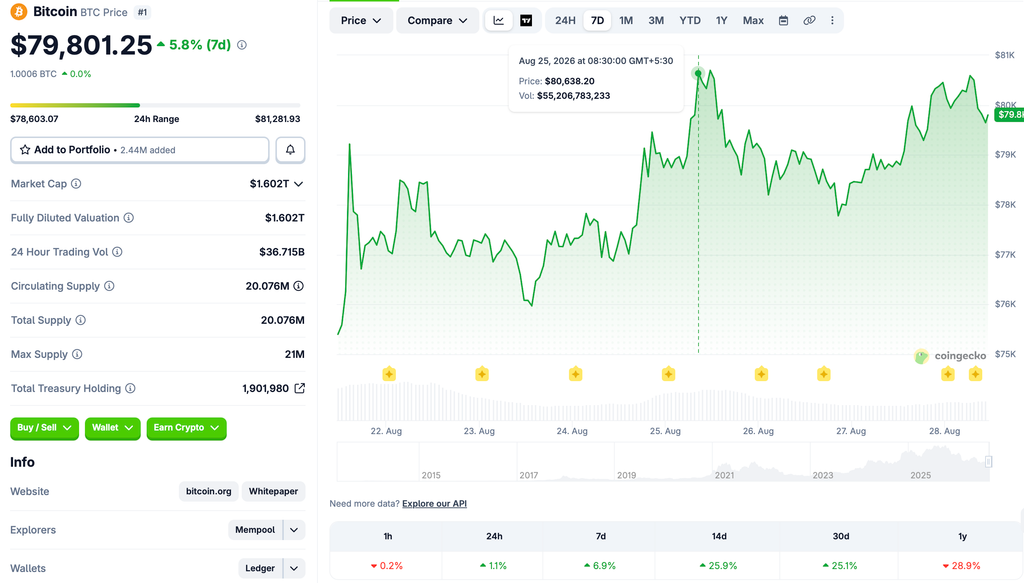
- On August 17th, Bitcoin was reported at around $62,679.
- On August 21st, the price rebounded to around $79,500.
- 5-day cumulative increase of approximately 27%
Previous reports have shown that this round of gains was also accompanied by factors such as adjustments in the repurchase operations by the US Treasury Department, strong demand for ETF in the spot market, short covering, and a weakening dollar. Therefore, it is difficult to attribute the market trend to a single macroeconomic variable.
However, Bitcoin later retracted some of its gains, which also indicates that even though its correlation with gold has increased, its short-term volatility remains significant.
Debt concerns drive trading of scarce assets
The so-called "currency devaluation trading" usually refers to the flow of funds towards assets that are considered to be able to withstand the decline in the purchasing power of fiat currencies. Gold has long played this role, while Bitcoin, with a maximum supply of 21 million coins, is seen by some market participants as a digital alternative.
According to data from the U.S. Treasury Department, the total debt of the U.S. federal government exceeded $40 trillion on August 18, reaching approximately $40.05 trillion, and further rose to around $40.10 trillion by August 25. The Congressional Budget Office predicts that the federal deficit for fiscal year 2026 will reach $1.9 trillion.
Grayscale believes that persistent deficits and higher long-term yields may prompt some investors to turn to scarce assets outside of the government monetary system. However, this judgment still falls within the realm of investment logic and does not imply that debt growth will automatically drive up the price of Bitcoin.
Next, what the market is more concerned about is whether the correlation between Bitcoin and gold can remain high over a longer period of time. Only if this indicator continues to be strong within the new 90-day observation window can it further indicate that there are ongoing changes in its trading characteristics.