
















After reaching $100, the focus of the market has shifted beyond just the price itself. Since August, SOL has seen a cumulative increase of over 40%, accompanied by multiple factors such as traditional securities firms getting involved, increased activity in related ETF in the United States, and the advancement of Solana governance proposals.
AXA Financial plans to expand trading access
Charles Schwab plans to incorporate Solana, Avalanche, and Chainlink into Schwab Crypto in the coming months. The platform has already been providing direct trading for Bitcoin and Ethereum since May, and adding SOL would mean that its coverage of digital assets will continue to expand.
The significance of this change is that SOL is now getting closer to investors within the traditional brokerage system, rather than relying solely on native cryptocurrency trading platforms. The article mentions that Jiaxin Financial Management manages assets worth over $12 trillion, with approximately 39 million active brokerage accounts.
US-related ETF active trading
In addition to brokerage channels, Solana related products in the U.S. market are also continuously attracting funds. The article states that such products have maintained a net inflow recently, indicating that institutional demand has not weakened.
- BSOL Sets a Record with a Daily Trading Volume of $126 Million
- The cumulative trading volume in the past 7 days is approximately 500 million US dollars.
- U.S. Solana related products maintain capital inflows
Among them, BSOL, which is pledged by ETF, recorded a daily trading volume of $126 million on August 27, with a cumulative trading volume of about $500 million over 7 days. For SOL, this indicates that the demand for trading and configuration in traditional markets is increasing.
Governance proposal aims for faster inflation reduction
While the demand side is heating up, the Solana community is also discussing the future supply rhythm. Verifiers are currently voting on two proposals: SGP-0002 and SGP-0003. The core focus is to accelerate inflation reduction and increase the amount of transaction-related fees that are destroyed.
According to the article, SGP-0002 plans to increase the annual inflation reduction rate from 15% to 30%, in order to more quickly approach a terminal inflation rate of 1.5%. If this plan is implemented, it is estimated that about 18.9 million new SOL will not be issued over the next six years.
SGP-0003 plans to introduce a fee mechanism based on resource usage and will directly destroy the related fees. Based on the current activity on the chain, SOL's daily destruction volume is expected to increase from about 600 to 800 to about 7,500 to 9,000.
$100 becomes a short-term observation level
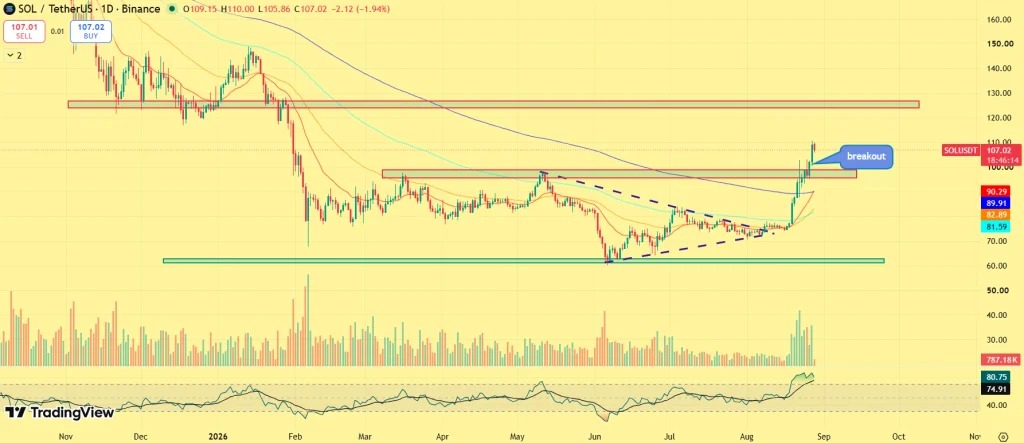
On the price front, SOL has previously broken through the resistance range of $78 to $79, then formed a higher support level around $92 to $97, and subsequently surpassed $100. The article argues that this gradual upward trend indicates that the buying momentum does not rely solely on a single rapid surge.
It is mentioned in the text that $105 to $110 is the current resistance zone. If the daily chart can remain above this range, the market may further focus on the $115 to $120 area. However, SOL has been rising rapidly recently, which also increases the pressure for short-term pullbacks. If it can still hold above $100 to $105 after a pullback, the rebound structure can generally be maintained; if it falls below $100 again, the market's focus may shift back to the $90 range.
Overall, the driving force behind this round of gains has shifted from mere price correction to a combination of "expanded capital inflows + ETF activity + tightening supply expectations." Whether SOL can turn the $100 level into a stable support will become the focus of market attention in the next phase.