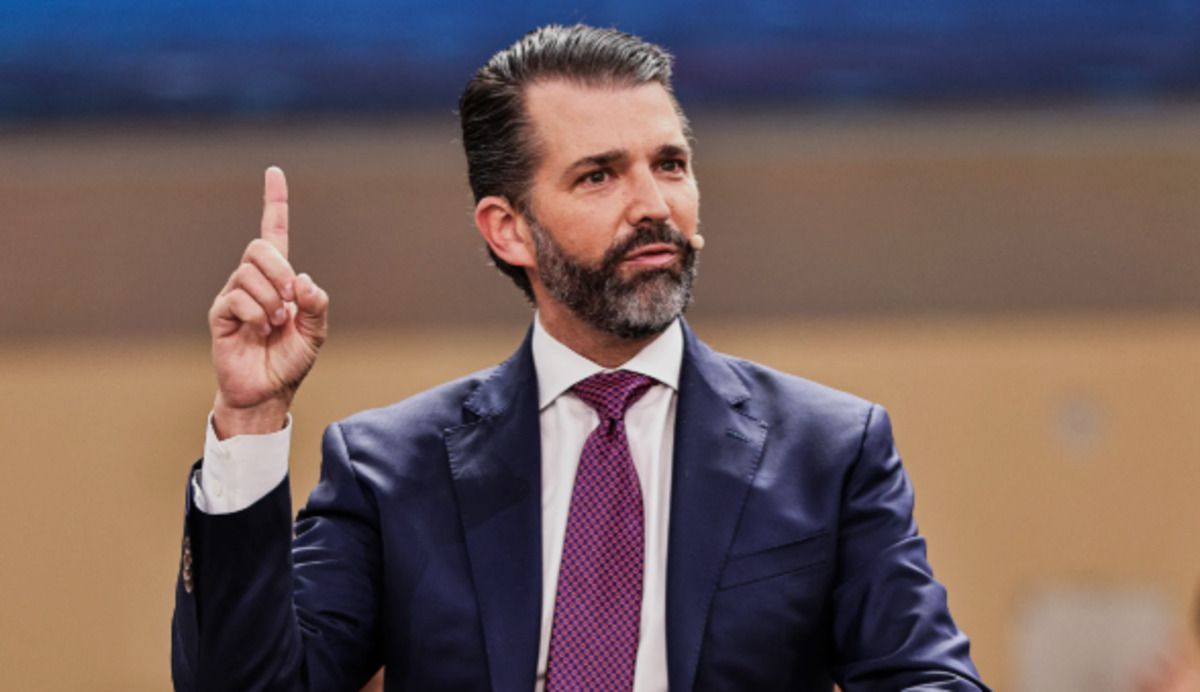


According to The New York Times, Trump's eldest son Donald Trump Jr stated earlier this year at a Republican Attorneys General Association event that states should cease pursuing prediction market platforms. This statement has drawn attention because Kalshi and Polymarket are facing legal pressure in multiple states in the United States, and federal regulatory agencies have also become involved, competing for regulatory authority over such platforms.
In contact with both platforms
It was reported that Donald Trump Jr stated at an event held in New Orleans in March that some state governments were being influenced by gambling companies, which were attempting to maintain their own “monopoly positions.” He believed that the gambling market should be regulated at the federal level, rather than being handled on a state-by-state basis.
This statement has drawn external attention because he has connections with two major market forecasting operators. He currently serves as an advisor for Kalshi, and his venture capital firm, 1789 Capital, has also invested in Polymarket. In addition, he holds a position on the advisory board of Polymarket. Kalshi stated that his role within the company is mainly related to marketing and does not involve regulatory affairs.
Multiple states sue Kalshi and Polymarket
The controversy surrounding the prediction market has shifted from political statements to judicial actions. In March, the Attorney General of Arizona, Kris Mayes, filed 20 criminal charges against Kalshi, accusing him of operating an unlicensed gambling business and illegally providing betting services related to elections, including the 2026 Arizona Governor's election and the 2028 presidential election.
Massachusetts has also taken measures. In January of this year, a local court issued a preliminary injunction requiring Kalshi not to provide sports event contracts to users in the state until it complies with the state's sports betting laws and licensing requirements.
New York State joined the lawsuit in July, accusing Kalshi's prediction market of being an illegal and unlicensed gambling business. The state government also argued that Kalshi allowed users aged 18 to 20 to participate, while New York State has a minimum age requirement of 21 for participants in sports betting.
Kentucky has listed companies such as Kalshi and Polymarket as targets for enforcement, considering their sports event contracts to essentially constitute unauthorized sports betting.
CFTC advocates for exclusive federal regulation
The position of the Commodity Futures Trading Commission (CFTC) of the United States is significantly different from that of the individual states. The agency believes that prediction market exchanges that are already registered at the federal level should be under its exclusive jurisdiction for regulation. To prevent states from using gambling laws to regulate events contracts that are under federal supervision, the CFTC has taken legal action in states such as Arizona, Connecticut, Illinois, Wisconsin, New York, Minnesota, Rhode Island, New Mexico, and Kentucky.
However, the states did not accept this claim. An alliance composed of 44 state attorneys general wrote to CFTC in July, stating that the organization had no authority to essentially take over sports betting affairs by predicting market regulation.
This disagreement will directly affect the way the US predictive market industry operates. If federal regulation prevails, a unified framework may be applied nationwide; if state positions gain the upper hand, operators will face different gambling laws, licensing requirements, and business restrictions from state to state.