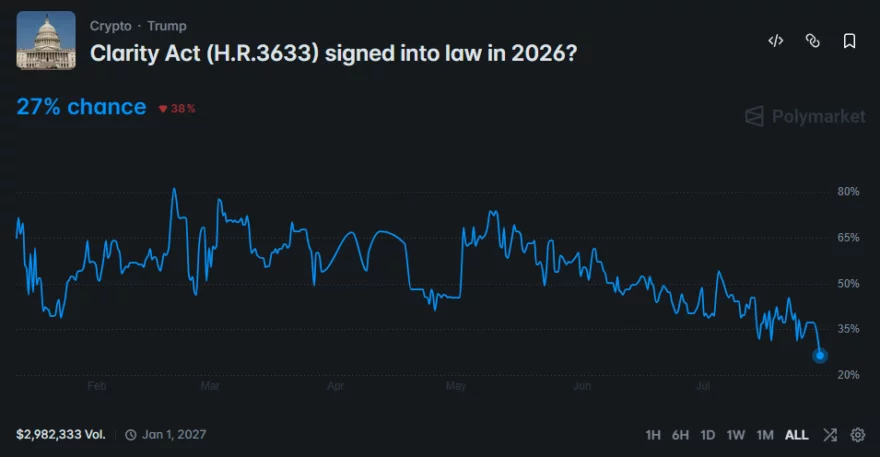


Foreign media commentators argue that if the US Senate passes the CLARITY bill, the market should not view it as the end of regulation, but rather as the beginning of the implementation phase. The article suggests that the bill will proceed at two completely different paces: some provisions will take effect immediately upon the president's signature, while others will await the completion of subsequent rule-making by the Securities and Exchange Commission (SEC) and the Commodity Futures Trading Commission (CFTC).
Terms effective immediately
The article points out that the most attention-grabbing aspect is the "grandfather clause" related to exchange-traded products. According to the draft merger proposal, if a token is already the principal asset of an ETP listed on a national securities exchange in the United States on January 1, 2026, that token will be legally recognized as a non-security. Based on this, the commentary suggests that tokens such as XRP, SOL, and DOGE, which are expected to be included in ETFs or similar products by the end of 2025, may receive a clearer legal status on the day the bill takes effect.
Besides token classification, protections for non-custodial software developers are also considered "signature-based." The article states that these provisions don't rely on additional forms, review procedures, or enforcement rules, but directly alter the scope of the law. Meanwhile, if the bill explicitly places certain digital goods activities under federal jurisdiction, conflicting state-level regulatory arrangements could also become ineffective on the same day.
We still need to wait for the regulatory details.
However, the article argues that the "regulatory clarity" the industry truly anticipates is mostly not in the immediately effective parts, but in subsequent rules. These include self-certification processes, registration of digital commodity exchanges and brokers, disclosure of affiliated asset information, standards for encrypted terminals, and custody requirements, all of which require the SEC and CFTC to develop separate operational guidelines.
The commentary states that while the bill will include principles such as a "60-day window," the market's more pressing concerns—such as what certification materials should include, how to determine the proportion of control, and whether certifications remain valid after being challenged—will all require regulatory agencies to complete the necessary procedures. In other words, the bill provides a framework, but the truly enforceable system still depends on subsequent rule texts, forms, and review processes.
The article also mentions that new categories such as digital commodity exchanges, brokers, dealers, and custodians, even if included in the legislation, are only legally defined at the outset. These categories will only become truly operational once the CFTC establishes registration forms, capital requirements, custody standards, and inspection mechanisms.
Market expectations and implementation speed may be misaligned.
The article summarizes this difference in implementation as a misalignment between the "speed of signing" and the "speed of regulation." Commentators believe that the market may quickly price in the passage of the bill, but deeper changes such as new listings on trading platforms, institutional allocation, and expanded financing channels will not all emerge on the next trading day.
The article also cites the GENIUS Act as a reference. This act, passed in July 2025, requires relevant agencies to finalize stablecoin implementation rules within a year. However, as of July this year, the Treasury Department, the Federal Reserve, the Office of the Comptroller of the Currency, and the Federal Deposit Insurance Corporation have still not submitted their final rules by the deadline. The commentary argues that the CLARITY Act involves a heavier workload, and given the current shortage of personnel at the CFTC, the implementation period may be longer.
Therefore, the core judgment of this commentary is that if CLARITY is passed, the market will first see a few provisions that immediately change the legal status and regulatory affiliation of tokens; however, key aspects such as exchange registration, information disclosure, and compliance frameworks will still have to wait for the progress of rule-making by the SEC and CFTC.