















Goldman Sachs CEO David Solomon expressed support for pushing forward the CLARITY Act, the U.S. crypto market structure bill. While acknowledging the bill's imperfections, he believes the legislation will help establish a more stable regulatory framework for the digital asset industry and allow the market to develop under clearer rules.
The Senate may vote next week.
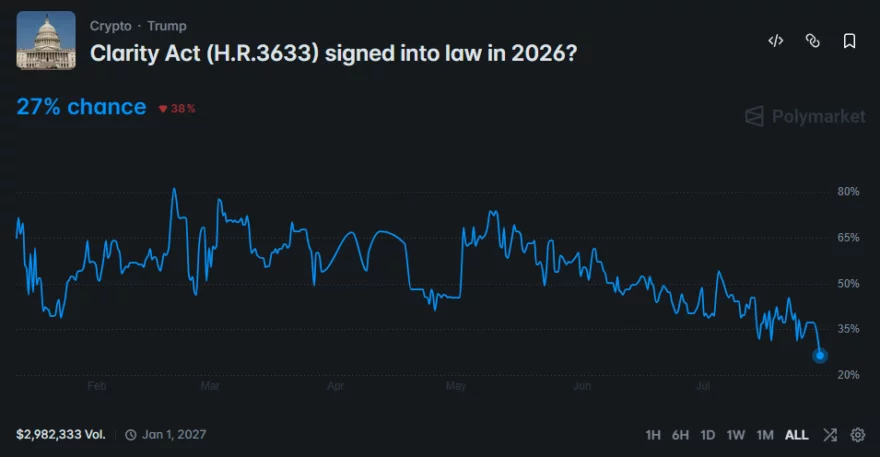
Solomon made the remarks during an interview with Polit's token launch. The news comes as Republican senators are distributing an updated text of the bill, with a full Senate vote potentially possible as early as next week. This signifies that the long-awaited legislation on the US crypto market structure is moving towards its next step.
He stated that one of the most important functions of the Clarity Act is to create a more level playing field in the market and enhance overall stability. He also expressed his hope that the market structure rules would be implemented as soon as possible to promote the continued development of related innovations.
The banking sector is increasingly divided on stablecoin terms.
Salomon's stance contrasts sharply with that of some senior executives at major banks. JPMorgan Chase CEO Jamie Dimon and others have recently criticized certain stablecoin provisions in the bill, particularly opposing allowing crypto companies to offer yield-bearing stablecoin products.
The banking industry's core concern is that these products, while functionally similar to bank deposits, may not be subject to the same regulatory requirements as banks. If these arrangements are implemented, traditional banks may face more direct competition in attracting deposits and offering cash-like products.
JPMorgan Chase previously stated in a blog post that encryption legislation should fill regulatory gaps, not create new regulatory disparities. The bank believes that any institution offering functions similar to traditional bank accounts should bear similar regulatory and consumer protection responsibilities.
The focus of the controversy lies in stablecoins with yield.
The debate surrounding stablecoin reward mechanisms has become one of the major sticking points in the negotiations for the Clarity Act. Supporters argue that stablecoin products can improve the efficiency of payments and the use of funds; opponents worry that this could allow non-bank institutions to provide deposit-like services without equivalent constraints.
Coinbase CEO Brian Armstrong previously stated that the banking industry is lobbying lawmakers to limit stablecoin rewards because it would impact banks' deposit-dependent business model. Bank executives responded that if crypto companies' products increasingly resemble banking services, they should be subject to similar regulation.

According to current descriptions, the CLARITY Act aims to clarify the division of responsibilities between the U.S. Securities and Exchange Commission (SEC) and the Commodity Futures Trading Commission (CFTC) in regulating digital assets. Members of Congress are still deliberating on provisions regarding stablecoin issuers, consumer protection, and yield-bearing products.