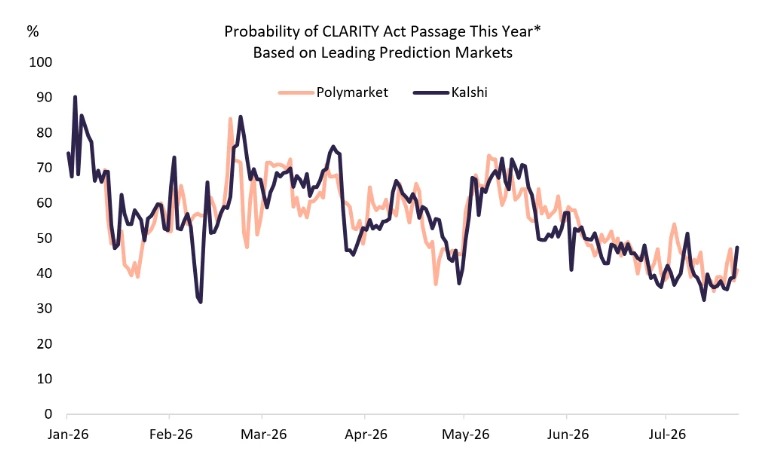


Foreign media reports that three major U.S. crypto industry organizations are pressuring the Senate to expedite the CLARITY bill. The article argues that if this bill clarifies the regulatory distinction between digital assets as securities and commodities, it could reduce compliance uncertainty for XRP in the U.S. market.
Industry organizations jointly pressured the Senate
The report mentions that the Digital Chamber, the Chamber of Digital Commerce, and the Blockchain Association have jointly called on Senate leadership to accelerate the legislative process. Their core argument is that if the United States fails to establish a clear digital asset market structure, funds and businesses may continue to flow to jurisdictions with more clearly defined regulations.
The article interprets this trend as the U.S. crypto industry striving for more unified federal rules, rather than simply engaging in negotiations around individual law enforcement cases.
The article argues that XRP is still hampered by unclear rules.
The article states that while Ripple's long-standing legal dispute with the U.S. Securities and Exchange Commission has largely subsided, the broader market still lacks a unified standard to define which digital assets should be regulated as securities and which are closer to commodity attributes. This ambiguity has led many institutional investors to remain cautious about related products.
Based on this assessment, XRP is considered one of the assets most significantly affected. The article argues that once the rules are clearer, banks, payment service providers, asset management institutions, and investment companies will face lower legal risks when designing XRP-related products, and long-term investments will be easier to implement.
Ripple's business may benefit from XRPL simultaneously.
The article also mentions that Ripple's business in recent years has expanded beyond cross-border payments to include the stablecoin RLUSD, digital asset custody, tokenization, and enterprise-grade blockchain infrastructure. A more stable regulatory environment may reduce financial institutions' concerns about adopting these products.
Regarding the XRP Ledger, the article argues that a clearer regulatory environment could also drive increased investment from developers and businesses, including deploying DeFi applications, tokenizing real-world assets, and other financial products. Increased activity in this area could lead to a expansion of on-chain activity and XRP's use cases.
The scope of institutional participation may be further expanded.
The article further points out that if the Market Structure Act is passed, exchanges, custodians, brokers, and ETF issuers may have greater certainty when expanding XRP-related services. This will open more channels for institutional funds to enter the relevant ecosystem.
However, this article is essentially an opinion-based analysis. Its core judgment is that the significance of the CLARITY Act for XRP lies not only in a single compliance issue, but also in whether it can provide a more stable institutional environment for the Ripple ecosystem and XRP Ledger, thereby promoting institutional adoption.