

NEAR has recently garnered market attention, not only due to price volatility but also because of a potential significant adjustment to its token model. NEAR founder Illia Polosukhin has proposed changing the existing inflationary issuance mechanism to a fixed-supply model. If this proposal is adopted and passes governance, NEAR will no longer rely on continuous issuance to reward validators.
The founder proposed to eliminate annual inflation.
Under the current design, NEAR issues approximately 2.4% new tokens annually to reward validators. The new proposal aims to eliminate this continuous issuance and instead use the protocol's actual revenue to pay validators.
This means that the supply cap of NEAR tokens will tend to be fixed. For token holders, the value brought by network growth will theoretically be reflected more directly in existing tokens, rather than being continuously diluted by new issuances.
However, this adjustment is still in the community discussion stage and has not yet been officially implemented. The market's focus is on whether NEAR will become one of the few projects in mainstream Layer 1 networks that explicitly promotes a fixed supply model.
On-chain funds and activity levels remained stable.
Besides governance proposals, NEAR's ecosystem data is also a key factor supporting its popularity. The article mentions that the network currently has a total locked value exceeding $150 million and stablecoin liquidity exceeding $110 million, indicating relatively stable capital participation within the ecosystem.
Meanwhile, NEAR's daily active addresses, decentralized transaction activity, and application usage have remained resilient. Even during periods of overall market volatility, its on-chain performance did not show any significant slowdown.
This type of data is often seen as a direct indicator of a public blockchain's fundamentals. Compared to rebounds driven solely by sentiment, stable on-chain activity is more easily interpreted by the market as a sign that the ecosystem remains sustainable.
The market is focused on whether governance and fundamentals can resonate together.
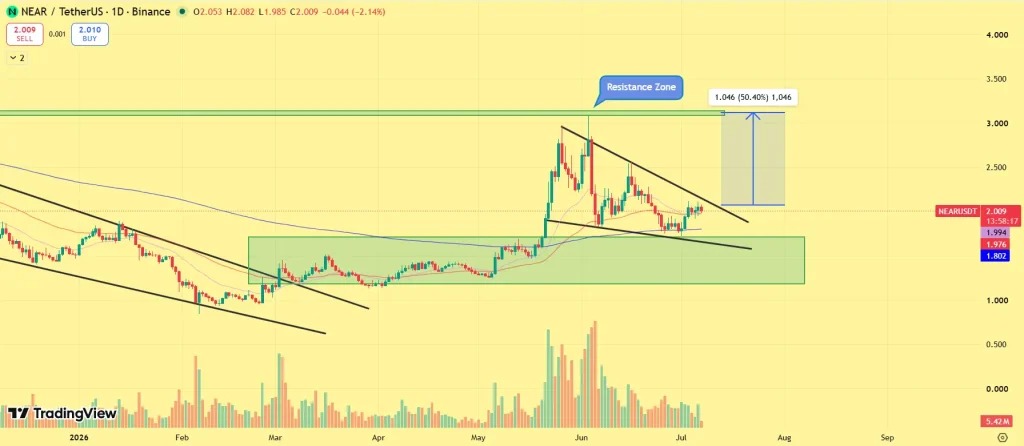
The article argues that NEAR is currently attracting attention primarily because of two simultaneous trends: first, the proposed fixed supply could alter the long-term token economic structure; and second, on-chain funds and user activity have not shown significant signs of weakening.
If subsequent governance discussions continue and ecosystem data remains stable, NEAR is likely to remain one of the key projects to watch in the Layer 1 sector in the second half of the year. More than short-term sentiment fluctuations, the market is more concerned with whether these token model adjustments can truly translate into long-term value support.