

As the conflict with Iran continues to escalate, a rare "pricing split" is unfolding in global financial markets.
According to TrendFocus, Deutsche Bank macro strategist Henry Allen pointed out in a report released on May 7 that significant and contradictory pricing logics have emerged between different asset classes, and these misalignments may indicate that there is a risk of market correction.
Since the outbreak of the Iranian conflict, the oil price shock has triggered rising inflation expectations and a hawkish repricing of central bank policies. However, the stock market has diverged significantly from the interest rate market – the S&P 500 has returned to historical highs, and credit spreads have even narrowed compared to before the conflict. Meanwhile, market confidence in long-term inflation anchoring remains exceptionally strong, despite US PCE inflation having exceeded the Fed's target for five consecutive years.
The aforementioned four market misalignments are particularly pronounced in the current environment and warrant close attention from investors. The report argues that these abnormal pricing practices are logically inconsistent, and some assets face downward pressure to correct.
Stock-bond divergence: Stock market "ignores" oil price shock
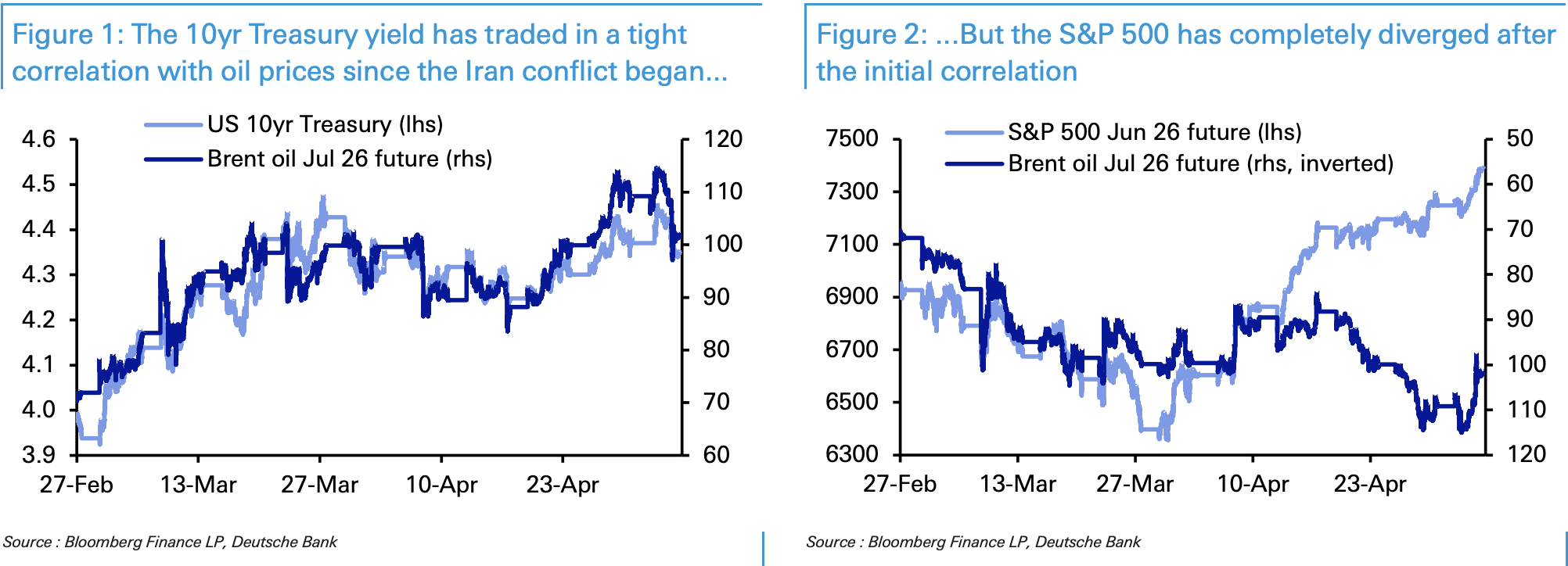
In the early stages of the conflict, oil prices, bonds, and stocks moved in a highly synchronized manner, exhibiting a consistent risk pricing logic. However, since mid-April, a clear divergence has emerged between the stock market and oil prices and interest rates.
The 10-year U.S. Treasury yield has remained closely linked to Brent crude oil prices since the outbreak of the conflict, reflecting the market's full pricing of the oil price shock and its inflationary consequences. However, the S&P 500 has completely decoupled from this correlation, climbing back to record highs.
This divergence is not unique to the US market. European stock markets are showing a similar trend, with the STOXX 600 index currently only 1.7% below its all-time high, a stark contrast to the major indices that entered a bear market in 2022. Some argue that US tech earnings reports have changed the market landscape, but this explanation is incomplete—European stock markets, with greater exposure to energy shocks, have also exhibited a similar divergence.
The current contradiction lies in:The interest rate market is pricing in the oil price shock and its inflationary consequences, while the stock market sees it as a temporary shock and chooses to ignore it; neither can be right at the same time.
Central bank pricing: European interest rate hike expectations contradict fundamentals
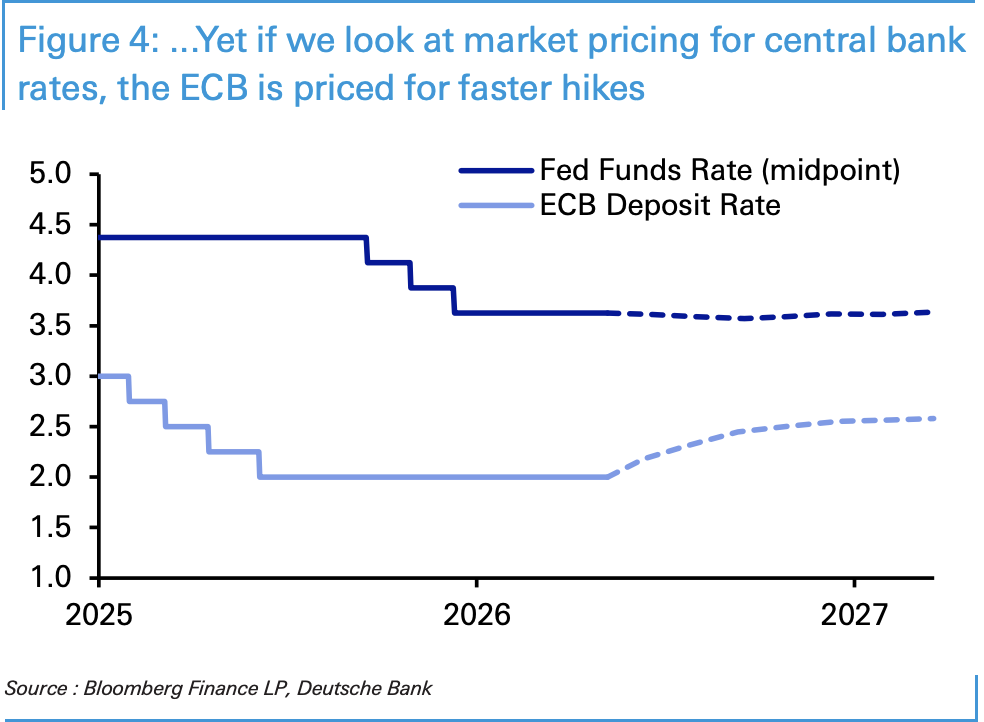
Another significant misalignment exists between the policy expectations of the Federal Reserve and the European Central Bank.
Interest rate futures are currently pricing in a near-perfect hold by the Federal Reserve over the next 12 months, implying only a 2-basis-point rate hike by March 2027. In contrast, the market is pricing in the European Central Bank in a completely different scenario – two 25-basis-point rate hikes are fully priced in by March 2027, with an implied probability of a third hike of about one-third, totaling 59 basis points.
This pricing strategy is fundamentally untenable. US core PCE inflation reached 3.2% in March, while the Eurozone's core CPI was 2.3% in the same period, with the initial April figure further declining to 2.2%. Meanwhile, the US economy is growing significantly faster than the Eurozone, with recent non-farm payroll data showing its strongest performance in 15 months, and the unemployment rate remaining largely stable.
The report points out that against the backdrop of stronger growth and higher core inflation in the United States,The market, however, is pricing in multiple rate hikes by the European Central Bank while the Federal Reserve has paused its rate hikes for an extended period, a combination that is logically difficult to justify.
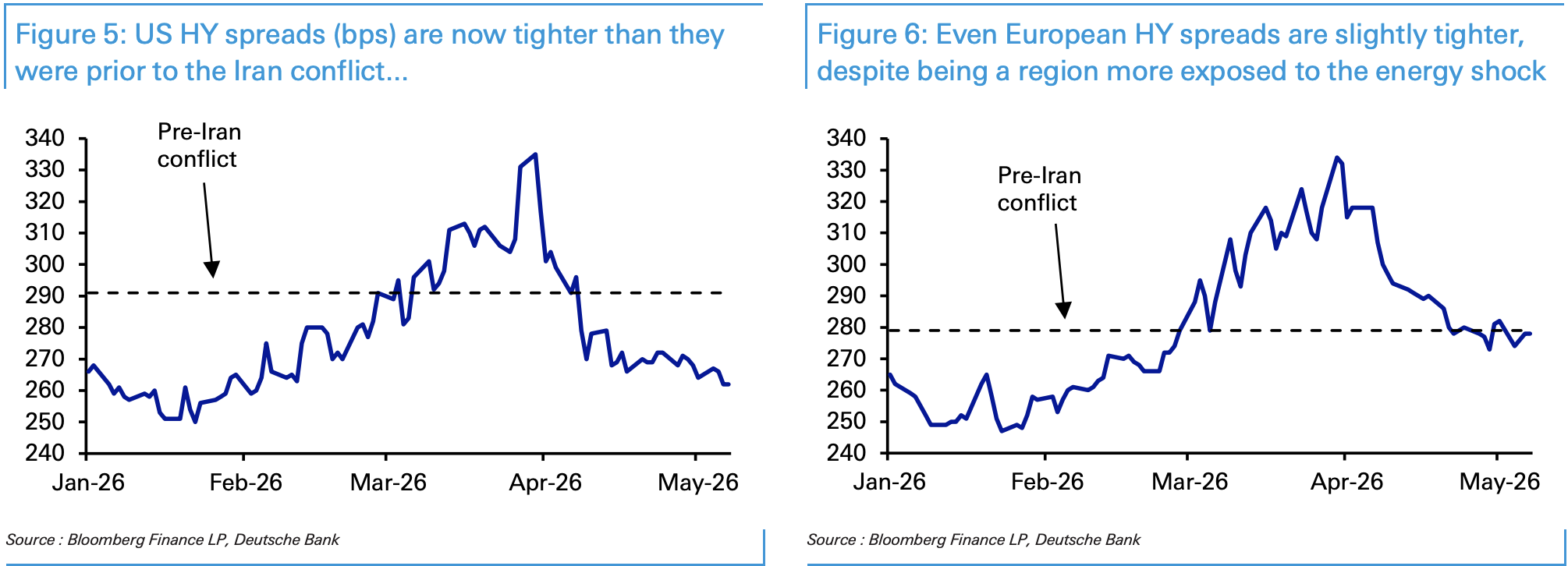
Credit spreads narrowed despite energy shocks.
The performance of the credit market is equally perplexing. Under multiple pressures from the energy shock, downward revisions in growth expectations, and a hawkish shift in central bank policy, high-yield (HY) and investment-grade (IG) credit spreads in the US and Europe have not only failed to widen, but have actually narrowed compared to before the conflict.
Even before news of positive developments in the Iranian conflict emerged, credit spreads were already below pre-conflict levels. This phenomenon was particularly pronounced in Europe—high-yield spreads also narrowed, despite the region's greater exposure to rising energy prices and more direct impact from growth shocks.
The report believes that,If investors knew in advance that an energy shock, downward revisions to growth expectations, and a shift towards a hawkish stance by central banks would occur, their reasonable expectation would be a widening of credit spreads, as was the case in 2022. However, the current market trend is completely contrary to this expectation, and this divergence is difficult to explain using fundamental logic.
Long-term inflation expectations: Market confidence may be overly optimistic.
The fourth misalignment is perhaps the most profound: the market's confidence in the long-term return to the inflation target appears exceptionally firm in the current environment.
The Eurozone's 5-year/5-year forward inflation swaps (i.e., 5-year inflation expectations starting 5 years from now) are currently at 2.16%, while the US benchmark is 2.41%. Both are within 10 basis points of pre-conflict levels, indicating that the market believes long-term inflation will remain stably anchored near the target.
However, this confidence faces multiple challenges. US PCE inflation has been above the Federal Reserve's 2% target for five consecutive years, and the Eurozone's core CPI has been above 2% for 4.5 years. The latest energy shock means that the period of inflation exceeding the target will be further prolonged.
The report also cites a longer-term historical perspective: since the collapse of the Bretton Woods system in 1971, no country in the world has been able to maintain an average inflation rate below 2% for an extended period.Against this historical backdrop, the market's high level of confidence in inflation anchoring may itself be a misalignment that needs to be examined.