


A committee of the U.S. House of Representatives has advanced a bill that could lock up government-held Bitcoin for 20 years.
H.R. 8957 will prohibit the sale, exchange, or auction of Bitcoin in reserves within two years; however, the original text states 20 years.
After the release of this news, and with the advancement of the Strategic Bitcoin Reserves Act, Bitcoin rose by more than 4%.
The House Financial Services Committee advanced a bill proposing to establish a strategic Bitcoin reserve, which led to a price increase of over 4% for Bitcoin. After briefly approaching $57,339, the price rose above $61,000. BTC
At the same time, inflation in the United States PCE is higher than expected, which has also intensified market concerns about the Federal Reserve's potential for another interest rate hike in December.
House Committee Advances Bitcoin Reserve Bill
The House Financial Services Committee has advanced H.R.8957, namely the '2026 United States Reserve Modernization Act', which was proposed by Representative Nicholas J. Begich. The purpose of this act is to utilize Bitcoin obtained through criminal and civil asset forfeiture to establish a strategic Bitcoin reserve.
The bill was passed by the committee on November 24 with a vote of 28 to 21 and has been placed on the joint agenda, awaiting possible voting by the House of Representatives. The U.S. government currently holds approximately 306,800 to 328,000 BTC, most of which were obtained through asset forfeiture.
According to this bill, the government is not allowed to sell, exchange, or auction its reserve of Bitcoin for at least 20 years, nor may it use it as collateral. The bill also excludes the possibility of purchasing more BTC through borrowing or by imposing new taxes.
The earlier proposal to purchase up to 1 million BTC units has been deleted.
In its place, the Ministry of Finance and the Ministry of Commerce must study how to obtain more Bitcoin within 180 days without using new taxes or debt.
The bill faces dual obstacles from the House of Representatives and the Senate.
The strategic Bitcoin reserve currently exists in accordance with President Trump's executive order from March 2025, and future presidents may revoke that executive order. If the bill is passed by both houses of Congress, it will enshrine this reserve in federal law, granting it a more permanent legal status.
The bill has now entered the joint agenda, which means that the leadership of the House of Representatives can arrange a full-house vote during the remaining lame-duck session. As of yet, no voting date has been announced.
Even if the House of Representatives approves the bill in December, it still needs to pass the Senate before Congress concludes on January 3, 2027.
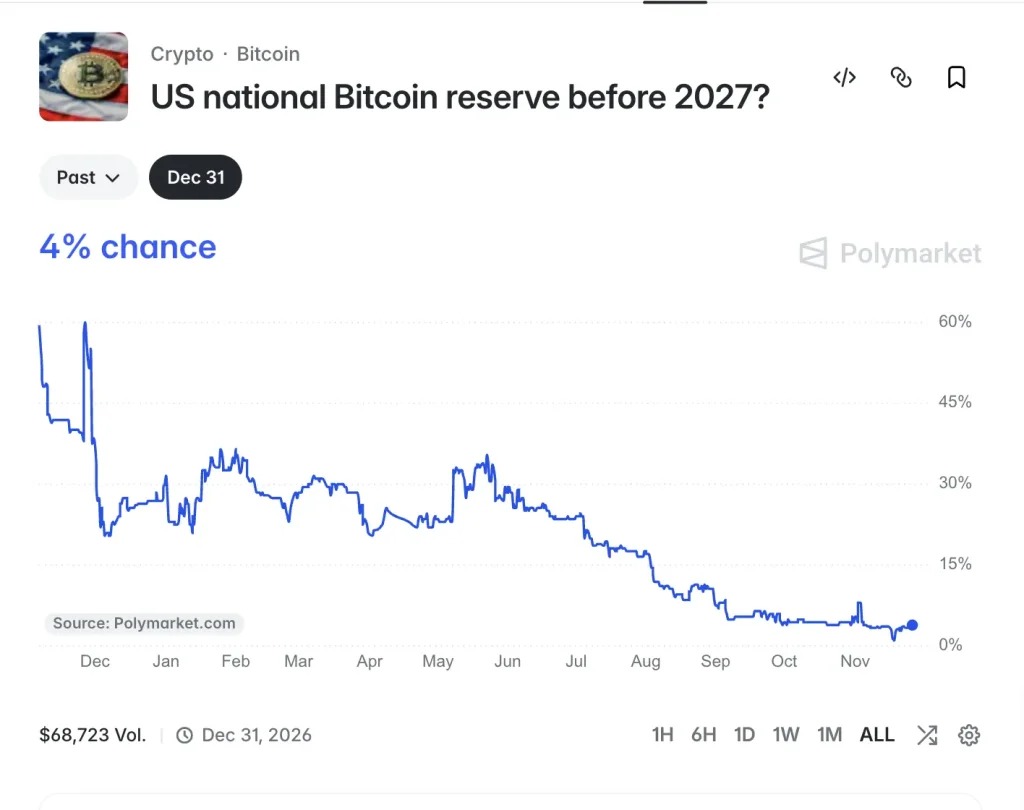
The Senate's schedule at the end of the year is crowded, including spending bills and other bills that must be passed, leaving limited time for a separate bill on encryption.
At the same time, trader Polymarket believes that the probability of the United States enshrining Bitcoin reserves in law before 2027 is less than 4%.
Bitcoin recorded a 4% increase on the occasion of PCE data heat
Bitcoin price reacted quickly, rising by more than 4% to once again exceed $61,000.
Despite the relatively high inflation data in the United States PCE, this round of price increases still occurred. Data released on November 25th PCE showed that the overall inflation rate rose from 3.6% to 3.8%, and the core PCE inflation rate increased from 3.1% to 3.3%, exceeding the expected 3.2%.
Higher inflation data has pushed the market's expectation of the Federal Reserve raising interest rates by 25 basis points in December to 99%.