


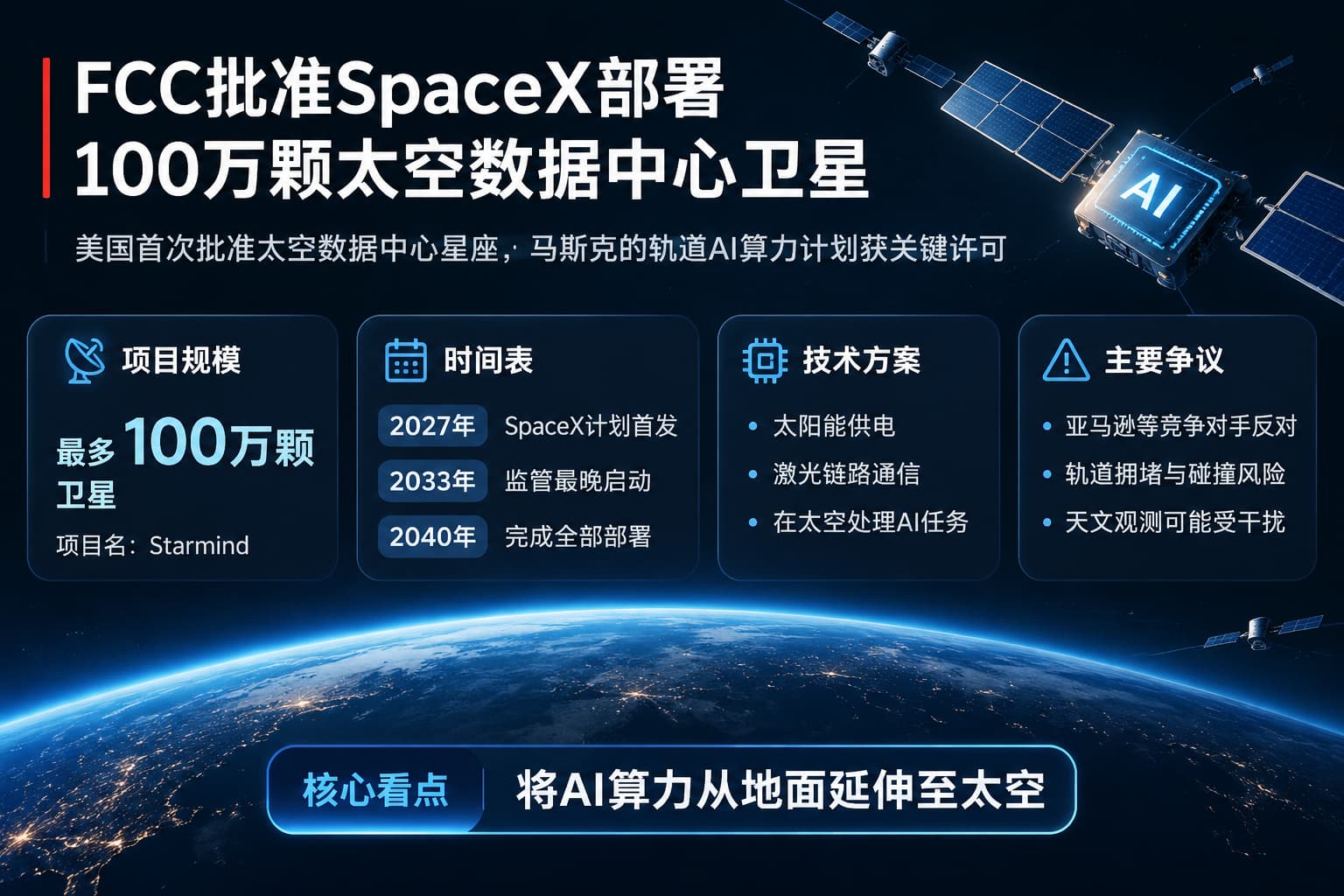
On Wednesday local time, the US Federal Communications Commission ( FCC ) approved the deployment of up to 1 million satellites by SpaceX to form a space data center constellation named “ Starmind ” in low Earth orbit.
This is the first time the United States has approved such a space data center project, indicating that Musk's plan to extend artificial intelligence computing infrastructure into space has overcome a key regulatory hurdle.
According to the authorization decision published by FCC, SpaceX is required to deploy at least one satellite by November 2033, reach 10% of the approved scale by 2035, 50% by 2038, and complete all deployments by November 2040.
As previously mentioned by SpaceX ( SPCX.O ), there is a hope to launch the first batch of space data center satellites in 2027, which is about six years earlier than the latest start time permitted by regulations.
Chairman Brendan Carr ( Brendan Carr ) stated that this approval will boost the United States' leadership in the fields of artificial intelligence and space. Musk, on the social media platform X, responded that this will become an important asset for the United States and the whole world.
Solar-powered, with satellites undertaking the AI computing tasks
SpaceX plans to build Starmind into a distributed data center network composed of numerous orbital computing modules. Each satellite will be equipped with computing devices to process artificial intelligence tasks in space and then transmit the results back to Earth.
According to the application documents previously submitted by SpaceX to FCC, this system will primarily rely on solar power for energy. The satellite generates electricity from solar energy and releases the heat produced by its computing devices into space through thermal radiation, thereby reducing the dependence on electricity and water resources required by ground data centers.
In terms of communication, the Starmind satellites will be interconnected via laser links and will work in conjunction with the existing Starlink (Starlink) network of SpaceX, transmitting the processed data back to Earth. FCC has also approved the use of radio frequency links by SpaceX as a backup communication method for emergency telemetry, tracking, and command transmission.
SpaceX believes that as the demand for artificial intelligence model training and inference continues to grow, on-ground data centers face limitations in terms of power supply, land, and cooling resources. By deploying computing infrastructure in orbit, we can take advantage of the continuous solar energy available there, thereby reducing our dependence on on-ground energy systems.
Space data centers are also an important part of SpaceX's future artificial intelligence business strategy. Previously, in June during the IPO process, the company had already incorporated the concept of space computing power into its long-term growth narrative.
The 1 million satellite plan faces opposition from the astronomical community and competitors
The approval of FCC has not dispelled the external controversy surrounding this plan.
According to reports from The Associated Press, the application for SpaceX received over 1,500 public comments. Amazon's satellite business Kuiper Systems, satellite communications company Viasat, and the American Astronomical Society (AAS) have all requested that FCC reject this application.
Previously, in its comments submitted to FCC, Amazon described the Starmind project as a grand vision rather than a practical plan with sufficient detailed support, and questioned whether SpaceX could complete such a large-scale satellite deployment as envisioned.
The main concerns in the astronomical community focus on the congestion of low Earth orbit and the interference with ground-based astronomical observations. The American Astronomical Society states that a large number of larger satellites may create more noticeable light pollution in the night sky, affecting both astronomers' and the public's ability to observe the night sky.
In addition, large-scale satellite deployment may also increase the risk of orbital collisions. Once a collision occurs, the resulting debris could further trigger a chain reaction of collisions, posing a threat to other communication, meteorological, and scientific research satellites.
Astrophysicist and author Adam Becker ( Adam Becker ) told The Associated Press that the idea of launching one million satellites to build a space data center is almost fanciful. He pointed out that although space has advantages in accessing solar energy, the vacuum environment also poses complex physical limitations to device cooling, and the design and deployment costs of related hardware could be very high.
FCC stated in the authorization decision that the opinions submitted by the public had been taken into consideration, and that the project was deemed to be in the public interest. Regarding issues such as environmental impact and optical astronomical observations, the regulatory authorities believed that some aspects exceeded the scope of their jurisdiction for this approval.
There are still multiple hurdles from regulatory approval to actual deployment.
This approval provides a regulatory basis for SpaceX to advance Starmind, however, the deployment scale of 1 million satellites poses extremely high requirements for manufacturing and launch capabilities.
According to the licensing arrangement, SpaceX is required to complete the deployment of the first satellite by November 2033, followed by achieving 10% and 50% deployment rates in 2035 and 2038 respectively, with the entire constellation construction to be completed by 2040. If any of these milestones are not met, the license will become invalid.
SpaceX hopes to launch the first batch of satellites in 2027, which means the company needs to advance satellite manufacturing, integration of computing equipment, and preparations for orbital deployment in the coming year or so.
Space data centers also face technical challenges such as launch costs, equipment cooling, orbital debris management, and the disposal of retired satellites. For such a large constellation, a bottleneck in any one of these areas could affect the overall deployment progress.
Meanwhile, the space data center track has also attracted other tech companies to participate. Google is advancing Project Suncatcher, exploring the deployment of artificial intelligence chips in space; Jeff Bezos' Blue Origin (Blue Origin) has also applied to FCC to deploy up to 51,600 satellites, in order to build its own orbital data center constellation.
FCC indicates that the review of applications for space data centers submitted by other companies is ongoing, and it is planned to proceed with related decisions according to the regular procedures.