

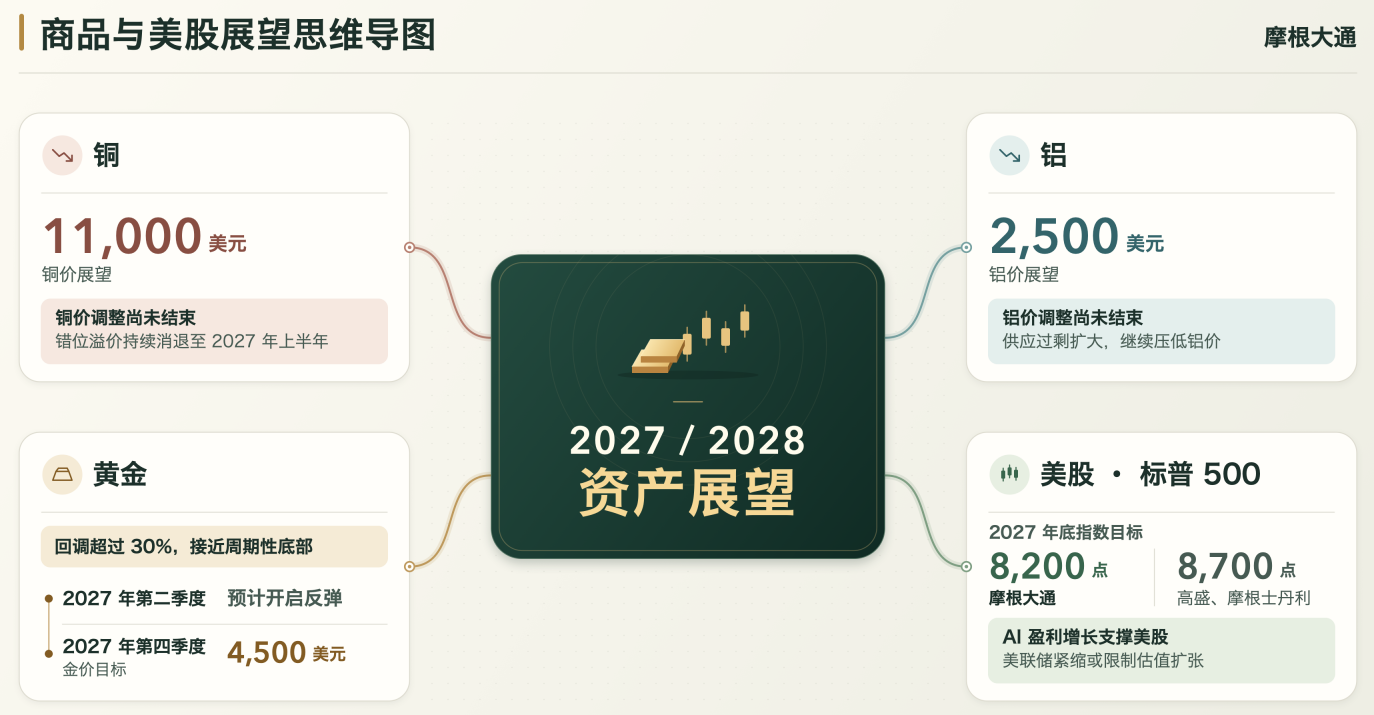
In its latest report on the metal market outlook and U.S. stock strategy for 2027/2028, JPMorgan Chase made different assessments regarding asset trends over the next two years: The adjustment of base metals such as copper and aluminum has not yet ended, and oversupply and market misalignment will continue to drive down prices; gold, after experiencing a deep correction of over 30%, is gradually approaching a cyclical bottom.
In terms of the U.S. stock market, JPMorgan Chase remains optimistic about the corporate earnings growth brought by investments in AI, but its target for the S&P 500 index by the end of 2027 is only 8,200 points, which is lower than the forecasts of 8,700 points from Goldman Sachs and Morgan Stanley. The bank believes that the Federal Reserve's tightening policies could become an important factor limiting the upside potential of the U.S. stock market.
Copper and aluminum supply pressures persist; the adjustment of base metals has not yet ended.
Copper: The United States has stockpiled nearly 2 million tons; the market misalignment and premium will gradually subside.
JPMorgan Chase believes that the copper price breaking through $14,000 per ton in the past year was not mainly driven by a global supply-demand shortage, but rather by excessive imports and hoarding on a large scale by the United States, which led to a misalignment in the market.
In the past two years, the United States has imported and stockpiled nearly 2 million tons of refined copper in order to guard against potential import tariffs. This action has drawn away a large portion of the supply from markets outside the U.S., widening the annual supply gap for refined copper in related regions to between 350,000 and 400,000 tons. It has also forced China to continuously raise its purchase prices in order to compete for the limited copper resources.
However, as the Trump administration has been slow to release clear policy signals regarding refined copper tariffs, market confidence in this premium has begun to waver. Since September of this year, the price of COMEX copper has basically fallen back to par with, or even below, the price of copper on the London Metal Exchange ( LME ), and the price of LME copper fell by 15% in November.
JPMorgan Chase expects that the process of market misalignment and premium dissipation will continue until the first half of 2027, during which copper prices may fall further to $11,000 per ton. Thereafter, as mine supply tightens, copper prices are expected to gradually stabilize in the second half of 2027.
From the perspective of supply and demand balance, the report predicts that in 2027, global copper mine supply will only increase by 1.3%, while refined copper supply is expected to grow by about 1.2%. The global copper market is set to shift from a surplus of around 450,000 tons in 2026 to a roughly balanced situation.
However, changes in US inventories remain an important factor in determining the supply and demand patterns in different market regions. If the US reduces its inventories by about 400,000 tons as expected, the refined copper market outside of the US will shift from a severe shortage that has persisted for several years to a surplus of about 400,000 tons.
JPMorgan Chase believes that this change is the key variable determining the future trend of copper prices.
Tariff policies constitute the main upward risk for copper prices. If the US government reactivates and continuously escalates tariff measures, there could be a "significant bullish reversal" in the copper market, but this would require substantial changes to US trade policy.
Aluminum: Indonesia's expansion drives oversupply, target price lowered to $2,500 by the end of 2027
Compared to copper, JPMorgan's assessment of the aluminum market is more straightforward: oversupply is rapidly expanding, and prices need to fall further to force some high-cost production capacity to exit the market.
The forecast for an oversupply in the global aluminum market in 2027 has been raised to approximately 1.4 million tons, and it is expected to further expand to nearly 2.4 million tons in 2028.
The main pressure comes from Indonesia's rapidly expanding smelting capacity. JPMorgan Chase estimates that Indonesia will add 1.7 million tons of aluminum supply in 2027, and another 1.9 million tons in 2028. At the same time, the smelting capacity in the Middle East region is also gradually recovering.
This line predicts that global primary aluminum supply will increase by 5.8% in 2027 and by 3.8% in 2028, with growth rates nearly twice as high as its expectations for demand growth.
Previously, JPMorgan Chase believed that the relatively strong copper price could provide some support for the aluminum price, but as the bank lowered its copper price forecast, this supporting factor has also weakened.
Therefore, JPMorgan Chase has lowered its aluminum price target from $2,700 per ton at the end of 2027 to $2,500 per ton, and expects it to fall further below $2,400 per ton in 2028.
Gold is approaching a cyclical bottom, with a target of $4,500 for the fourth quarter of 2027.
Unlike base metals, JPMorgan Chase believes that after a deep adjustment, gold is gradually approaching a cyclical bottom.
Since the beginning of this year, rising energy prices, persistent high inflation, and the Federal Reserve's renewed interest rate hikes have interrupted gold's previous upward trend. Since February 2026, real interest rates in the United States have risen by more than 100 basis points, and gold prices have fallen by over 30% from their highs at the beginning of the year.
JPMorgan Chase believes that the rebound window for the gold market is expected to gradually open in the second quarter of 2027.
The core judgment is that energy prices and the monetary policy environment will gradually improve. The bank expects that starting from the second quarter of 2027, Brent crude oil prices will fall back to the range of $65 to $75 per barrel, alleviating the pressure of energy costs on inflation.
Regarding Federal Reserve policy, JPMorgan Chase expects officials to raise interest rates by 25 basis points in December, January, and March of next year, followed by a pause in rate hikes, and to begin lowering interest rates in the first half of 2028.
This means that the significant pullback in gold prices triggered by the tightening of monetary policy may be coming to an end. However, if the Federal Reserve continues to send hawkish signals, inflation exceeds expectations, or energy prices soar again, gold prices could still face new downward pressure.
Under the baseline scenario, JPMorgan Chase expects that by 2027, the gold ETF holding volume will increase by about 11%, which is equivalent to an addition of approximately 480 tons, and the new funds will be mainly concentrated in the second half of the year.
With the reinflow of investment funds, the bank expects the gold price to break through $4,000 per ounce again by mid-2027, rise to $4,500 in the fourth quarter, and further approach $5,000 by mid-2028.
Other precious metals: Silver supply is turning surplus, while platinum and palladium show divergent trends.
The supply and demand dynamics in the silver market are also undergoing changes.
JPMorgan Chase expects that the physical silver market will end its previous five-year supply shortage and turn into a surplus of about 30 million ounces in 2026, which is expected to expand to about 54 million ounces in 2027.
The decline in demand mainly comes from the solar energy and jewelry industries. The industry expects that silver demand in the solar energy sector will decrease by about 50 million ounces year-on-year, a reduction of 28%; demand in the jewelry sector is also expected to fall by about 50 million ounces, with a decrease of about 21%.
However, JPMorgan Chase does not believe that the gold-silver ratio will further widen significantly. The bank expects that silver prices will stabilize starting from the second quarter of 2027 and recover to over $50 per ounce by the end of the year, with the gold-silver ratio remaining around 80 times.
Platinum is expected to benefit from the rebound in gold and the inflow of ETF funds. JPMorgan Chase predicts that the average price of platinum will be around $1,500 per ounce in the first half of 2027, rising to $1,800 in the second half of the year, and further reaching $2,000 in 2028. The bank believes that the inflow of ETF funds will be a key factor driving up platinum prices, with $1,600 per ounce being an important fundamental support level.
The outlook for palladium is relatively weak. JPMorgan Chase expects that there will be a surplus of about 340,000 ounces in the palladium market by 2027. The recovery of Russian production, increased recycled supply, and declining demand in the automotive catalyst sector will all put pressure on prices. The bank forecasts that palladium prices will range between $1,000 and $1,200 per ounce.
In the field of industrial metals, the upside potential for nickel and zinc is also limited.
JPMorgan Chase expects that the Indonesian government will establish relatively strict initial quotas for nickel mines at the beginning of 2027, which could briefly push nickel prices back up to around $16,500 per ton. However, as the quotas are relaxed in the second half of the year, nickel prices are expected to fall back again, and between 2027 and 2028, prices are expected to fluctuate between $15,500 and $16,500 per ton.
Zinc prices are supported by tight concentrate supply and low inventories. The bank expects the average zinc price in 2027 to be around $3,400 per ton, but due to the drag from copper prices, there is a risk of a decline to $3,360 per ton in the first half of the year. By 2028, as mine supply recovers, zinc prices are expected to gradually fall back to around $3,200 per ton.
S&P 500 target of 8,200 points; AI Profit growth cannot offset the risks of the Fed's tightening policies
In terms of the U.S. stock market, JPMorgan Chase' Global Markets Strategy Team expects the S&P 500 index to reach 8,200 points by the end of 2027, representing a rise of about 14% from the current level.
This forecast is significantly lower than that of some of Wall Street's peers. The market consensus summarized by Bloomberg is around 8,470 points, while Goldman Sachs and Morgan Stanley have set a target of 8,700 points for the end of 2027.
JPMorgan Chase's forecast is on the more cautious side of Wall Street, in line with the expectations of UBS Global Wealth Management, Wells Fargo, and Bank of America.
Despite the relatively conservative target price, JPMorgan Chase has not given up its optimism regarding the investment cycle of AI.
The team expects that the profitability of AI related companies will continue to grow above the long-term trend in 2027. The ongoing increase in computing power demand, along with the accelerating pace of technological progress, will support a new round of large-scale AI investments.
In JPMorgan's view, the recent concerns in the market regarding the growth rate of capital expenditure and financing methods for AI do not mean that the entire investment cycle for AI has come to an end.
Recent selling in the U.S. stock market has actually brought some opportunities. Strategists point out that the weakening of market trading momentum and the overall readjustment of investors' positions have improved the short-term risk-return ratio of the stock market.
JPMorgan Chase remains cautious, mainly due to the rise in U.S. interest rates and the policy uncertainties surrounding the development of the AI industry after the mid-term elections, which are weighing on market sentiment.
The team believes that the current financial environment and market liquidity have deteriorated, and investor sentiment remains fragile. In this context, the Federal Reserve's continued tightening of monetary policy could lead to more significant chain reactions.
Strategists point out that only if the Federal Reserve places more emphasis on economic growth goals while maintaining price stability can the market be expected to gradually recover.
Therefore, JPMorgan's outlook for the U.S. stock market in 2027 is as follows: The corporate earnings growth brought about by AI will still provide support, but the tightening of monetary policy may limit valuation expansion, constraining the upside potential for the index.