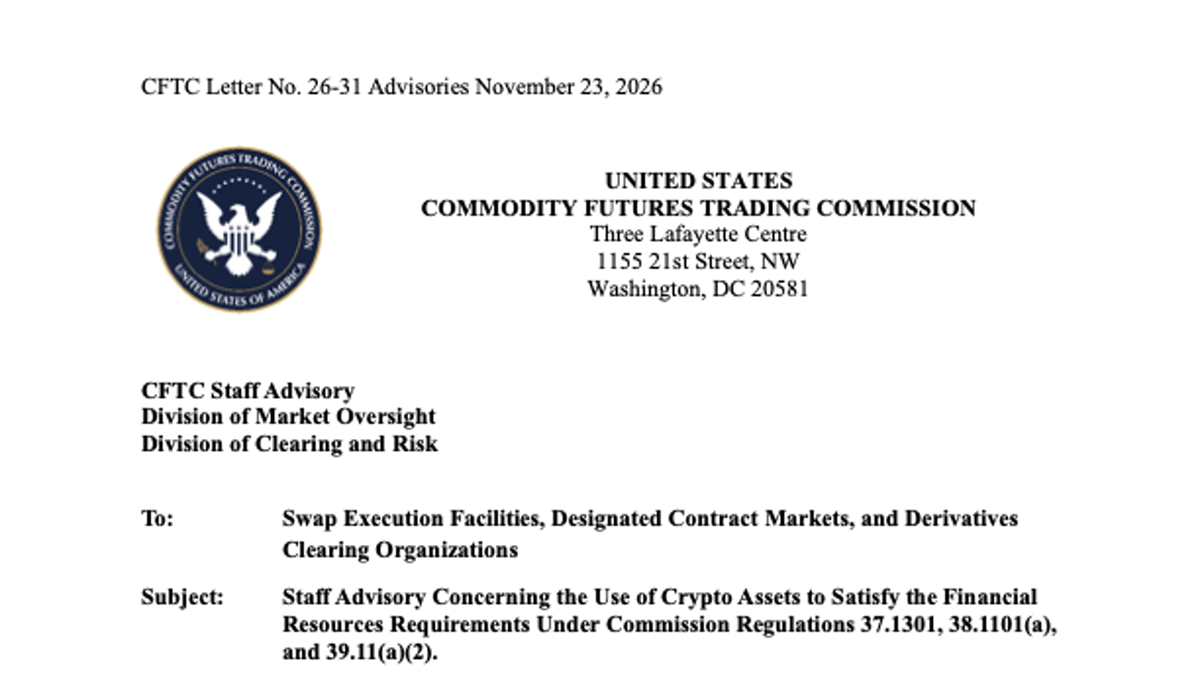


On November 23, two departments of the Commodity Futures Trading Commission (CFTC) of the United States issued guidelines for staff. Bitcoin, Ethereum, and qualified payment stablecoins can be counted towards the annual operational financial resources of certain institutions after deductions, but they still cannot be included in the separately specified liquidity quotas.
The document is aimed at three types of regulated institutions: swap execution facilities, designated contract markets, and derivatives clearing organizations. The information provided is tailored to the resources required by these institutions for their daily operations. A footnote in the document specifically excludes resources related to clearing members' defaults, as there are separate provisions for those cases. When discussing crypto asset reserves externally, the platform clarifies whether it is referring to operating expenses, customer funds, or safeguards in the event of clearing members' defaults.
Within the annual operating expenses, a portion can only be invested in cash or highly liquid securities.
For swap execution facilities, relevant regulations require that financial resources always exceed one year's rolling operating expenses. Among the resources that can be used to meet this requirement, unencumbered liquid assets must amount to the greater of three months' rolling estimated expenses and the estimated closing costs. This liquidity requirement is limited to cash or highly liquid securities. If the facility also engages in derivative clearing, it must also comply with the rules of the corresponding clearing organization.
For the specified contract markets, the requirement is also based on one year's rolling operating expenses, with cash or highly liquid securities covering at least six months of those expenses. Derivatives clearing organizations are also required to maintain at least six months of unencumbered liquidity resources to cover ordinary business risks and operating expenses. The guidelines provide the same direction for asset utilization for three types of institutions, while still maintaining their respective different thresholds for cash and securities.
The staff's explanation focused on accounting classification. The document states that these crypto assets cannot be presented as cash in accordance with U.S. Generally Accepted Accounting Principles (GAAP), nor do they constitute high-liquidity securities as required by the regulations. The ability to transact quickly and convert them into US dollars is a different issue from whether they can utilize liquidity quotas under these regulations. Even if the total operational resources are sufficient, institutions still need to separately account for the short-term liquidity portion.
Deduction valuation occurs in the institutional account.
The two departments stated that adopting a discount rate of at least 20% for Bitcoin and Ethereum, and 2% for qualified payment stablecoins, would not raise any objections from the staff. The discount is based on the current market value. For example, a Bitcoin with a market value of $100 would be discounted by 20%, resulting in a price of $80, while a qualified stablecoin with a market value of $100 would be discounted by 2%, resulting in a price of $98. This is an example of the institutional discount rate and has nothing to do with how much money users can get when exchanging for stablecoins, nor does it represent the spot trading fees of the exchange.
In addition to the reduction ratio, there is another layer of risk. For crypto assets that are not easily tradable and do not belong to payment stablecoins, the document states that a 100% reduction is generally required. If one wishes to use crypto assets other than Bitcoin, Ethereum, and payment stablecoins, staff recommend contacting the relevant departments first. The swap execution facilities and designated contract markets need to consider market and credit risks, while the clearing organizations must also take into account liquidity risks, and appropriate reductions should be assessed on a monthly basis.
The guidelines also mention that asset prices and institutional operations may be under pressure at the same time. For example, a decline in the price of crypto assets may coincide with an institution experiencing operational losses, causing the value that can be counted as reserves and the need to cover those losses to move in opposite directions. This is a risk relationship that the document reminds auditors about, without making any judgment that any particular trading venue is currently facing such difficulties.
Which payment stablecoins meet the document criteria?
The document defines payment stablecoins before and after the implementation of the “GENIUS Act.” Before its implementation, it specified that these stablecoins must be denominated in US dollars, issued by designated institutions, and their reserves could include cash, US Treasury bonds, and overnight Treasury bond repurchases. It also required monthly audits to verify whether the composition of these reserves and their fair values were commensurate with their circulation volumes. After the act came into effect, the requirements for payment stablecoins and compliant issuers continued to apply, including those from overseas that met the corresponding conditions. The document did not list any brand whitelists.
These are the opinions of staff from two departments; they do not establish new binding rules, enforceable rights, or positions of inaction. What is added is clarity regarding the valuation of operational resources. For those using US derivative platforms, when seeing institutions disclose their holdings of stablecoins, it is still necessary to check whether there are other qualified liquid assets listed separately, and whether these figures correspond to the company's operating expenses or to other accounts. Documents 26-31 can verify the former method of valuation, but they do not answer questions regarding how customer assets are managed on behalf of the platforms.