

On November 23rd, LlamaRisk suggested that Aave V4 increase the upper limits for two types of deposits. The limit for cbBTC under Ethereum Core is proposed to be raised from 500 to 1000, and the limit for cirBTC under Arc Core is proposed to be raised from 1600 to 2000.
These two suggestions are publicly made on the Protocol Governance Forum, and the post indicates that they will be implemented following the Risk Steward process. The targets are the token storage capacities in the two markets represented by Aave V4 that correspond to Bitcoin. The report shows that over 90% of these capacities have already been utilized in both places. However, there are significant differences regarding who has occupied these capacities, what has been borrowed, and how much additional assets can be accommodated after the upper limits are increased.
Two places are close to the full quota, with different degrees of increase.
The Main Spoke of Ethereum Core Hub has already stored 476.51 cbBTC, which represents a utilization rate of 95.3% of the current upper limit of 500. Assuming the stock remains unchanged at the time of reporting, about 47.7% of the upper limit will be used after it is doubled. This ratio describes the static capacity; if the actual storage amount increases subsequently, the ratio will change again.
Arc Core Hub's Main Spoke has a deposit of 1475.31 cirBTC, with a utilization rate of 92.2% under the upper limit of 1600. It is recommended to increase the upper limit to 2000, and even with the same static algorithm, it would still account for about 73.8%. Based on the difference between the current stock and the upper limit mentioned in the text, if the parameters are implemented and the stock remains unchanged for the time being, there would be approximately 523.49 cirBTC left for the former and about 524.69 left for the latter. At first glance, the expansion ratios seem quite different, but the remaining quantities of tokens are actually quite close. These are the numbers of two different types of tokens in their respective markets and cannot be considered as the same pool of liquidity that can be used interchangeably.
The original forum text separates the deposit limit from the loanable quota into two columns. The deposit limit specifies the maximum amount that can be received at a certain point, while the loanable quota indicates how much can be drawn from the pool. This table only lists two items: the deposit limit, and it does not allow for inferring that there will be an equal amount available for lending based on the proposed parameters of 1000 or 2000. The original diagram of the loanable quota also excludes cross-pool credit channels that are solely responsible for lending and are supported by collateral from another fund pool.
The maximum position difference between the two sides is over forty percentage points.
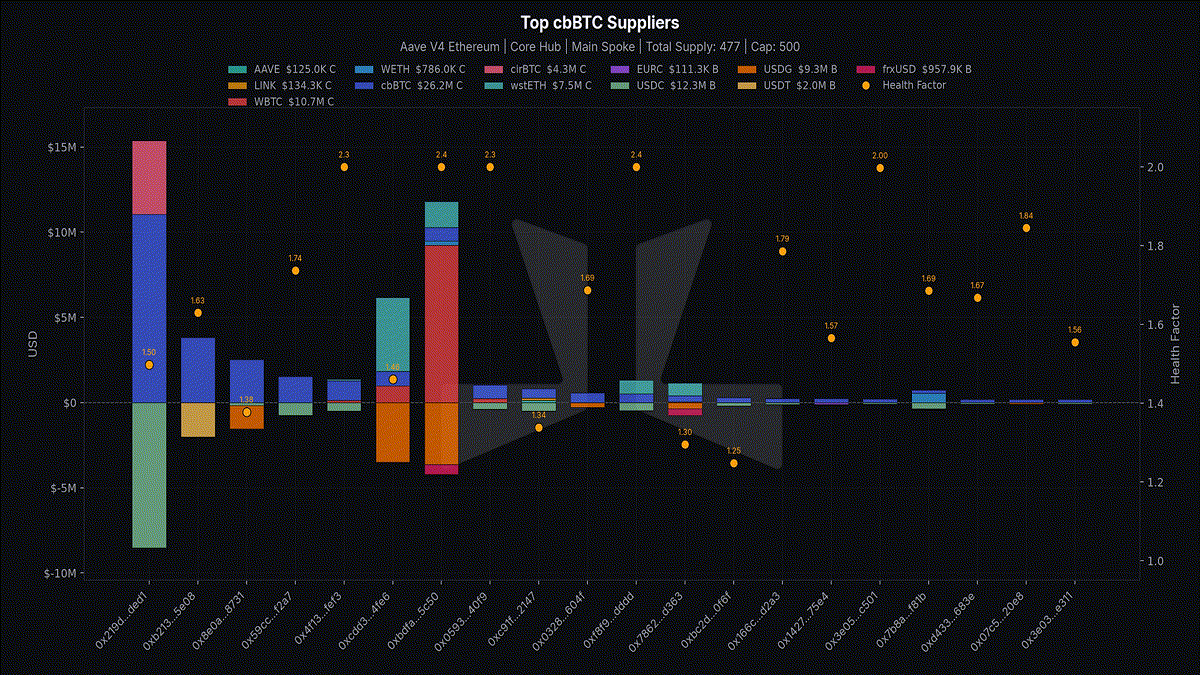
cbBTC is in reserve, with the maximum supply position accounting for about 38%. For LlamaRisk, the first 20 supply positions observed all have debts, with health factors ranging from 1.25 to 2.39, and a median of 1.68. The report lists 15 of them as borrowing USDC and 6 as borrowing USDG. The same position can have different debt assets, so it is not possible to simply add the two counts to determine the number of individual borrowers.
cirBTC is more concentrated on one side. Its largest position accounts for about 85% of the reserves, and the health factor for that position is 1.66. The first 20 supply positions recorded in the report also have debts, with health factor ranges from 1.17 to 5.03, and a median of 1.57. Among them, 12 are borrowing from USDC and 8 are borrowing from EURC. These numbers describe a set of positions that the risk team has reviewed, but the current situation of the entire market still depends on the real-time inventory.
The health factor considers mortgage guarantees and debts within the same ratio. The report indicates that two top positions use assets linked to Bitcoin as collateral, and the loans issued are stablecoins; therefore, the health of these positions will fluctuate with the price of Bitcoin. If all other conditions remain unchanged, the protection margin will narrow when the value of the collateral decreases. 85% informs readers of the proportion of a single position within this reserve, while 1.66 describes the safety buffer of that position at the time of reporting; both figures need to be read together.
Make space for new entries; existing positions will still be based on real-time parameters.
From the data provided in the announcement, it can be seen that scaling out can reduce the initial maximum occupancy rate, but it is not possible to change the proportion of maximum positions to reserves simply by changing the denominator. If more accounts deposit in the future, the concentration level may change. If the new positions are still established by a minority of borrowers, an increase in the upper limit may not necessarily be accompanied by an improvement in concentration. This is a conditional judgment based on the report distribution, and the proposal does not predict who will fill the new capacity.
When preparing to deposit such collateral into Aave, first check on the Risk Steward panel whether the upper limit has been reached, and then check the remaining capacity of the respective market. Existing borrowers must still refer to their own market's position indicators. These two adjustments are related to Ethereum Core Main Spoke and Arc Core Main Spoke respectively; the used quota from another market cannot replace the readings from this place.
This risk recommendation lists the specific adjustment values for two reserves that are nearly at their maximum capacity, and also specifies the entry points for implementation. At the time of the announcement, what can be confirmed is the recommended position snapshot; however, the additional storage capacity that can be utilized will only be available for confirmation on the panel after the corresponding parameters have been finalized through the process.