Dell Technologies' latest financial report shows that the boom in AI infrastructure investment is being transformed into company revenue at an unprecedented speed. Revenue in the third fiscal quarter doubled year-over-year, AI optimized server revenue grew nearly threefold, and both new orders and backlogs reached record highs, prompting the company to raise its performance guidance for this fiscal year for the third time.
On November 24th local time, Dell announced its financial results for the third quarter of fiscal year 2027, which ended on October 30, 2026. The financial report showed that the company's revenue for that quarter reached $54.937 billion, a year-on-year increase of 103%; non-GAAP earnings per share were $9.45, a year-on-year increase of 265%, both indicators significantly exceeding market expectations. Analysts had previously anticipated an average revenue of $49.32 billion and adjusted earnings per share of $6.59.
More importantly, Dell's AI optimized server business continued to experience accelerated growth. In the third fiscal quarter, this business segment generated revenue of $22.031 billion, a year-on-year increase of 291%; the company received new AI server orders worth $60.2 billion during that quarter, and by the end of the period, the backlog of AI server orders reached $132.3 billion, both setting new historical highs.
Driven by this, Dell has raised its full-year revenue forecast for the fiscal year 2027 to $20.2 billion and increased its AI optimized server revenue target to $78 billion.
However, Dell's growth also exhibited a clear differentiation in its business segments: the infrastructure business became the core driver of performance growth, while the growth rate of the PC business significantly slowed down.
At the same time, the tight supply of memory chips and rising costs of components are presenting new challenges for server manufacturers in terms of pricing and profit margins. How to maintain profitability while expanding the delivery scale of AI servers will become a key focus for the market in the coming period.
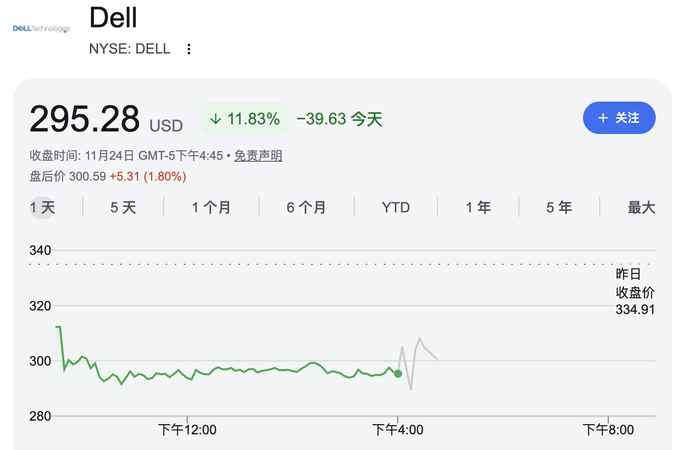
After the financial report was released, Dell's stock price fluctuated little after the market closed, and as of the time of publication, it had risen by 1.8%.
AI Server business becomes the core of growth, with backlogged orders exceeding 100 billion US dollars
Dell's growth in the third fiscal quarter was driven almost entirely by its infrastructure business.
Financial reports show that the Infrastructure Solutions Group (ISG) achieved revenue of $41.974 billion for the quarter, a year-on-year increase of 198%; operating profit reached $7.118 billion, a year-on-year increase of 308%, and the operating margin rose to 17.0%, higher than the 12.4% from the same period last year.
Among them, AI optimized server revenue to reach $22.031 billion, a year-on-year increase of 291%, becoming the main source of growth. Traditional server and network business revenue also reached $15.013 billion, with a year-on-year increase of 235%; storage business revenue was $4.930 billion, with a year-on-year increase of 24%.
Order momentum is also strong. Dell received $60.2 billion in new server orders during the quarter, with backlogged orders at the end of the period rising to $132.3 billion. Jeff Clarke, the company's Vice Chairman and Chief Operating Officer, stated that Dell is conducting a rigorous screening of these backlogged orders, evaluating customer qualifications as well as the availability of funds, land, and power resources.
Clarke also indicates that currently, there are over 7,500 customers worldwide deploying Dell AI Factory solutions. By completing full rack testing before shipment and deployment within six hours after delivery, Dell aims to reduce the time from device delivery to model operation for its customers.
This business expansion has also prompted Dell to further adjust its business structure. As stated in the financial report, the Infrastructure Solutions Group now contributes the majority of the company's profits and growth. Clarke
Third annual performance guidance upward revision, AI server revenue target raised to $78 billion
Strong quarterly results have prompted Dell to raise its full-year performance forecast again.
The company expects that its annual revenue for the fiscal year 2027 will reach $202 billion, a year-on-year increase of 78%, higher than the previous forecast of $192 billion. The annual non-GAAP earnings per share forecast has been raised from $25.50 to $29.68, representing a year-on-year increase of 188%.
The annual revenue target for optimizing server services, which is marked with AI, has also been increased from $74 billion to $78 billion, representing a year-on-year growth of 216%.
For the fourth fiscal quarter, Dell expects revenue to reach $56.3 billion, a year-on-year increase of 69%; non-GAAP earnings per share are expected to be $8.40, a year-on-year increase of 116%.
This outlook is also higher than what Wall Street had previously anticipated. According to data cited by Reuters from LSEG, analysts had previously estimated that Dell's annual revenue for the fiscal year 2027 would be around $194.48 billion.
In addition, Dell's board of directors approved an authorization for an additional $25 billion in stock repurchases. During the third fiscal quarter, the company returned $4.9 billion to shareholders through stock repurchases and dividends, with cash flow from operating activities reaching $10.765 billion over the first three fiscal quarters.
Rising memory costs force server manufacturers to pass on the pressure to customers
While the demand for AI servers is growing rapidly, supply chain costs are becoming a new variable in the industry.
The rise in memory chip prices is particularly noteworthy. Previously, in its regulatory documents for the second quarter of fiscal year 2027, Dell disclosed that there was strong demand for AI optimization solutions. Coupled with limited production capacity of memory manufacturers, this has led to a global supply shortage and a significant increase in the cost of memory components. The company also noted that the procurement costs for some components are on the rise.
On November 22, the Financial Times reported that server manufacturers such as Dell, HP Enterprise, Lenovo, and Supermicro are asking some customers to pay a higher price for AI servers for which contracts have already been signed, with price increases for some orders ranging from 25% to 45%.
Reports cited informed sources as saying that the prices of some GPU servers have increased by 20% to 30%, and the increase for memory in CPU server nodes, which have higher memory costs, is even greater. The rise in memory prices has made it difficult for server manufacturers to continue delivering equipment at the previous contract prices.
Dell is also facing legal disputes over a server transaction. A British trading company, XTX Markets, has sued Dell in Ireland over a server contract worth $549 million. The XTX party claims that Dell demanded an additional payment of $62 to $70 million on top of the original contract amount. The related dispute is still ongoing.
This means that although the demand for the AI server market is strong, manufacturers' profitability does not depend solely on the scale of orders; it also depends on their ability to pass on the rising costs of memory and other components to their customers.
It is worth noting that Dell did not disclose the specific impact of memory price increases on profits in the third fiscal quarter in its financial report this time, nor did it provide a quantitative forecast for future memory costs. Therefore, it cannot be assumed that the company has fully absorbed the pressure of memory costs based solely on revenue and profit growth.
PC Business growth has slowed down, and consumer demand is under pressure.
Compared to the strong performance of its infrastructure business, Dell's traditional PC business growth has been relatively weak.
Financial reports show that the Client Solutions Group (CSG) reported revenue of $12.886 billion in the third fiscal quarter, a year-on-year increase of 3%; operating profit was $704 million, a year-on-year decrease of 6%, and the operating margin fell from 6.0% in the same period last year to 5.5%.
Among them, commercial PC business revenue reached $11.3 billion, a year-on-year increase of 6%; consumer PC business revenue was $1.586 billion, a year-on-year decrease of 15%.
This indicates that there is still some support for the demand of enterprise customers for device updates, but the consumer side is relatively weak.
The rise in memory prices may further increase the cost pressure on PC manufacturers. For Dell, the rapid growth of its enterprise-level AI server business is changing the company's revenue and profit structure. However, whether the PC business can resume growth, and whether the rising costs of components will erode the overall profit margin, still need to be verified by subsequent financial reports.
From a broader industry perspective, Dell's performance this time also highlights the divergence between AI infrastructure investment and traditional consumer electronics demand: Data center construction continues to drive demand for servers, networking equipment, and storage, while the personal computer market faces the dual challenges of rising costs and changing consumer purchasing intentions.