


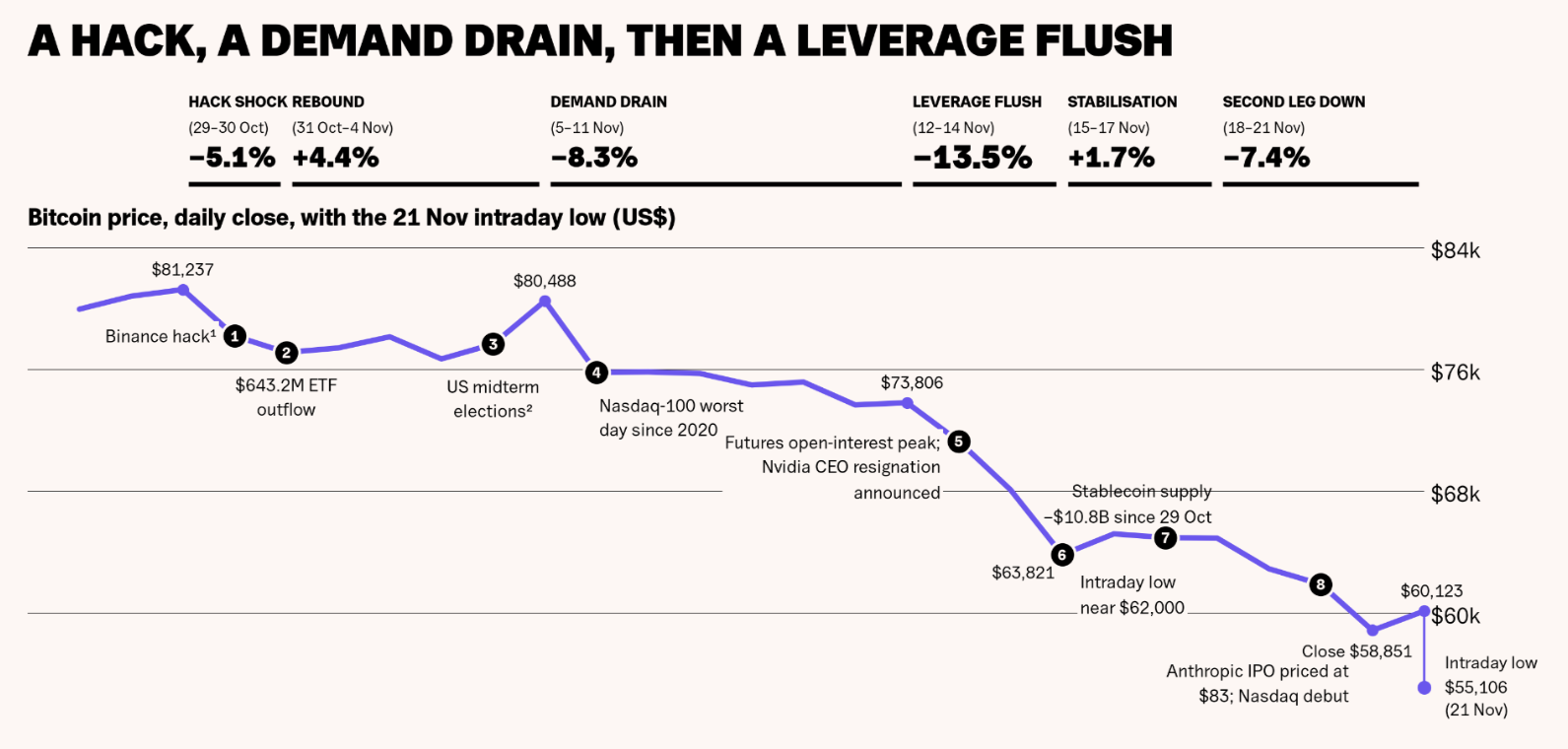
In a report released on November 24, the crypto asset management firm 21Shares stated that the $6.4 billion hack incident at Binance ( Binance ) in October triggered a recent sell-off of Bitcoin, but most of the subsequent decline was driven by weakened investor demand and forced liquidations.
The report states that although the hacker attack on October 29th triggered the initial decline, weakening demand further pushed Bitcoin (BTC) down by 8.3% from November 4th to November 11th. Subsequently, leveraged positions were forced to be sold, leading to the steepest drop, with BTC falling another 13.5% in the following three days. By the week of November 15th, the total amount of cryptocurrency liquidations reached $5.8 billion, of which long positions accounted for 81%.
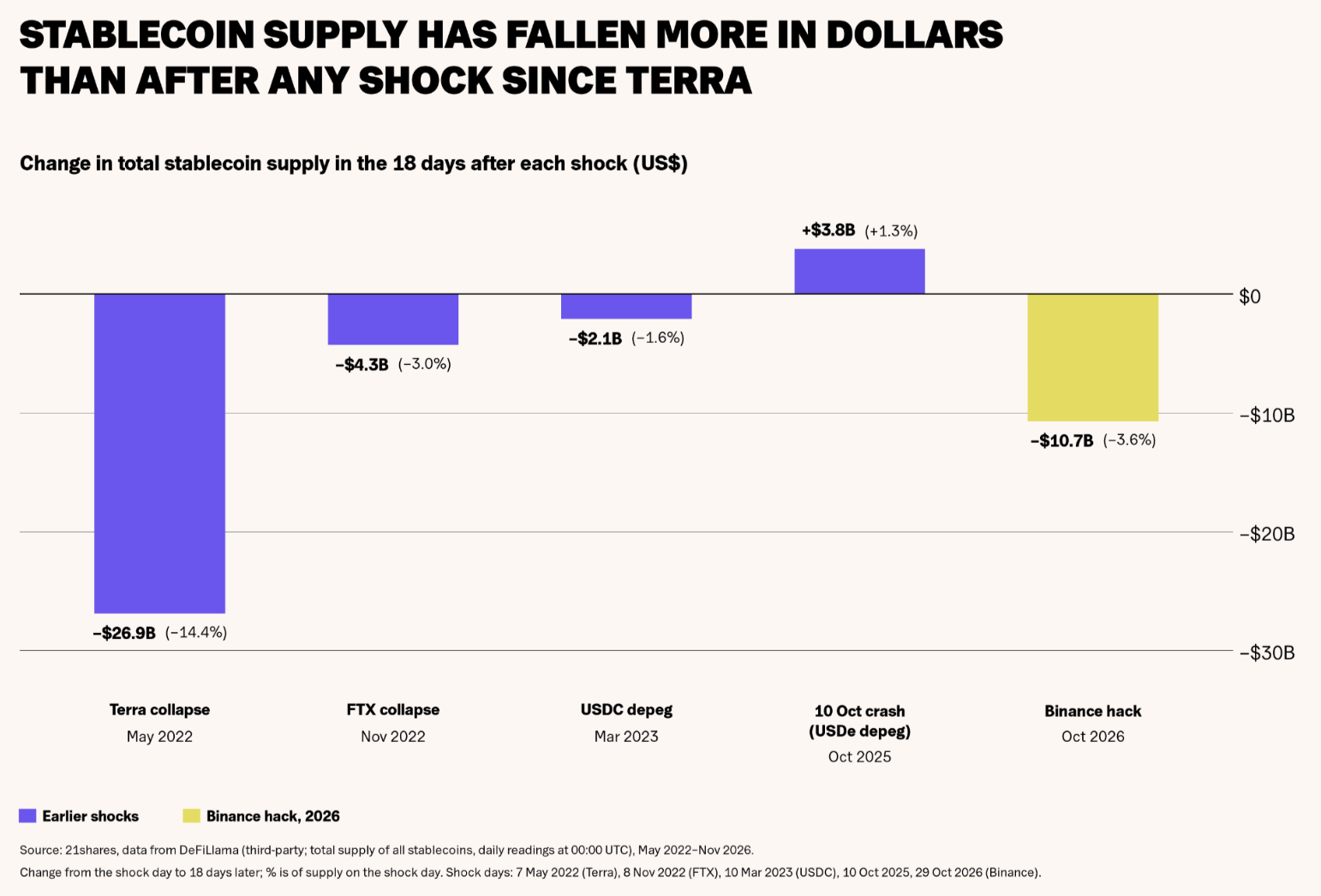
Signs of weakening demand are also reflected in the supply of stablecoins. Following the hacker attacks, the supply of stablecoins decreased by $10.7 billion, which is the largest decline in 18 days since the collapse of Terra in 2022. Between October 30th and November 13th, there was a total net outflow of $3.9 billion from US spot Bitcoin and Ethereum (ETH) exchange-traded funds (ETF).
The report also mentioned that the Federal Reserve raised interest rates in September, with core inflation rising by 0.3% for the third consecutive month. Concerns about spending on artificial intelligence kept the Nasdaq 100 index below its record high set on October 6th. The hack incident triggered this round of selling, but Bitcoin only fell by 5.1% in the two days following the event and nearly regained all of its losses before November 4th.
The report also found that other major Bitcoin holders showed almost no signs of selling. The 18,270 BTC and 522,409 ETH coins stolen in the Binance hack have not been touched as of mid-November, and neither the U.S. government nor the trustees of Mt and Gox have transferred any Bitcoin to exchanges since the attack.
Bitcoin treasury company Strategy continued to buy from October 26 to November 15, increasing its holdings by 2,332 units of BTC. Meanwhile, miners' transfers to exchanges dropped to their lowest level since at least 2020, although these figures may not account for the selling activities of listed mining companies.
However, researchers believe that the probability of Bitcoin returning to its previous bear market lows is low, due to the growing presence of institutional investors and spot ETF. Ndinga also indicates that the competitive landscape in the crypto market has changed:
In the eyes of investors, cryptocurrencies are no longer the only cutting-edge technology; artificial intelligence and robotics are drawing away talent and capital from this field. We expect to see a K-shaped recovery, with Bitcoin, 24/7 trading platforms, privacy protocols, and quantum-resistant solutions making progress, while other parts of the market will fall behind.
Ndinga warns that if the Federal Reserve raises interest rates more than expected in December, it could prolong this downward trend. Another potential source of selling pressure is the $2.2 billion in BTC and ETH that was stolen in the Binance hack. These assets may enter the market in the coming months through over-the-counter (OTC) trading brokers.
Ndinga considers the realized price of Bitcoin at $53,250 to be a key downward level that requires attention, as this indicator measures the average holding cost of investors. On the contrary, if the price returns to the range of $73,000 to $75,500, and at the same time there is a continuous inflow of ETF and the balance of stablecoins rises, it would indicate that investor demand has resumed.
Magazines:Binance faces a $6.5 billion freeze order; Hong Kong expresses "doubts" about HYPE: Asia Express