The South Korean central bank is expected to raise interest rates again on November 26th, but the prosperity of semiconductor exports cannot conceal the weakness of domestic demand. The decline in AI technology stocks has further exacerbated consumer pressure, and this round of interest rate hikes may be coming to an end.
According to a survey by Reuters among 34 economists, 32 expect the Bank of Korea to raise its benchmark interest rate by 25 basis points to 3.25% on November 26, with only 2 predicting that it will remain unchanged. An economist from Societe Generale, Michelle Lam, stated that the market has fully anticipated the interest rate hike, and "if there is no hike, it would instead come as a surprise to the market."
She pointed out that South Korea's GDP performance was strong in the third quarter, and inflation is not expected to fall back to the target level of 2% until the second half of 2027. Coupled with the continuous rise in housing prices, these factors provide reasons for another interest rate hike.
However, Goldman Sachs takes a relatively cautious attitude towards this. Zhou, a senior Asian economist at Goldman Sachs, stated on Tuesday that considering the further deterioration of consumption in October and November, it is not ruled out that the South Korean central bank may not take any action this week; even if there is an interest rate hike, the wording of the policy statement may be dovish. Although there are still disagreements in the market regarding this week's decision, the mainstream view is that the terminal interest rate for this round of interest rate hikes will not exceed 3.50%.
Reasons for interest rate hikes: Strong semiconductor exports, inflation still above targets
Export prosperity and inflationary pressures are the two major factors supporting the South Korean central bank's continued interest rate hikes.
In the first three quarters of this year, South Korea's semiconductor exports nearly tripled year-on-year, driving economic growth significantly above expectations. At the same time, the process of inflation cooling down is still not ideal. In October, the consumer inflation rate was 2.8%, which, although lower than 2.9% in September, is still higher than the South Korean central bank's policy target of 2%, and it is expected to return to the target level only in the second half of 2027. The continuous rise in housing prices also adds to the reasons for tightening monetary policy.
The South Korean central bank has currently raised interest rates by a total of 50 basis points in this round of tightening. A Reuters survey shows that most economists expect that after this week's rate hike, the central bank will raise rates by another 25 basis points in the first quarter of 2027, pushing the benchmark interest rate to 3.50%, and then maintain it at that level for the rest of the year.
AI Tech stocks decline, consumption faces pressure of wealth shrinkage
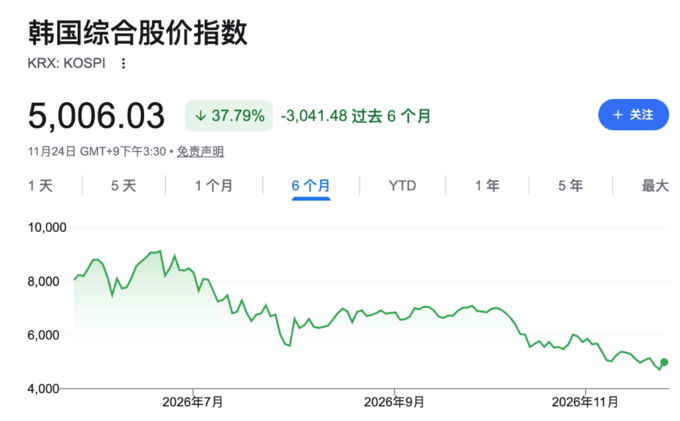
The strong performance on the export side cannot conceal the weakness of domestic consumption in South Korea. Last week, South Korea's Composite Stock Price Index ( KOSPI ) fell to a 10-month low, with technology stocks experiencing heavy selling. The market is concerned that the negative wealth effect brought about by the stock market decline will further undermine household consumption confidence and also reinforce the expectation that the interest rate hike cycle is coming to an end.
Goldman Sachs expects that South Korea's real private consumption growth rate will be around 2% in 2027. The negative wealth effect caused by the decline in the stock market, population aging, and increased household interest expenses will all put pressure on consumption.
Kwon indicates that if consumer spending growth falls to around 2%, there would be no need for the Bank of Korea to continue raising interest rates, as government policies can also play a role in stabilizing prices and inflation expectations.
What is more noteworthy is that the prosperity of the chip industry has not fully benefited ordinary households. Kwon points out that the excess profits resulting from the rise in memory chip prices are mainly concentrated among a few large enterprises. This means that strong semiconductor exports do not necessarily mean that ordinary households will benefit simultaneously, and the boosting effect of export growth on domestic consumption is relatively limited.
Won and the Federal Reserve: External pressures may still support interest rate hikes
The appreciation of the Korean won has alleviated the pressure on the South Korean central bank to maintain the exchange rate to some extent, but the policy direction of the Federal Reserve remains an important variable affecting South Korea's interest rate decisions.
Since the beginning of this year, the Korean won has appreciated by about 7%, making it one of the best-performing currencies in Asia. Another survey by Reuters earlier this month predicted that the won will appreciate by another 2.2% by the end of April 2027.
However, according to another survey by Reuters, the Federal Reserve is expected to raise interest rates again in December. Senior economist Kelvin Lam warns that if the Bank of Korea does not raise interest rates now, and the United States does so subsequently, the trend in the foreign exchange market will be difficult to predict. A further widening of the interest rate gap between South Korea and the United States could put pressure on the Korean won and increase the risk of capital outflows, providing additional reasons for the Bank of Korea to continue to tighten its policies.
Meanwhile, Kwon expects that South Korea's current account surplus will reach approximately 20% of GDP in 2027. The scale of chip manufacturers converting US dollars into Korean won for tax payments, dividends, and salary disbursements is expected to increase to about three times that of this year, providing support for the Korean won.