Key Points
- Fed governor outlines the future direction of blockchain payments
- Tokenized settlement brings potential opportunities for XRP Ledger.
- It has not yet been announced that the Federal Reserve will adopt XRP.
Will the Federal Reserve use XRP in the future? This question has become more prominent after Federal Reserve Governor Christopher Waller delivered an important speech on November 17th. In his speech, Waller outlined how blockchain technology, stablecoins, and tokenized assets could reshape the US payment system.
At the The Clearing House annual conference held in New York, Waller stated that the connection between traditional financial infrastructure and blockchain-based markets is deepening.
According to his official speeches as a Federal Reserve official, the key points included interoperability, programmable settlement, and the possibility of coexistence between traditional payment systems and tokenized currencies.
The Federal Reserve signals growing interest in blockchain settlement
Waller pointed out that tokenization is becoming an increasingly important development trend in the financial market, with institutions exploring how blockchain networks can support securities, bank deposits, and payments.
He said that stablecoins have already been used for settlement obligations within the bank card network, and financial institutions are also developing tokenized deposit systems.
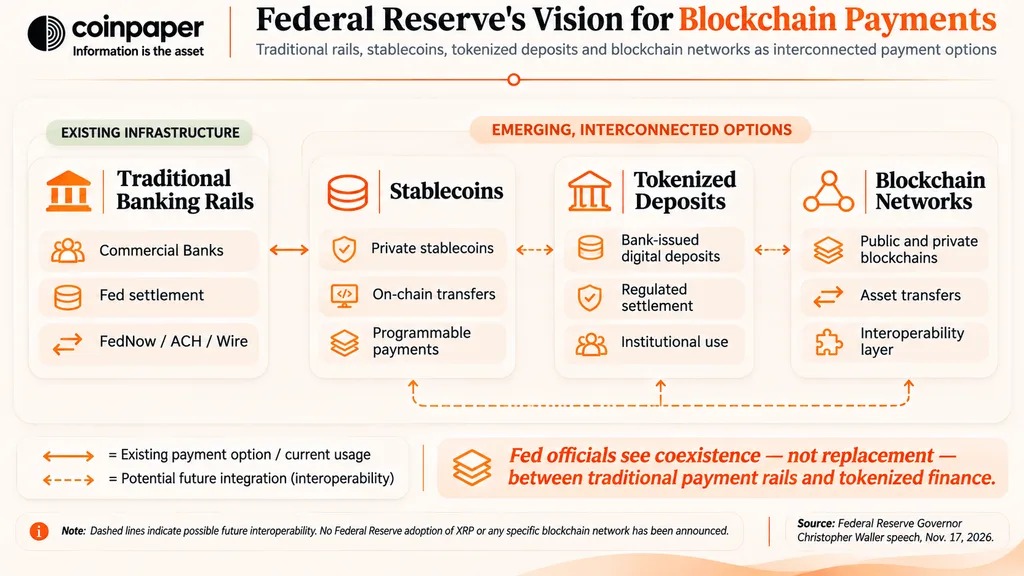
This Federal Reserve governor also emphasized that programmable payments can allow for the simultaneous exchange of funds and tokenized securities, which could potentially reduce settlement delays.
However, he also emphasized that different financial applications will require different settlement methods.
His comments come shortly after the Federal Reserve's previous proposal to expand FedNow. This proposal has once again sparked discussions about how fintech providers can connect with existing banking infrastructure.
Waller's speech did not announce any integration between FedNow and blockchain networks. On the contrary, he described a future where multiple payment systems coexist.
XRP Ledger Will it become part of the Federal Reserve's payment ecosystem?
The technology of Ripple addressed several issues mentioned in Waller's speech, particularly regarding cross-border settlements, interoperability, and the transfer of value between different currencies.
According to the official documents of Ripple, XRP can act as a bridging asset within XRP Ledger to facilitate the exchange between different assets.
Ripple also issued RLUSD, which is a stablecoin backed by the US dollar and can be used on XRP Ledger and other supported blockchain networks.
This distinction is very important because transactions involving RLUSD do not necessarily require XRP to be used as the asset being transferred.
After SWIFT launched its blockchain payment plan, the potential relationship between XRP and existing financial networks has drawn attention.
Similarly, MasterCard's collaboration with Ripple also involves exploring the use of RLUSD for settlement on XRP Ledger, indicating that blockchain infrastructure can support traditional financial services without necessarily requiring XRP as the primary settlement asset.
If the Federal Reserve is to implement such a plan, it will require clear operational use cases, an appropriate regulatory framework, and confirmed technical arrangements.
Currently, regarding XRP, none of these have been announced yet.
Will the Federal Reserve adopt XRP in the future?
Waller's speech indicates that the Federal Reserve expects blockchain infrastructure to become increasingly closely connected with existing markets.
However, he also emphasized that central bank money and traditional payment channels will continue to play an important role in maintaining financial stability.
Therefore, the role of the Federal Reserve is different from that of private companies that develop cryptocurrency settlement products.
At the same time, Ripple's participation in the tokenization program of the U.S. Depository Trust and Clearing Corporation (DTCC) indicates that it is increasingly involved in institutional financial infrastructure, although the direct role of this token has not yet been confirmed.
Marcus Hale
Marcus Hale is an author specializing in cryptocurrency and financial markets, covering topics such as Bitcoin, Ethereum, digital assets, regulation, ETF, and the adoption by institutions. His work focuses on developments that may drive market changes, investor trends, and the broader forces shaping the crypto economy.