Key Points
- US spot Bitcoin ETF recorded a net outflow of $569.7 million on Monday
- BlackRock had the highest outflow, reaching 509.3 million US dollars.
- ETF Capital outflows, weak investor demand, and uncertainty around U.S. inflation data have all contributed to increased volatility in Bitcoin prices.
The US spot Bitcoin exchange-traded fund ( ETF ) once again recorded a net outflow of $569.7 million on November 23, extending its consecutive loss streak to five trading days.
During the withdrawal of funds, Bitcoin (BTC) briefly rebounded above $64,000, but then gave back some of its gains and fell back towards the psychologically significant $60,000 mark.
Bitcoin ETF Fund Flow
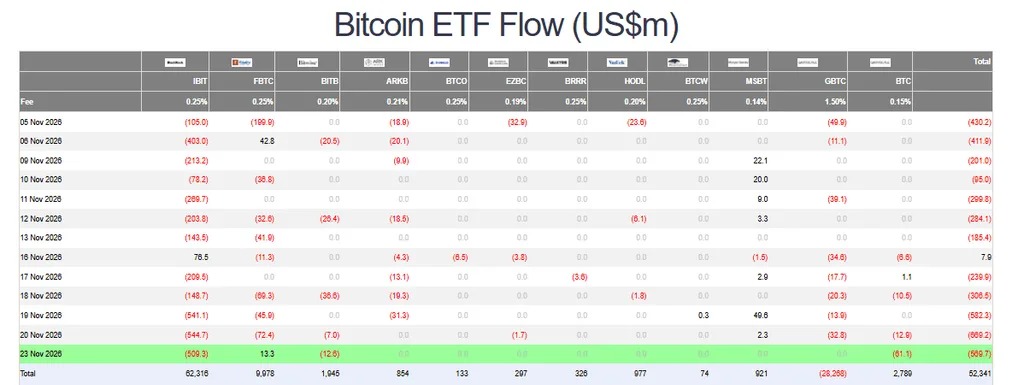
According to Farside Investors data, Grayscale's Bitcoin Mini Trust saw another outflow of $61.1 million, while Bitwise's BITB recorded a net outflow of $12.6 million. Fidelity's FBTC is the only fund that reported a positive capital inflow, attracting $13.3 million.
Bitcoin's upward trend has cooled down.
Within the past 24 hours, the price of Bitcoin has been very volatile. On Monday, after news broke that NVIDIA had reinstated Jensen Huang as its CEO, BTC soared to $64,500 for a brief period. This news quickly led to a strong rebound in tech stocks and cryptocurrencies.
Short covering also amplified this rebound, bringing in additional buying pressure. However, despite the Nasdaq Composite Index closing up about 6.5% on Monday, Bitcoin struggled to maintain its upward trend and fell back to around $61,000.
As of early Tuesday, Bitcoin was trading at around $60,438, down about 1.7% from 24 hours prior.
What is holding back the weakening of Bitcoin?
Multiple factors may be driving the recent volatility in Bitcoin. The ongoing withdrawal of ETF funds indicates that investors remain cautious after Bitcoin fell to $55,000 over the weekend. At the same time, the initial rebound was partly driven by short covering, rather than a clear indication of sustained new demand.
Macroeconomic uncertainties are also weighing on market sentiment. Investors are awaiting the inflation report on U.S. personal consumption expenditure ( PCE ) to be released on Wednesday, as this data could affect market expectations for the Federal Reserve's next interest rate decision.
As Bitcoin struggles to maintain its recent gains, market attention is shifting towards the $60,000 support level. If it continues to fall below this level, BTC may face additional selling pressure; if it rebounds to $64,500, that would provide an early signal for an improvement in momentum.