


Coinbase CEO Brian Armstrong predicts that within the next 10 years, AI agents will handle over 99.9% of all payments, a judgment based on the platform's $22 billion in USDC.
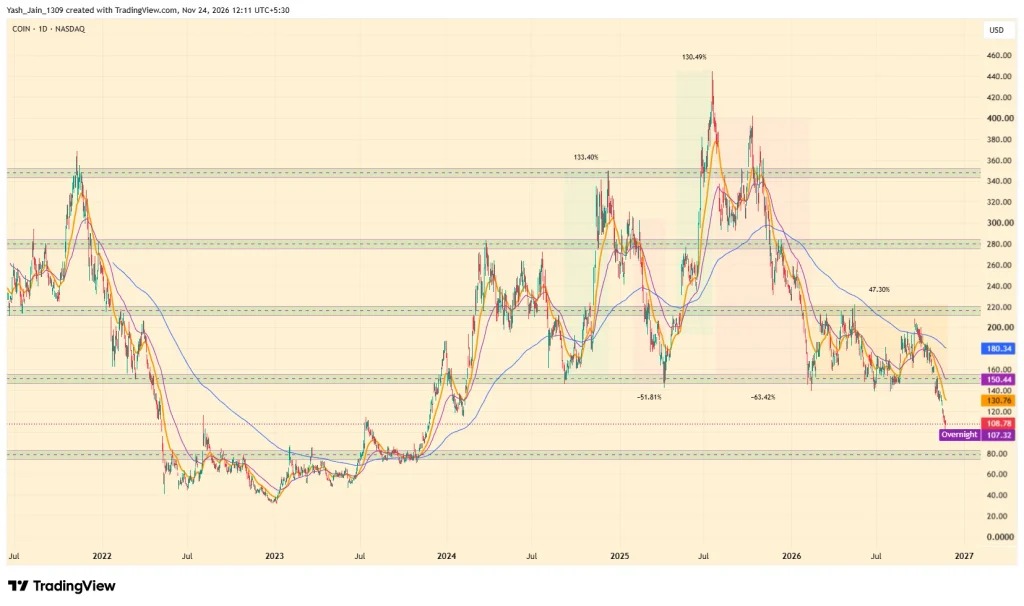
Although the stock price of COIN hovers around $108.78, the predicted annualized market revenue of Coinbase has exceeded $200 million, and the scale of tokenized stocks on Base has also reached $4 to $5 billion.
Industry estimates suggest that by 2030, the market size of AI proxy payments could reach $3 trillion to $5 trillion, while the current market value of AI proxy tokens is approximately $2.8 billion.
After falling by about 40% in the past three months, the stock price still hovers around $108.78, but CEO Brian Armstrong is painting a future worth $5 trillion.
He believes that autonomous AI agents will handle over 99.9% of all financial payments within the next decade.
While Wall Street is concerned about the weak growth in spot trading, Coinbase is working on setting up bank accounts and payment tools for software robots.
Why does the AI proxy need the USDC channel on Base?
Personal assistant robots can use credit cards to purchase airline tickets or shoes, but collaboration between robots requires instant, small, and global transfers, which are not suitable to be efficiently processed by card organization networks.
Therefore, Coinbase is building a USDC stablecoin payment tool on the Base network, backed by a platform balance of $22 billion from USDC. Industry estimates also suggest that this robotic payment market could reach $3 trillion to $5 trillion by 2030.
Real-time data from CoinGecko shows that the current market value of AI Agents tokens is approximately 2.8 billion US dollars, which also indicates that this trend is still in its early stages.
Coinbase How to Protect Funds from Being “Burned Out” by Trading Robots
It sounds risky to hand over real cash to software, and indeed that's the case. Armstrong admits that he once gave three or four AI agents $100,000 each to trade different combinations, with mixed results.
To prevent robots from depleting accounts, Coinbase has set strict spending limits, independent wallets, and a simulated trading mode. In the backend, over 99% of users' funds are in an offline state, and security tools scan every line of code.
Why Non-Bitcoin Income Is More Important Nowadays
COIN's stock price is rapidly approaching $80 and may continue to hit lower lows until there is a clear catalyst to drive a rebound. However, while traders are focusing on the daily charts, Coinbase is quietly expanding its revenue sources beyond just spot Bitcoin transaction fees.
Its predicted annual revenue in the market has recently exceeded $200 million, with derivatives and predictive contracts contributing 25% of the trading fee income. The tokenized stock scale on Base has also just surpassed $4 to $5 billion.
At the same time, Armstrong attributes the recent sale of Bitcoin to the flow of funds towards SpaceX and other AI IPO, as well as the listing of Anthropic last week, and insists that the cycle low has already been reached.