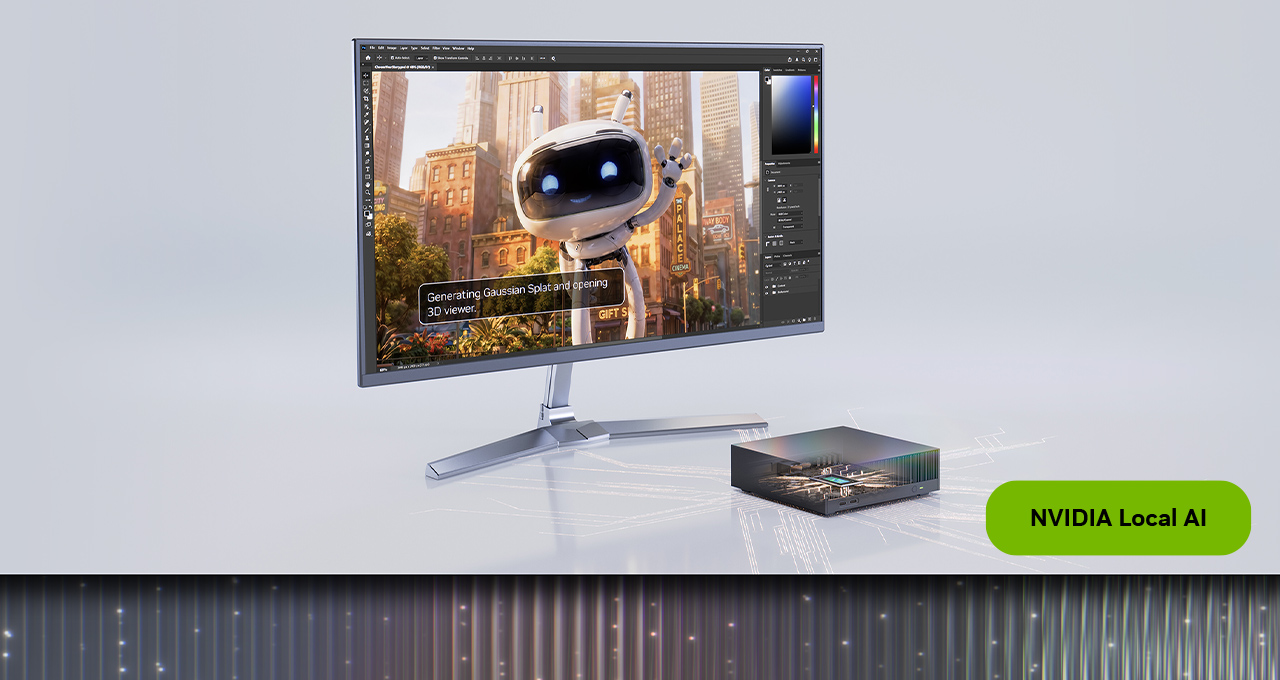
NVIDIA announced on November 18th that the RTX Spark compact desktop computer is now officially available for purchase.The first batch of products comes from ASUS, Dell, and MSI; Acer, Gigabyte, HP, as well as Microsoft Surface RTX Spark Dev Box, also plan to join later on. This product consolidates local AI agents, image and video generation, model fine-tuning, and creative development tools onto a dedicated Windows PC.
NVIDIA reveals that the RTX Spark desktop system utilizes a 20-core Grace CPU, Blackwell RTX GPU processor, and 6,144 CUDA cores, with a maximum of 128GB of unified memory. The highest performance of the AI can reach 1 petaflop. It also provides 10Gb Ethernet support. The officially listed capabilities include running large models with over 120 billion parameters locally, real-time rendering of 3D scenes exceeding 90GB in size, and real-time editing of 4:2:2 videos. However, the actual performance still depends on the specific model, software version, and workload.
In terms of the software ecosystem, the product supports native CUDA, and development tools such as Linux can be used through Windows Subsystem for Linux. Workflow tools like Hermes Agent, NemoClaw, Unsloth, ComfyUI, Adobe, creative tools, and Blender version 5.3 have been officially introduced. NVIDIA also states that running locally allows code and files to remain on PC, thereby reducing the costs associated with cloud API for these tasks. However, this does not mean that all cloud capabilities can be replaced by local devices.
From the company's brief reviewHighlightsLook, NVIDIA's core focus is shifting from being a supplier of data center acceleration cards to local AI systems and software stacks. Its core products, technological barriers, and competitive advantages come from the integration with Grace CPU, Blackwell RTX GPU, CUDA, and development tools; deep collaborations with leading customers and suppliers such as ASUS, Dell, MSI, and Microsoft have expanded its product coverage. For long-term growth, the key indicators are not the initial list of partners, but rather the actual shipment volumes, the adoption rate by developers, and whether local AI applications can generate sustained demand.
Source: NVIDIA Official Blog, published on November 18, 2026.