

Castle Securities (Citadel Securities) strategists warn that the current financial market is reproducing some of the dangerous characteristics from the end of 2018: economic data remains strong, but forward-looking growth expectations are deteriorating, while the Federal Reserve continues to insist on tightening monetary policy.
Frank Fleet, the head of macro strategy at Castle Securities ( Frank Flight ), pointed out in a report last Friday that the resilience of the U.S. economy has masked the ongoing deterioration of growth prospects, and the market may be underestimating the risk that this round of adjustments is not yet over.
This judgment comes at a time when the U.S. stock market is experiencing significant fluctuations. On Monday, U.S. stocks soared due to Jensen Huang's return to the NVIDIA CEO position.
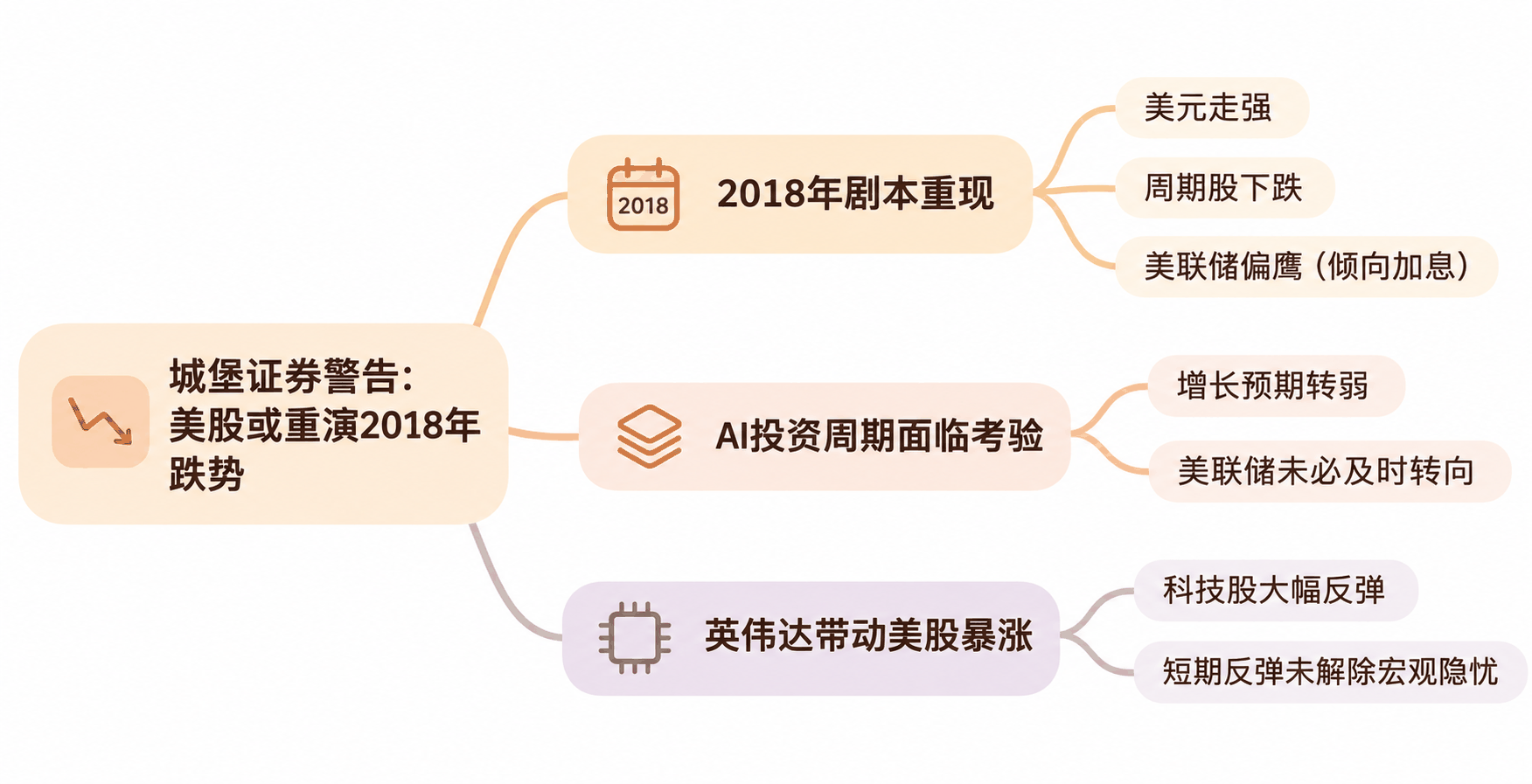
2018 scenario repeats: the US dollar strengthens, cyclical stocks fall, and the Federal Reserve takes a hawkish stance
Castle Securities believes that there are three important similarities between the current market environment and that of the second half of 2018.
Firstly, domestic economic activity in the United States remains resilient, but forward-looking indicators in the financial markets have begun to reflect the risk of a slowdown in growth.
Secondly, the US dollar continues to strengthen, while cyclical sectors such as industry, raw materials, and energy are performing weakly.
Thirdly, the Federal Reserve remains committed to tightening monetary policy, keeping U.S. Treasury yields high, which further suppresses expectations of economic growth.
Flete pointed out that the U.S. economy performed relatively strongly in 2018, but ongoing trade frictions gradually worsened the growth prospects. Today, the U.S. economy also exhibits considerable resilience, but the continuous Iran war and energy price shocks are increasing the uncertainties surrounding inflation and growth.
In his view, the common factor in both rounds of market trends is the disconnect between the lagging performance of economic fundamentals and the risks that were reflected in the financial markets in advance.
In 2018, the Federal Reserve was in a cycle of interest rate hikes. At that time, Chairman Powell stated that there was still significant room for interest rates to rise from the neutral level, which exacerbated investors' concerns about continued tightening. Subsequently, the S&P 500 index fell by nearly 20% from its high in September to December of that year, and market turmoil forced investors to re-evaluate the Fed's policy path.
Flete believes that investors tend to see recent market adjustments as a sign that future risks have been fully absorbed, but the experience of 2018 shows that an initial decline in the stock market does not necessarily mean that the adjustment has ended.
AI Investment cycle faces challenges; the Federal Reserve may not shift its stance in time
Compared to 2018, the current U.S. economy is also facing a new risk: investment in artificial intelligence infrastructure may slow down.
In the past few years, the construction of AI data centers, chip procurement, and related infrastructure has become an important force in driving corporate profits and economic growth in the United States.
However, as the market begins to question whether such substantial capital expenditures can generate sufficient returns, the financing pressures and investment sustainability of some tech companies are attracting increasing attention.
Noshad Shah, head of fixed income sales for Castle Securities in Europe, the Middle East, and Africa ( Nohshad Shah ), warns that the U.S. economy is entering a phase with less room for error. He believes that as fiscal support weakens, financing conditions tighten, and the AI investment boom gradually cools down, several factors that have supported U.S. economic growth may also weaken at the same time.
What is more concerning is that AI investment not only affects technology companies themselves but is also closely related to fields such as construction, equipment supply, energy, and employment. If large technology companies slow down the construction of data centers, the impact could be transmitted along the supply chain to a broader range of economic sectors.
At the same time, it is not certain that the Federal Reserve will quickly change its policy direction due to the decline in stock prices. Shah pointed out that, unlike in 2018, current inflation in the United States remains at a relatively high level of over 3%, significantly exceeding the Fed's long-term target of 2%. This means that even if the stock market continues to adjust, the Fed may not be able to immediately alleviate financial market pressures by cutting interest rates due to concerns about ongoing inflation.
Shah believes that the market should not simply assume that a decline in stock prices will inevitably lead to more relaxed monetary policy. If future economic growth expectations continue to deteriorate, and the Federal Reserve still needs to control inflation, the market may first show signs of a further flattening of the U.S. Treasury yield curve, as well as continued pressure on risk assets such as stocks.
Recommended Reading More
- "Directors should resign!" Just 2 minutes ago, NVIDIA's board of directors was no match for Trump and Jensen Huang's supporters, with its governance capabilities being questioned.
- 27 minutes ago, the debate about rejoining the EU has reignited! The British Prime Minister made it clear that rejoining the EU would require a referendum.
- 38 minutes ago, Goldman Sachs: The US dollar still has room to rise in the short term, but it may weaken moderately by 2027.
- 1 hour ago, Vance involved in investigation into large Venezuelan oil deal! Senator investigates whether he used the vice president's authority to profit for political backers
- 2 hours ago, the inside story of Jensen Huang's reinstatement was revealed: The White House launched a 72-hour operation to stabilize the stock market!