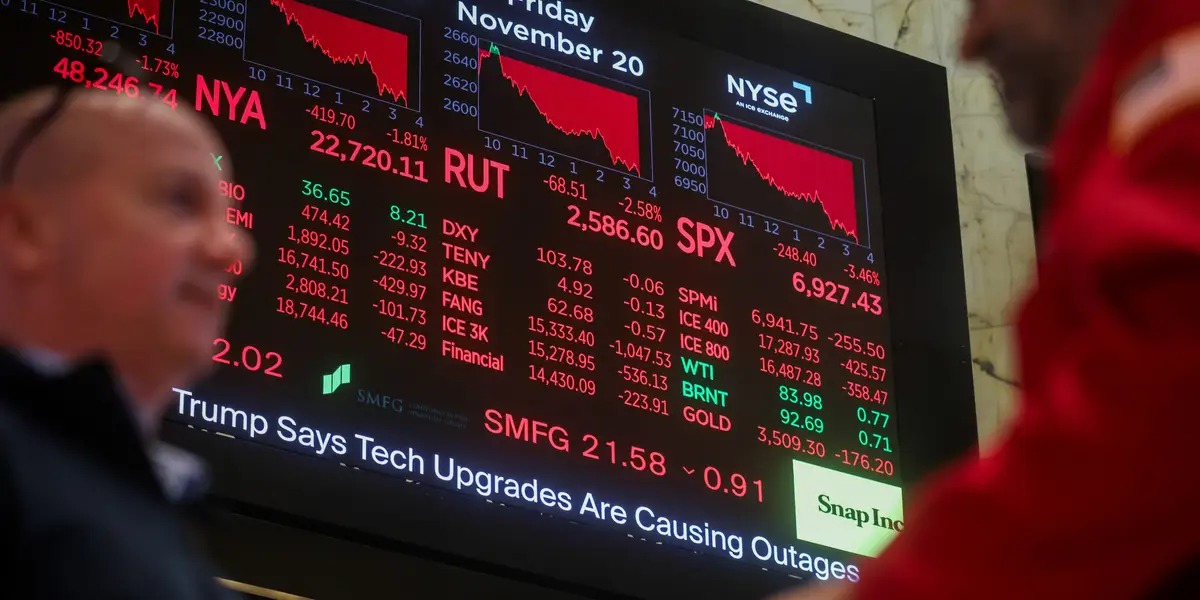


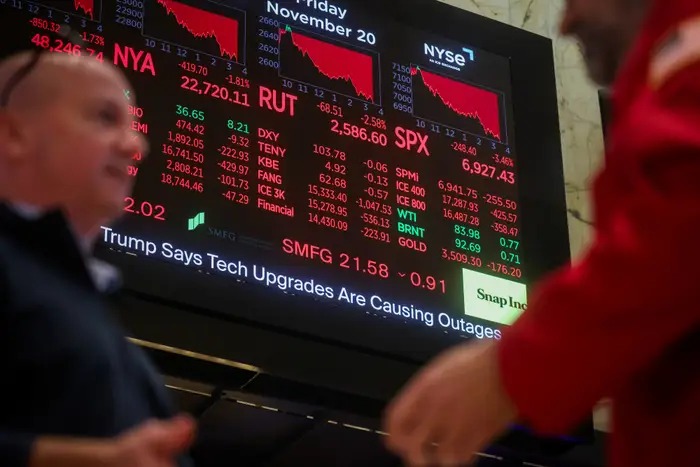
I don't intend to sugarcoat the situation: last week, the stock market experienced a complete disaster.
To be fair, after NVIDIA's financial reports and Anthropic IPO, we were aware that the situation might become tricky. However, the depth, breadth, and persistence of this round of selling pressure have been more severe than most investors anticipated.
Stock index futures indicate that there may be a rebound on Monday, but a single-day increase is not enough to erase the losses from last week. To illustrate how dangerous the market was last week, here are some of the most disgraceful “achievements” of the stock market, listed in no particular order:
- The major U.S. indices – the S&P 500, the Dow Jones Industrial Average, and the Nasdaq Composite Index – all recorded their worst weekly performances in several years.
- Nasdaq fell by 10% over five trading days, while the Dow Jones Industrial Average dropped by 8%. Both recorded their worst weekly performances since March 2020. Meanwhile, the S&P 500 tumbled by 9%, experiencing its largest single-week decline since April 2025.
- All three major indices had entered a correction zone by the time of closing, that is, they had fallen more than 10% from their recent highs.
- As of Thursday, NASDAQ was still down 13% for the year; while the Dow Jones and the S&P 500 confirmed a pullback on Friday.
- The S&P 500 has fallen for 7 consecutive trading days, marking the longest streak of declines since 2020.
- If this benchmark index continues to decline at the close of trading today – that is, for the eighth consecutive trading day – it will mark the longest streak of declines since 2016.
- The Nasdaq Composite Index erased its year-to-date gains.
- The S&P 500 is still expected to rise by 1% within the next year, and the Dow Jones by 0.2%, but both are in precarious positions after last week's selling spree. Meanwhile, the Nasdaq has already fallen by 2.7% as of 2026.
- NVIDIA has seen consecutive declines for the seventh week, marking the longest streak of weekly declines since 2008.
- The Philadelphia Semiconductor Index has fallen by 43% from its record high.
- Last week, some of the most notable declines among well-known stocks included: Micron Corporation falling by 24%, Marvell Technology falling by 22%, AMD falling by 21%, TSMC falling by 20%, and of course, NVIDIA falling by 23%.
- “neoclouds” also suffered heavy damage.
- Roundhill Neocloud ETF tumbled 25% last week, with Iren falling 35%, Nebius dropping 30%, and CoreWeave declining 26%, leading the decline in related sectors.
You probably already get it.
However, regrettably, I have more bad news to share. Looking at the schedule ahead, there isn't much that's particularly exciting to come. Moreover, many of the negative factors that are suppressing the market have not yet been resolved, and the most significant one among them is:
- At a time when artificial intelligence emotions are already fragile, NVIDIA's plummeting stock price over the past two weeks continues unabated.
- The much-anticipated listing lost momentum on the second day, dampening the market's optimism regarding AI.
- The market almost unanimously expects that the Federal Reserve will raise interest rates at its next meeting on December 9th.
Lack of a catalyst
In terms of potential positive catalysts, there's hardly anything for the market to look forward to. The earnings season has basically come to an end, and NVIDIA's earnings report last week also marked a rather lackluster quarter. The next important economic data point – the November employment report – will not be released until after Thanksgiving.
Will oil prices become a lifeline?
Despite investors' gloomy outlook on the stock market, the price of Brent crude oil has fallen by more than 20% in November, with a 8% drop last week alone. Investors had certainly been concerned about rising oil prices before, but so far, the AI narrative has overshadowed the impact of the price decline. If traders begin to focus on this mitigating effect, there could be a rebound in the market.
The Future of AI Transactions
For a long time, the AI market has experienced its first major shock. So far, its most important stocks have repeatedly withstood these shocks and managed to rebound. But how many more blows can they withstand without any truly exciting catalysts?
The answers are being revealed in real-time.