













The Federal Reserve's weekly report H.8 released on November 20th showed that in October, the annualized growth rate of credit for U.S. commercial banks was 6.5%, while residential real estate loans were at a negative 0.3%. Although the total amount of credit increased, it did not correspond to an expansion in housing loans.
Both of these percentages have been adjusted for seasonality and discontinuities, and represent annualized rates. They cannot be interpreted as a 6.5% actual increase for the month of October alone. The latest weekly figures are as of November 11th; the weekly values are based on data from Wednesday, while the monthly values are calculated as a proportional average of Wednesday's data. These two types of time points should not be confused or combined.
Corporate loans and residential loans are going in different directions.
In October, the annualized growth rate of loans and leases was 8.9%, higher than 7.8% in September. Commercial and industrial loans amounted to 11.7%, lower than 13.0% in September, but still indicated relatively rapid expansion; real estate loans were at 2.6%, with commercial real estate loans at 5.1% and residential real estate loans showing a slight contraction.
There are also differences within residential properties. Home equity line of credit loans increased by 2.9%, while closed-end residential loans decreased by 0.7%. The former utilizes the home equity to support revolving loans, while the latter includes closed-end first and second lien loans secured by one to four residential properties. Summarizing home purchase financing with overall positive growth in real estate would obscure this differentiation.
Consumer loans grew at a year-on-year rate of 4.1% in October, slowing down from 5.3% in September; however, credit card and other revolving plans accelerated from 4.6% to 5.3%, while other consumer loans decreased from 6.2% to 2.6%. Even within consumer financing, the pace of revolving credit and other loans is not consistent.
In addition to the overall volume, the expansion of securities holdings has been relatively slow. In October, the year-on-year growth rate of securities in bank credit was only 0.8%, while loans and leases accounted for 8.9%. Therefore, the expansion of bank credit this month is mainly reflected in loans, and it cannot be directly described as banks making large-scale purchases of bonds.
Over a week, there was $62.3 billion in credit, yet deposits decreased.
According to the seasonally adjusted stock figures, as of November 11, bank credit amounted to 20.1332 trillion US dollars, compared to 20.0709 trillion US dollars the week prior. The difference between the two figures represents an increase of 62.3 billion US dollars. Of this increase, loans and leases rose from 14.2260 trillion to 14.2642 trillion US dollars, an increase of 38.2 billion US dollars; securities increased from 5.8449 trillion to 5.8690 trillion US dollars, an increase of 24.1 billion US dollars.
This is the arithmetic difference calculated using the figures from the published table, without any additional adjustments for potential structural changes that may have occurred this week. According to the same table, industrial and commercial loans increased from 2.9921 trillion to 3.0181 trillion, while residential real estate loans decreased from 2.6974 trillion to 2.6967 trillion. An increase in the total amount has once again occurred alongside a contraction in the residential sector.
The liability side did not increase accordingly. Total deposits decreased from $19.8629 trillion to $19.8252 trillion, by $37.7 billion; large-time deposits increased from $2.6550 trillion to $2.6726 trillion, while other deposits decreased from $17.2079 trillion to $17.1525 trillion. The reduction was mainly observed in the latter category.
Cash assets have decreased from $3.1469 trillion to $3.0787 trillion. This indicator cannot be directly referred to as "bank reserves": the footnote makes it clear that it includes cash on hand, cash items in collection, balances held with other banks, and balances held with the Federal Reserve. By looking at the total change alone, it is not possible to discern the flow of each item separately.
Therefore, the weekly report can inform readers of how the bank's balance sheet has changed, but it does not provide a motive for the decrease in deposits, nor does it show whether the funds have gone into U.S. stocks, Bitcoin, or other accounts. To simply refer to $37.7 billion as "incremental funds" in risky assets goes beyond what evidence can support.
Lending money to non-banks can change the apparent figures.
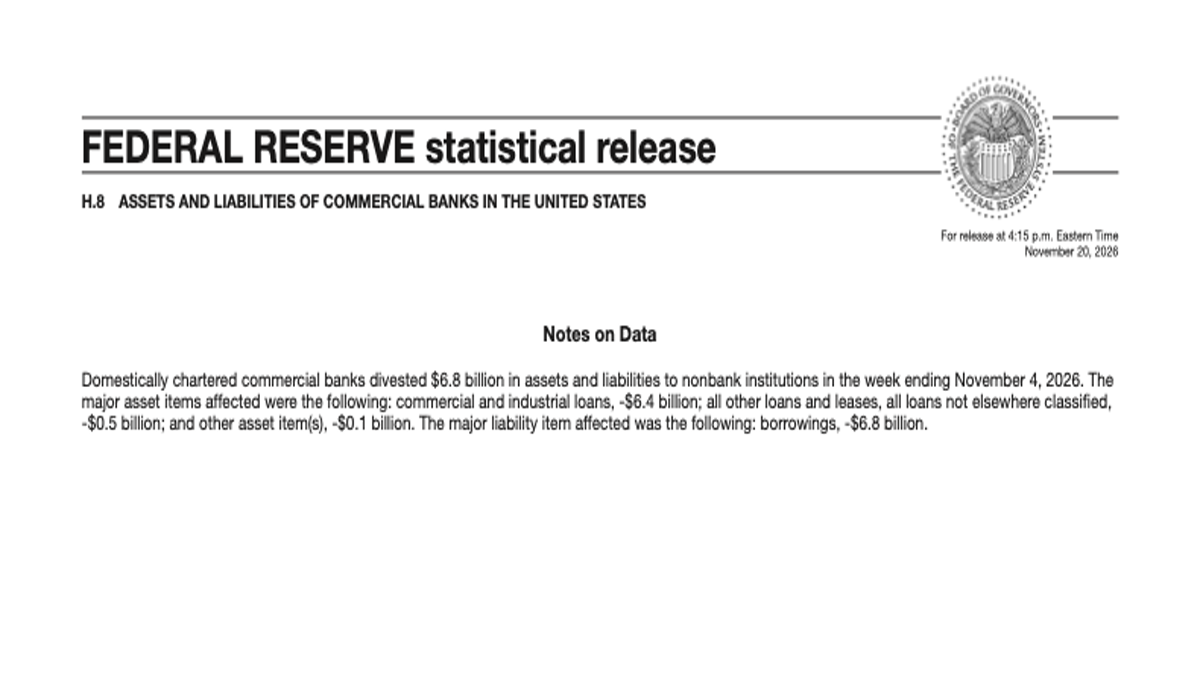
This issue's data also records a transfer that requires separate handling: during the week ending November 4th, locally registered commercial banks divested $6.8 billion in assets and liabilities to non-bank institutions, mainly involving $6.4 billion in industrial and commercial loans, with borrowing liabilities decreasing by $6.8 billion.
The fact that such assets are no longer included in the bank's statistics does not necessarily mean that the ultimate borrower has repaid the loan. When comparing different weeks of industrial and commercial loans, readers should first check the transfer details in Notes, on, and Data before deciding whether the changes reflect changes in financing needs or whether the loan has been transferred to a different holder between institutions.
Non-bank financing also has its own separate categories of projects. On November 11th, banks provided loans amounting to 2.1374 trillion dollars to non-deposit financial institutions, compared to 2.1188 trillion dollars the week prior. The footnote covers mortgage and consumer credit intermediaries, private equity funds, insurance institutions, hedge funds, and securitization vehicles, etc.; not all of this amount can be considered as loans from private credit funds.
This statistic includes local banks, foreign bank branches in the United States, and agencies, and presents data both on a seasonally adjusted and unadjusted basis. It also notes that the residual from assets minus liabilities is not an equity capital indicator used for capital adequacy analysis. Changes in loan balances and provisions for losses require separate evidence to assess whether capital is sufficient.
The most clear relationships in this issue are already reflected in the reports: corporate and non-bank financial financing continue to expand, but residential loans have not kept up. For readers who hold shares of American banks or use bank credit to measure the macroeconomic environment, the detailed breakdowns and metrics provide more precise guidance than a general statement of “loosening liquidity.”