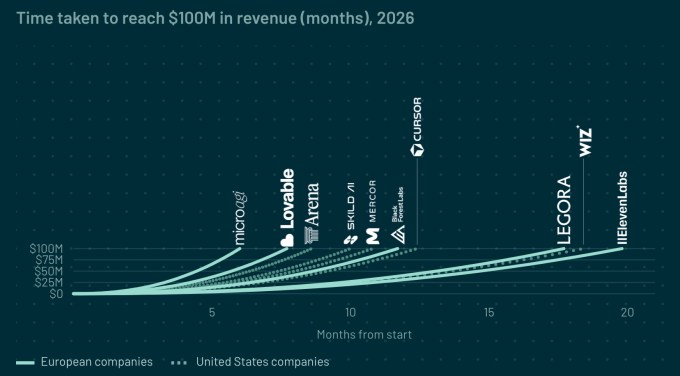
The report indicates that companies such as Black Forest Labs and Microagi achieved revenue of $100 million within just a few months, rather than taking several years to do so. Tom Wehmeier, a partner and head of intelligence at Atomico, said to TechCrunch, "I think we can put aside the idea that there is some fundamental reason or limitation in Europe that prevents the emergence of a breakthrough company."
However, this venture capital firm founded by Skype's founder Niklas Zennstr öm still hopes to see more. This year's call from Atomico is that Europe should not only "build" and "expand," but also "own" these companies. This means hoping that these companies can maintain their European identity for a longer period of time; it also reflects a sense that these successes have not yet been adequately recognized and may be overshadowed by louder calls for improvement.
As the main author of the report, Wehmeier quickly stated: "The pace of policy advancement, procurement, and capital movement has not been in line with that of our founders." However, he also said that the tech industry should speak up for itself in an inspiring manner.
He said, "When it comes to policy, I think the wording should be, 'Hey, this isn't about us complaining. It's about the opportunity to make the impact even greater.' If we present it as a problem, then things will become more difficult."
This rephrasing could also help European technology improve its image overseas. Abroad, complaints about excessive regulation may have overshadowed Europe's potential to leverage its deep pool of high-tech talent and the growing community of returnees entrepreneurs to create more successful stories.
There is still a lot of work to be done to fully unleash this potential. Wehmeier states that "the coming weeks will be a very important test, especially EU Inc." EU Inc, also known as the "28th System," aims to establish a unified European corporate system, similar to Class C corporations in Delaware.
If the EU Inc grassroots movement achieves its goals in the final stages, it will be much easier to establish and operate businesses within the European Union. This would also indicate that the tech industry has managed to make its voice heard, which could open the door to more support than Atomico hopes to see.
Politicians have a strong incentive to meet the demands of the tech industry. If the tech sector is Europe's second-largest industry, the biggest contributor to growth, and the largest creator of jobs, "wouldn't we want more industries like that?" Wehmeier asked in return. However, it is still unclear whether this will win them votes at the moment.
To make the answers clearer, the tech industry must also seek public support. For Wehmeier, one of the keys is “to prove that this will translate into something valuable for citizens.”
This report supports this effort through high-level data and cases from its portfolio. For example, the report mentions that the satellites of ICEYE can monitor severe weather, floods, and other disasters; Neko Health, founded by Daniel Ek, has now completed over 100,000 full-body scans, some of which have helped to identify serious or life-threatening health conditions.
One limitation of this argument is that for most Europeans, the scanning of Neko Health would seem very expensive, as they rely largely on collective public medical insurance. However, Atomico seems to hope that this report will not only create a sense of "fear of missing out" among readers as potential customers, but also among them as potential shareholders.
To achieve this, there is still more work to be done. In addition to joining the efforts of the industry to promote the EU Capital Markets Union, Wehmeier also hopes that more European institutional investors will invest in local technology companies.
He said, "We must reach a point where Europe and its beneficiaries become the largest shareholders in the success we create."
Before that, the industry must overcome some anti-industrial concepts, such as concerns about artificial intelligence leading to unemployment. But Wehmeier believes that the power of proof will ultimately prevail.
He said, "I believe that trust will be earned by showing the results to the public—whether it's lower energy bills, better healthcare, cheaper and faster construction of more housing, or having an infrastructure we can rely on."