

NVIDIA ( NVDA.O ) will release its third-quarter financial results after the U.S. stock market closes on Tuesday (November 17), but Wall Street's focus has shifted. Last week, CEO Jensen Huang suddenly resigned, casting new uncertainties over the long-term growth prospects of this artificial intelligence chip giant. Even if the financial report exceeds expectations again, it may not be enough to dispel investors' doubts about the company's future.
Since Jensen Huang disclosed controversies involving his personal life on November 8th, NVIDIA's stock price has fallen by 16%. Compared to the high point reached on October 6th, the cumulative decline has reached 35%, with a market value of approximately $2 trillion evaporating. The options market expects that there may be a one-day fluctuation of about 7.8% in either direction after the financial report is released.
Zed Francis, the Chief Investment Officer of Chicago-based investment consulting firm Convexitas, stated that NVIDIA's continued strong performance is crucial for the entire market, but the pressure caused by Jensen Huang's resignation will still hang over the stock price. It will be difficult for NVIDIA to break through its historical highs again until there is a clearer explanation for the management issues.
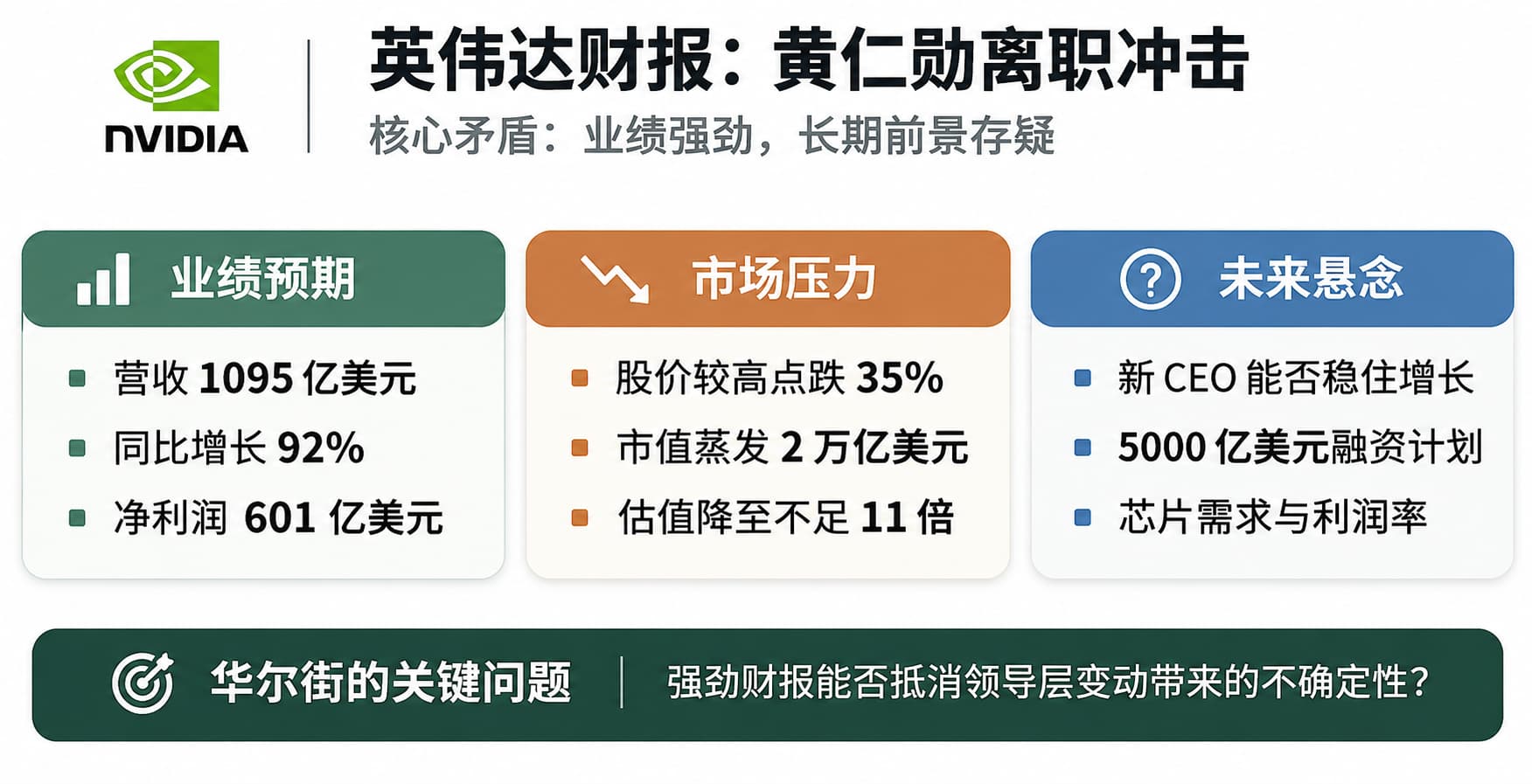
S&P Global Visible Alpha consensus forecasts indicate that NVIDIA's revenue for the third fiscal quarter is expected to grow by 92% year-over-year, reaching $109.5 billion, with a net profit forecast of $60.1 billion. Analysts from LSEG under Reuters predict revenue of around $109.1 billion and earnings per share of $2.47.
These figures continue NVIDIA's rapid growth during the boom in artificial intelligence infrastructure construction. The company previously estimated its revenue for the third fiscal quarter to be around $108 billion, with a fluctuation of 2%, and predicted that revenue would grow by about 70% in the next fiscal year.
However, investors have already begun to re-evaluate the sustainability of this round of growth. Before Jensen Huang's resignation, NVIDIA's stock price fell by 10% in October, recording its worst monthly performance in nearly a year, and concerns about the massive investments in artificial intelligence infrastructure, financing risks, and profit margin pressures continued to rise in the market.
Currently, NVIDIA's expected price-earnings ratio for the next 12 months has dropped to below 11 times, marking the lowest level since 2013. Among the components of the Philadelphia Semiconductor Index, it is only higher than that of Micron Technology. Compared to around 40 times it reached eight months ago, the valuation has significantly shrunk.
Bloomberg analysis indicates that part of the reason for the decline in valuation is that analysts have not significantly reduced their forecasts for NVIDIA's revenue and profits over the next few years. If future profit expectations are lowered, the stock price may still face further pressure.
NFJ Investment Group Chief Investment Officer John Mori ( John Mowrey ) stated that although the current valuation is attractive, considering the high level of uncertainty faced by the company, it is difficult to determine what level of valuation would be considered sufficiently cheap.
The market's expectations for this performance are therefore more complex. Even if both revenue and profit exceed expectations, if the company fails to provide sufficiently convincing long-term growth guidance, the financial report may not be able to serve as a catalyst for a rebound in stock prices.
NVIDIA announced last Thursday that Jensen Huang resigned from his position as CEO, and Colette Kress ( Colette Kress ), who has served as Chief Financial Officer since 2013, will temporarily take over the role. The board of directors is currently working on selecting a permanent successor.
One of the most concerning issues on Wall Street at present is whether NVIDIA will be able to maintain its technological advantage in the artificial intelligence chip market after losing its long-term leader, as well as its relationships with cloud computing customers, suppliers, and financing partners.
Jensen Huang has previously been deeply involved in the financing arrangements for artificial intelligence infrastructure. NVIDIA has helped some cloud computing companies and artificial intelligence developers obtain the funds needed to build data centers through equity investments, loan guarantees, and supply chain support, while also promoting the sales of its own chips.
These arrangements have also exposed NVIDIA to an increasing amount of financial risk. According to estimates by analysts at Bank of America cited by Reuters, as of August this year, NVIDIA's equity investments in artificial intelligence-related companies amounted to approximately $70 billion, with an additional $230 billion in financing guarantees provided.
Jensen Huang announced an $500 billion artificial intelligence financing platform in August this year, which has thus become the focus of market attention. The platform plans to introduce funds from Wall Street institutions to support the construction of artificial intelligence infrastructure, but as of now, no transactions have been announced to have been completed.
Reuters reported on Monday that financial institutions participating in the platform are still discussing related financing transactions. People familiar with the matter said that NVIDIA has not signaled a suspension of the project. However, analysts expect that the new management may adopt a more cautious attitude towards high-risk projects.
J.P. Morgan credit analyst Erica Spill ( Erica Spear ) believes that the existing commitments are not expected to change, but new transactions may take longer to proceed, and investors may also demand higher risk compensation.
Cres has previously raised doubts about some investment arrangements. As a result, the market is concerned about whether she will adjust NVIDIA's support for emerging cloud computing companies, and how these changes will affect future orders and revenue growth.
This Tuesday's financial report conference call will be Cres's first time facing Wall Street investors since he took over as interim CEO.
Analysts hope that management will provide further clarification on the leadership transition arrangements, long-term growth guidance, and whether the company will adjust its financing strategy. However, since the board of directors has just initiated the successor selection process, it is not certain that the market will receive a clear timeline at this meeting.
NVIDIA's business itself still has strong support. The Financial Times points out that there is still a high demand for the company's high-end artificial intelligence chips in the market, and some products are in short supply. The supply chain layout that has been established over the years also enables it to continue to obtain key components and advanced manufacturing capacity.
However, cost pressures are on the rise. Goldman Sachs expects NVIDIA's gross margin to decline from around 74% this year to 73% next year, with rising prices of memory chips and other semiconductor components being one of the main concerns.
The production progress of the new generation of Vera Rubin artificial intelligence chip platform is also under attention. Citibank estimates that NVIDIA will ship approximately 2 million Rubin chips this fiscal year, compared to the estimated 7.7 million chips of the previous generation Blackwell.
Analyst Ben Bagarin ( Ben Bajarin ) believes that the supply chain advantages established by NVIDIA over the years will not disappear with the departure of one executive, and the company still has the capability to execute its product roadmap on a large scale.
However, some investors believe that the biggest current doubts cannot be resolved by a single quarterly financial report.
Jim Awad ( Jim Awad ), the senior managing director of Clearstead Advisors who holds NVIDIA stocks, stated that less than ten days have passed since the news of Jensen Huang's resignation was announced, and the company has not had enough time to develop a plan of action that could significantly affect the stock price.
He expects that before the company's strategic direction, the selection of a new CEO, and the management approach for future balance sheets and financing commitments become clearer, NVIDIA's stock price will still face pressure.
Jensen Huang's future has also continued to be a subject of controversy. Many figures in the tech industry, including Tesla's Elon Musk and Tim Sweeney, the CEO of NVIDIA, have publicly expressed their support for his return. U.S. President Donald Trump also voiced his support on Monday this week. However, it is reported that NVIDIA's board of directors has no intention of reinstating him to his previous position.