
















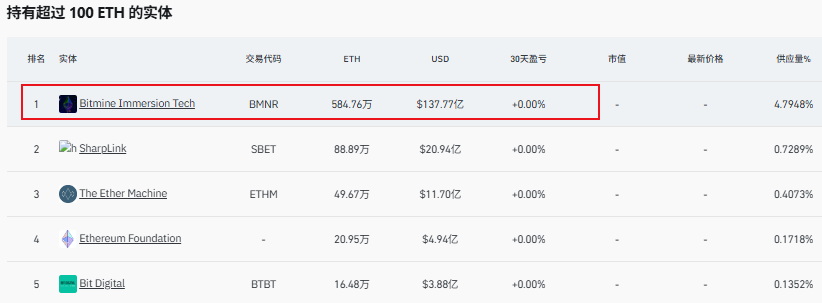
What is Bitmine? Why did the world's largest ETH treasury company pause buying Ether? According to CoinMeta data, on November 8, Bitmine disclosed holdings of 6,070,092 ETH, accounting for 4.97% of Ethereum's total supply, with over 86% of it staked. At the same time, its average ETH holding cost was about $3,352 per token, and at the then-current price, unrealized losses approached $9.7 billion, with an FY2026 net loss of $6.313 billion. A company that turned "hoarding ETH" into a public market strategy stopped just as its goal came within reach. On the surface, it was the fulfillment of a 5% hard cap; at a deeper level, it was a stress test for the treasury company model.
Table: Overview of Bitmine Key Data
| Key Data Item | Value |
|---|---|
| Total ETH Holdings | 6,070,092 |
| Share of Ethereum Total Supply | 4.97% |
| Staked ETH | Approx. 5.227 Million |
| Average ETH Holding Cost | Approx. $3,352.58 per token |
| Holding Market Value (at then-current price) | Approx. $10.64 Billion |
| Unrealized Loss | Approx. $9.7 Billion |
| FY2026 Net Loss | $6.313 Billion |
| Annualized Staking Revenue | Approx. $318–$336 Million |
| Share Buyback Scale | 22.9 Million Shares, Approx. $400 Million |
| Cash Runway | Less than one year |
Note: The above content is compiled and summarized by CoinMeta based on public market data. Please refer to actual data if there are any fluctuations.
What Is Bitmine?
Bitmine's core positioning is a digital asset treasury company. It raises capital by issuing shares, continuously buys Ether on the secondary market, and stakes most of its holdings to earn yield. As of November 8, 2026, Bitmine holds 6,070,092 ETH, about 4.97% of Ethereum's total supply, making it the largest publicly disclosed corporate Ethereum holder. About 5.227 million of its holdings are staked, a staking ratio exceeding 86%.

This strategy was named "Alchemy of 5%" by Tom Lee:
Accumulating 5% of Ethereum's circulating supply over roughly five years. The original five-year mission was nearly completed in just over a year, all during a bear market. Our analysis suggests Bitmine's business model is essentially a closed loop fueled by equity financing, backed by ETH as a reserve asset, and supplemented by staking yield as cash flow. When ETH's price rises, this loop self-reinforces; when the price remains below cost, every link in the loop tightens simultaneously.Why Did Bitmine Pause Buying ETH?
Why did Bitmine pause buying Ethereum? In our view, there are three fundamental reasons.
The 5% Hard Cap Is Within Reach
Tom Lee stated explicitly at Token2049: "We only need to buy another 100,000 ETH to reach 5%, and then we will stop." At the time of the announcement, Bitmine held about 6.016 million ETH, roughly 4.9% of the 122.1 million circulating supply, just a step away from 5%. At the then-current purchase pace of about $41 million per week, the cap would be reached in six to seven weeks. 5% is the strategic boundary the company set for itself; pausing purchases means Bitmine has completed the switch.
The Double Squeeze of a $10 Billion Unrealized Loss and Cash Runway
What truly made Bitmine pause buying Ethereum this time was financial reality.
Bitmine's average ETH holding cost is about $3,352.58 per token, for a total cost of about $20.35 billion. By mid-November 2026, ETH's price had fallen to the $1,753-$1,774 range, shrinking the holding market value to about $10.64 billion, with unrealized losses of about $9.7 billion—a loss rate of 47.7%. The FY2026 annual report shows a net loss of $6.313 billion, of which $6.229 billion came from fair value declines in digital assets.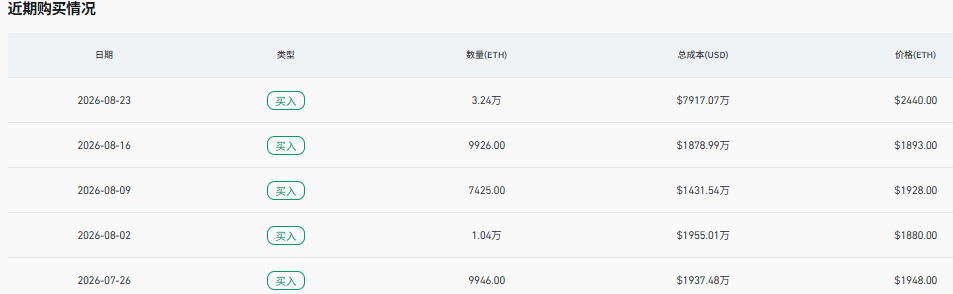
We also noted that Bitmine's cash runway has recently been highly dependent on equity issuance financing. Continuing to buy ETH at tens of millions of dollars per week means further consuming liquidity amid expanding unrealized losses and concentrating more balance sheet risk in a single token. It is fair to say that pausing purchases is a financial correction.
Capital Allocation Shifts from "Buying Coins" to "Buying Back Stock"
Since 2026, Bitmine has cumulatively repurchased 22.9 million shares for a total outlay of nearly $400 million, including 2.04 million shares bought back last week alone at an average price of $22.48. Tom Lee's logic is: when BMNR's stock price is below the intrinsic value of the ETH it holds per share, buying back stock enhances shareholders' "ETH per share" more than buying ETH. Meanwhile, Bitmine's staking business continues to contribute cash flow, with annualized staking revenue of about $318-$336 million, becoming the main source supporting operations after halting accumulation.
Currently, the Ethereum community is discussing EIP-8363, which proposes cutting annual issuance by about 58.6%, potentially reducing the annualized staking yield by about 56.4%. We speculate that if staking yields are significantly compressed, Bitmine's cash flow base after switching from "accumulation mode" to "yield collection mode" will be weakened. Stopping purchases solves the risk concentration problem, but does not solve the single dependence of the revenue side on ETH's staking rate.
Conclusion
What is Bitmine, and why did it pause buying Ether?
The answer lies on two levels: on the surface, it is the disciplined fulfillment of the 5% target; at a deeper level, it is the triple convergence of unrealized losses, cash runway, and capital allocation priorities. In our view, Bitmine's case provides a clear observation window for all latecomers who "carry crypto assets on corporate balance sheets." The end of the accumulation phase is when the real test of the treasury company model's sustainability begins. 5% of Ethereum will not disappear, and staking yield is still flowing in, but the main storyline has shifted to "at what cost to hold, for how long, and for whom to create value." The answers to these three questions will determine whether Bitmine becomes the definer of the digital asset treasury paradigm, or a footnote in this round of crypto financialization experiments.FAQ
Q: Will the unrealized loss cause Bitmine to go bankrupt?
A: It will not directly cause bankruptcy. Unrealized losses are paper losses that do not trigger a solvency crisis as long as the assets are not sold. However, with a cash runway of less than one year combined with reliance on equity issuance financing, the marginal risk of continuing to buy now exceeds the reward.
Q: How will Bitmine make money after stopping coin purchases?
A: Through ETH staking yield and share buybacks. About 5.227 million ETH are staked, generating annualized revenue of about $309-$359 million, which is the main cash flow source after halting accumulation. At the same time, the company buys back stock at prices below the intrinsic ETH value per share.
Q: Will BMNR's stock price definitely follow ETH's ups and downs?
A: Not necessarily. When BMNR's stock price trades at a discount to the ETH it holds per share, the two can diverge. The company choosing to buy back stock rather than coins is itself utilizing this discount to enhance shareholders' "ETH per share."
Disclaimer: Readers are strictly advised to comply with local laws and regulations. This article is compiled based on public market data for reference and educational purposes only, and does not constitute investment advice.