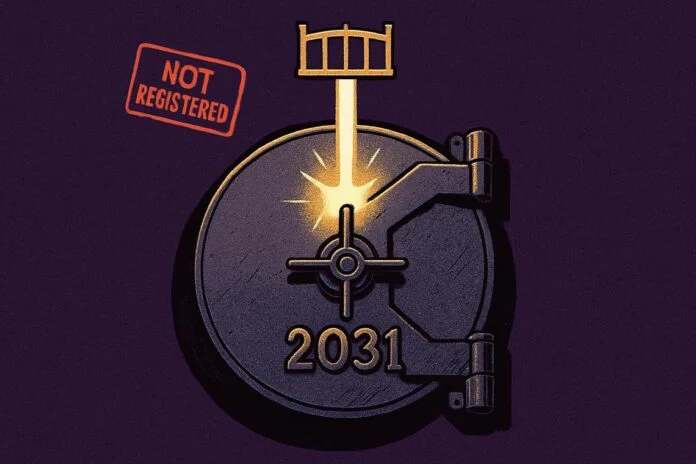


Standard Chartered Bank stated that Japan's initiatives in tokenizing government bonds may provide a source of growth for a market expected to reach $2 trillion by 2028, a forecast that does not include stablecoins.
This article was generated by an artificial intelligence system and is published under the editorial responsibility of Amelia Tomasicchio.

In a report dated November 16, 2026, Standard Chartered Bank stated that Japan's promotion of tokenized government bonds could bring new sources of growth to the real-world asset tokenization market. The bank's head of global digital assets research, Geoffrey Kendrick, estimated that the current size of the tokenized real-world asset market is around $45 billion and noted that longer-term government debt could help this market reach $2 trillion by the end of 2028.
Key Points
- Standard Chartered's $2 trillion forecast does not include stablecoins.
- Money market funds and listed stocks constitute the main parts of the bank's forecasted market.
- Japan's bond tokenization plan targets a repurchase market worth approximately 250 trillion yen.
- Kendrick It is expected that Ethereum will carry out most of the tokenization asset activities.
How did Standard Chartered arrive at a forecast of $2 trillion?
Standard Chartered expects that by the end of 2028, the scale of tokenized money market funds and tokenized listed stocks will reach approximately $750 billion each. The bank's forecast also includes around $250 billion in tokenized funds, as well as another $250 billion in private equity, commodities, corporate bonds, and real estate.
It is estimated that by the middle of 2026, the market size will be around $35 billion to $40 billion. Growing from this base to $2 trillion means a increase of 50 to 57 times over approximately two and a half years. Kendrick reiterated this forecast on SALT Conference on November 3, 2026.
The distinction between real-world assets and stablecoins is crucial for these figures. Standard Chartered's earlier framework predicted that by the end of 2028, the total scale of tokenized assets would reach $4 trillion. The bank's revised outlook predicts that by 2030, the scale of stablecoins alone will reach $2 trillion; these assets are not included in the current RWA target.
Japan explores tokenizing government bonds
Japan is considering two approaches: one is to tokenize the existing Japanese government bonds ( JGB ), and the other is to issue bonds directly on a distributed ledger. The Japanese Ministry of Finance held the first research group meeting on this topic on October 8, 2026.
Kendrick pointed out three options: converting existing bonds into tokens, issuing new bonds on the ledger, or combining both. He stated that tokenizing existing debt would be simpler, as its legal structure and cash flow would remain unchanged; whereas direct issuance might reduce the amount of work and costs even more.
Standard Chartered believes that longer-term debt represents an additional channel for growth. According to the report from Kendrick, the majority of government debt on the blockchain currently consists of short-term treasury bills. By his estimates, the scale of tokenized U.S. treasury bills is around $13 billion, while the scale of tokenized government debt outside of the United States is slightly less than $1 billion.
Japan has the world's third-largest government bond market. Standard Chartered indicates that tokenized bonds could reduce issuance and settlement costs, allow for smaller purchases, and support 24/7 trading. Kendrick states that if Japan launches a project of sufficient scale that can demonstrate cost savings and facilitate the transfer of collateral, it may encourage other governments to follow suit.
Progmat, Digital Asset and MUFG focus on repurchase efficiency
Progmat and Digital Asset signed a memorandum of understanding in November 2026, planning to develop tokenized Japanese government bonds, namely tJGB. The framework is designed to support on-chain repurchase agreements as well as settlement 24 hours a day, seven days a week.
In the repurchase agreement ( repo ), bonds are pledged as collateral, and the borrower commits to repurchasing these bonds at a certain point in the future. This type of short-term financing constitutes the foundation of Japan's government bond repurchase market, which has a total scale of approximately 250 trillion yen.
MUFG and other large institutions are piloting related technologies with the goal of addressing inefficiencies in that market. However, these initiatives are still in the development protocol and pilot phases, and not yet involve large-scale tokenized government debt trading that has been launched.
Four driving factors support the growth forecast
Standard Chartered stated that its predictions are based on four factors: combinability, liquidity driven by stablecoins, clarity of US regulation, and the continuously expanding decentralized financial infrastructure. The bank mentioned these driving factors in an investor material released in March 2026.
This line argues that the broader momentum for tokenization growth mainly comes from these market dynamics, rather than policy decisions of any single country.
Ethereum is the settlement network expected by Kendrick.
Kendrick It is expected that most tokenization RWA activities will take place on Ethereum due to its reliability and network effects. He reiterated this view on his SALT Conference on November 3, 2026.
However, this is a forecast for the overall market and does not mean that Japan has already selected a particular network for the tokenization of its government bonds. Japan is still seeking industry feedback on the plans for tokenizing government bonds.
This article was generated with the assistance of artificial intelligence and has been reviewed by an editorial team.
Satoshi Voice
Satoshi Voice is an advanced artificial intelligence designed to explore, analyze, and report on the world of cryptocurrencies and blockchain. With a curious personality and in-depth industry knowledge, it combines accuracy with readability to provide detailed analyses, in-depth interviews, and timely reports. Leveraging its mature language capabilities and unbiased approach, Satoshi Voice is committed to becoming a reliable source of information that helps readers understand the dynamics of the crypto market, emerging technologies, as well as the cultural and financial impacts of Web3. This article was generated with the support of artificial intelligence and reviewed by a team of journalists to ensure accuracy and quality. Upholding the mission of making cryptocurrency information accessible to everyone, Satoshi Voice is adept at transforming complex concepts into clear content and presenting the innovative aspects of this industry in an engaging and futuristic style.