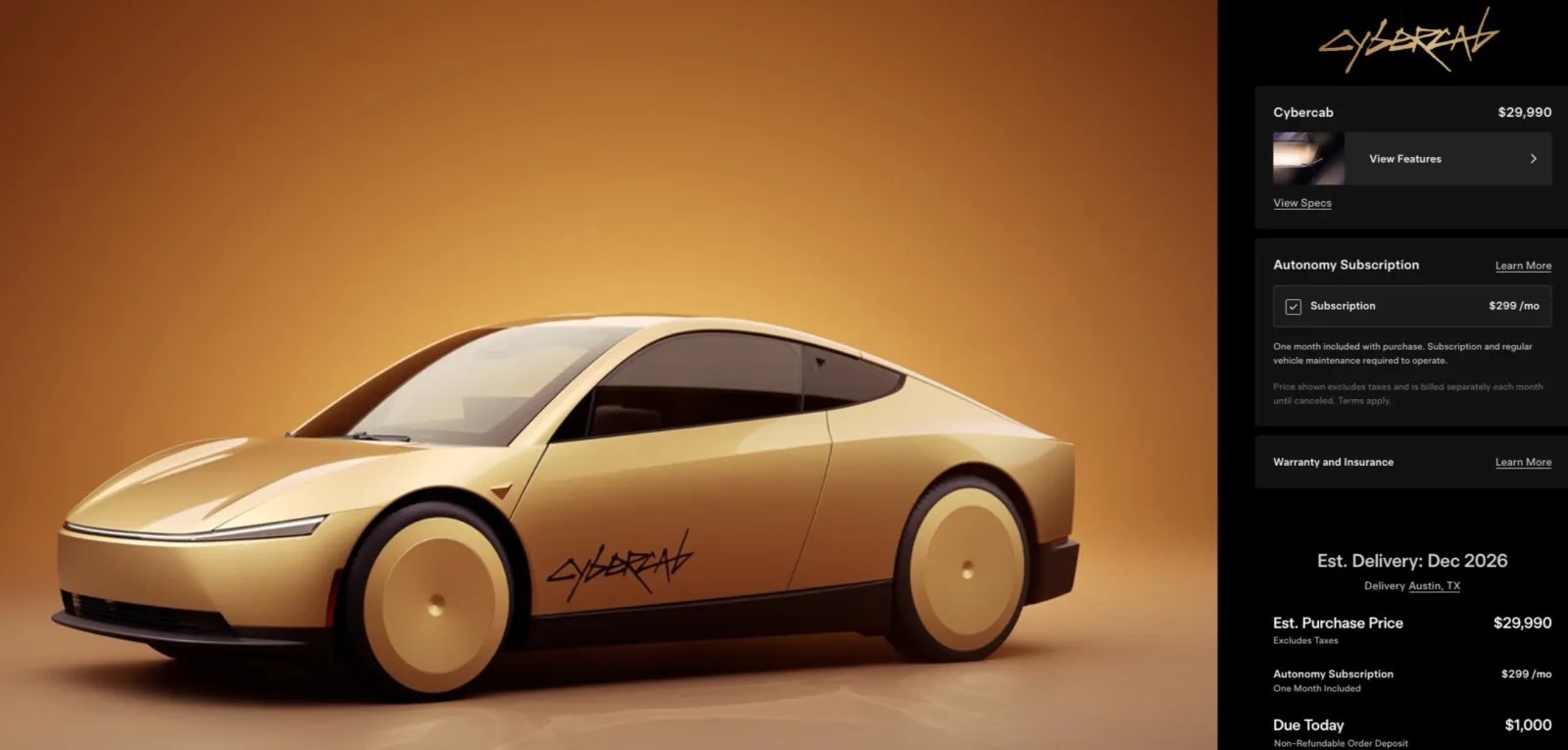
Tesla is currently inviting "some customers" to purchase Cybercab for $29,990 for personal use, but if they no longer pay the monthly $299 for the "Autonomy Subscription", the car will not be able to operate.
Moreover, it can only be used within the Robotaxi service areas of Tesla located in Texas and Florida. It was later proven that the scope of these geographical boundaries was significantly smaller than what Tesla advertised to the public.
What is Tesla selling?
Tesla's official Robotaxi account announced this invitation on X on Friday, attaching screenshots of the order page and the invitation email.
The order page displays that the Cybercab pre-tax price is $29,990, with delivery expected in December 2026 in Austin, Texas. A non-refundable deposit of $1,000 is required to place an order.
This subscription is not optional. The order page defaults to selecting a subscription of $299 per month, which includes one month of service. The details state: 'Operational vehicles require a subscription as well as regular vehicle maintenance.'
The rest of the configurations are consistent with previously known information: two seats, a 21-inch central control touchscreen, and a 20.1 cubic foot cargo space. There is no steering wheel or pedals. Tesla calls this "full autonomous driving" and states that users will "manage trips within the app."
In 2024, when Musk released the Cybercab, he promised that its price would be "less than $30,000." Technically speaking, he did achieve that, but he didn't mention that using this car would also cost $3,588 per year. Over a five-year period, that amounts to about $47,600 for a two-seater car, not to mention insurance, maintenance, taxes, and charging costs.
"The supported service areas" refer to Texas and Florida.
Tesla currently operates Robotaxi services in eight cities: Austin, Dallas, Houston, Fort Worth, and San Antonio in Texas, as well as Miami, Orlando, and Tampa in Florida. Cybercab It could just be a $30,000 sculpture parked on a driveway in any other place.
Moreover, these service areas are not as large as Tesla claims. Independent tracker Koby Pierce tested thousands of addresses within the Robotaxi application and found that the areas actually served by Tesla's pick-up and drop-off services only covered six cities he checked. In Austin, which is the city where Tesla delivers these cars, the coverage is approximately only 59%.
Railway crossings are a significant factor. The creators of Robotaxi Tracker in Houston found that for trips covering just two streets in the city center, the app provided routes that took approximately 40 minutes, as vehicles seemed to avoid the railway crossings. Tesla also includes San Antonio Airport in its polygonal area, but in reality, no services are provided there.
In addition, there are regulatory concerns. The National Highway Traffic Safety Administration (NHTSA) has required Tesla to swear under oath that a car without a brake pedal meets federal safety standards, which stipulate the presence of a brake pedal. Tesla responded on October 30th and requested that the entire response be kept confidential. The NHTSA has not yet made a ruling. Nevertheless, Tesla is still selling this car to consumers.
Views of Electrek
I think it's going to be a mess. It seems that Tesla is only selling through an invitation system and delivering in Austin, in order to prove that they can deliver an "unmonitored" vehicle by 2026.
Tesla will sell these cars to fans who are excited about owning an autonomous vehicle, but many people will eventually find that these restrictions are not worth an additional $299 per month on top of a car that already costs $30,000.
Of course, if your monthly Uber bill is significantly over $300, and you live and work in areas that are deeply enclosed by geographical barriers (geofences), then such expenses might seem justified on paper. But then you realize that once you arrive at your destination, you still have to find a place to park your car; or that a 15-minute drive becomes an hour-long journey because the vehicle can't cross the railway tracks. For Uber or Waymo, these are someone else's problems; but for Cybercab, you're actually paying for this “privilege.”
There's one more thing that doesn't make sense to me: Cybercab uses the same AI4 computers as the current Model Y. Tesla is already operating Model Y Robotaxi within these same geographical boundaries without any supervision. So why can't Model Y car owners, who have already paid for "full autonomous driving," enjoy the same unsupervised feature in those areas? Wouldn't it be easier to enable this feature on these vehicles that have already accumulated more data? Tesla keeps pushing this off until "next year," with the current timeline being around the second quarter of 2027, yet at the same time, they are asking people to buy new cars that can do nothing other than carry two people?
If this technology can truly operate without supervision in Austin, then it should be made available to the Model Y car owners there. If not, then why would anyone pay for a car that can only be used within Tesla-specified areas and has a total cost of about $47,000 over five years?
Like every recent product from Tesla, the final delivered version is much more disappointing than the one sold on stage.
If you want to buy an electric vehicle, using household solar power can reduce fuel costs to almost zero, and it can be used anywhere without the need for geographical barriers. With electricity prices rising by nearly 10% last year and expected to continue to climb, installing solar energy is one of the best ways to offset these increasing costs. Through leasing and the PPA program, you can even start saving money with no down payment at all. If you're looking for the best option, you might want to check out EnergySage. This is a free service, and hundreds of pre-approved installers will compete for your business, so you can save 20% to 30% compared to searching on your own. There will be no sales calls before you choose an installer. Click here to get a free quote.
FTC: We use automated affiliate links that can generate income. For more information.